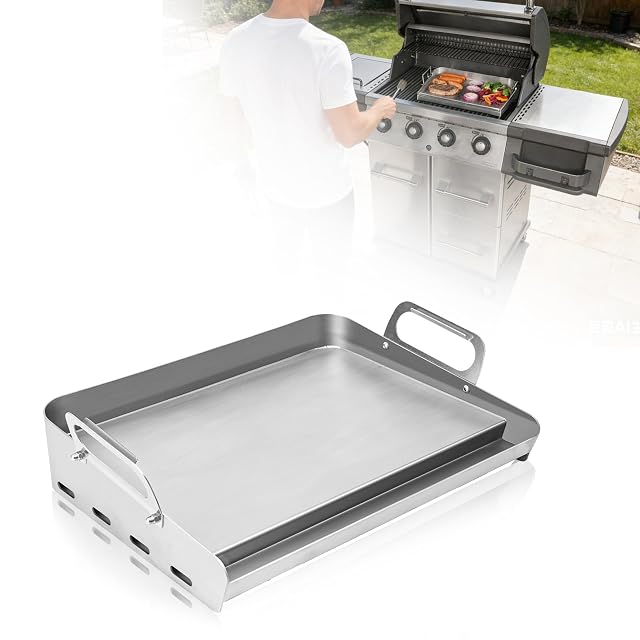
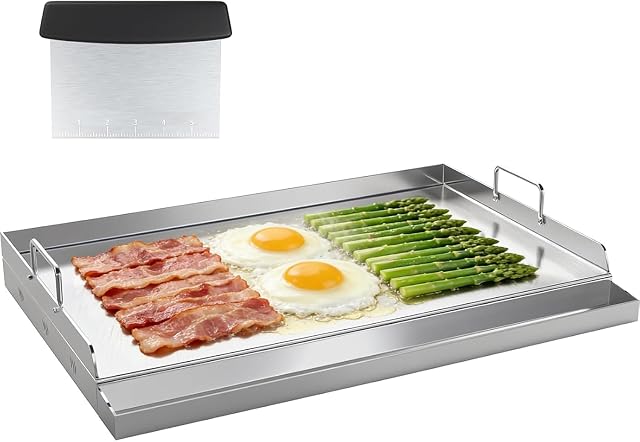
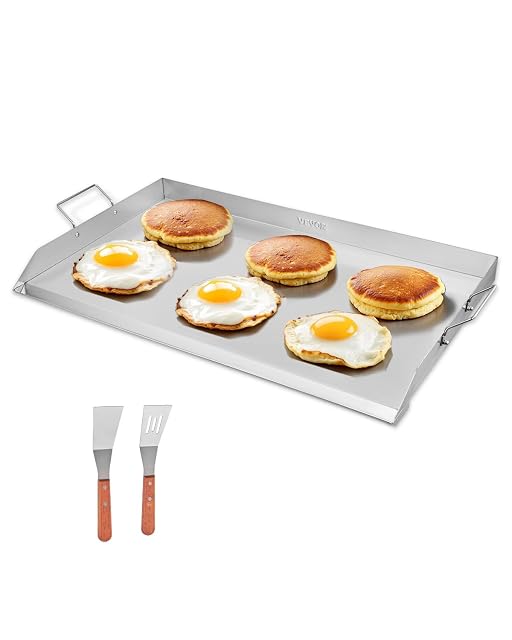
“Made from durable stainless steel, this griddle for gas grill can handle temperatures up to 500℉. The bottom x-shaped reinforcement resists to deform”
“The grease trough and drip hole allow excess oils to drain away… the sidewalls help keep food in place”
“The griddle top offers a large cooking area, providing ample space to cook multiple servings at once”
“The cast iron construction is built to last and easy to maintain”
“Whether you have a gas, electric stovetop, this griddle for gas grill is compatible with all”
The plate below it on this shelf is bigger and cheaper
This — 18 × 16 in — 288 sq in — $52.90 — 4,300 gVEVOR 23 × 16 in — 368 sq in — $51.99 — 4,649 g
Eighty square inches more for $10.59 less.
And the bullets are identical word for word: same stainless construction, same 500 °F rating, same grease trough and drip hole, same sidewalls, same X-shaped bottom reinforcement. Nothing in either listing separates them except size and weight.
There is one honest argument for this plate, and it is not in the bullets: shape. Eighteen by sixteen inches is nearly square, so on a small two-burner grill it sits within the grate where a 23-inch plate would overhang the edges and sit on the frame.
If that is your grill, this is the right plate. Otherwise buy the bigger one. Prices move, so check both.
Fourteen point nine grams per square inch
No listing on this shelf publishes a plate thickness, so the weights and areas have to stand in for it:
VEVOR 17 × 13 — 0.7 oz (20.8 g)/sq in
COZEER 23 × 16 — 17.3
This, 18 × 16 — 14.9
VEVOR 32 × 16 — 13.5
VEVOR 23 × 16 — 12.6
VEVOR 36 × 22 — 12.4
Middling, and that cuts both ways.
A thinner plate heats faster, which for twenty minutes of breakfast is a real advantage, and it is lighter to lift and to store.
A thicker plate holds its temperature, which is what a griddle is for: the surface has to stay hot when cold food lands on it, or the food steams in its own juice and greys instead of browning.
For eggs, onions and vegetables, this is well judged. For a batch of smash burgers, the 17-inch plate has forty percent more metal in it.
The X-brace, which is the only one here
The bottom x-shaped reinforcement resists to deform.
Warping is the real failure mode of a griddle plate, and this is the only structural answer to it named anywhere on this shelf.
A flat sheet over gas burners heats in stripes — hot above the flames, cool between — and expands unevenly, so it cups or rocks. Once a plate rocks, oil runs to one corner and the food cooks unevenly for the rest of its life.
VEVOR publishes the X-brace on all five of its plates. COZEER and DeintYei name no structure at all, though DeintYei claims its steel “resists warping” on material grounds.
Five hundred degrees
Published on all five VEVOR plates, and nowhere else on this shelf.
Worth reading as a limit rather than a reassurance: 500 °F is roughly what a smash burger wants at the surface, and a gas grill on full goes past it.
And the contradiction in the bullets
Bullet 1: stainless steel. Bullet 4: cast iron.
All five VEVOR plates here carry the same bullet set, so bullet 4 is a copy-paste from another product line. The title says “Stainless Steel Griddle”.
Treat it as stainless — do not season it, and do not worry about rust.
No removable handles stated, which VEVOR’s 17 × 13 plate does have. No scraper; COZEER is the only plate here that includes one.
Availability
On sale at about $53 on Amazon.com when we read the listing on October 31, 2026.
Price and availability were read on Amazon.com on October 31, 2026; both move.
Prices quoted in this text are dated readings and can differ from the live price in the buy box.
What we rate, and what we do not
Strengths
Nearly square at 18 × 16 inches, which suits a two-burner grill better than a long narrow plate
The same grease trough, drip hole, sidewalls and X-brace as the rest of the VEVOR range
The lightest plate in the range at 9.5 lb (4.3 kg), so it heats fastest of the four larger ones
Compromises
VEVOR’s own 23 × 16 plate is eighty square inches larger and $10.59 cheaper, with identical bullets
Eighteen cents a square inch, against eleven for that larger plate
The same stainless-versus-cast-iron contradiction, a 500 °F ceiling, and no scraper
Specifications
Size
18 × 16 in — about 288 sq in
Cost per square inch
$0.180 — the second highest on this shelf
Weight
9.5 lb (4.3 kg) — the lightest plate VEVOR sells here
Metal per square inch
0.5 oz (14.9 g)
Temperature rating
Up to 500 °F, stated by the maker
Grease
A grease trough and a drip hole
Sidewalls
Yes, to keep food in place
Reinforcement
X-shaped on the underside, stated to resist deforming
Also fits
Gas and electric stovetops
Dimensions
17.9 × 16.1 × 3.23 in (455 × 408 × 82 mm)
The problem
VEVOR’s own 23 × 16 in plate is 80 sq in larger and $10.59 cheaper
Material
Stainless steel in the title and bullet 1; bullet 4 says cast iron
Plate thickness
Not published by the maker
Removable handles
Not stated, unlike VEVOR’s 17 × 13 plate
Scraper
Not included
Amazon reference
B0F1N58S4J
EAN
0197988506430
The questions that come in
Should I buy the 23-inch plate instead?
On the published figures, yes. The two sit on this shelf together: this 18 × 16 in (288 sq in) at $52.90, and the 23 × 16 in (368 sq in) at $51.99. Eighty square inches more for $10.59 less — and the bullets are word-for-word identical between them: the same stainless construction, the same 500 °F rating, the same grease trough and drip hole, the same sidewalls, the same X-shaped bottom reinforcement. No listed feature separates them except size and weight (9.5 lb (4.3 kg) against 4,649). The one honest argument for this plate is shape: 18 × 16 is nearly square, so on a small two-burner grill it will sit within the grate where a 23-inch plate overhangs. Prices move — check both.
Is the lower weight good or bad?
Both, and the trade is worth understanding. At 9.5 lb (4.3 kg) over 288 square inches this is 0.5 oz (14.9 g) per square inch — lighter than VEVOR’s 17 × 13 plate (20.8) and the COZEER (17.3), heavier than the 23 × 16 (12.6) and the 36 × 22 (12.4). A thinner plate heats faster, which on a griddle you use for twenty minutes of breakfast is a genuine advantage, and it is lighter to lift and store. What it does not do is hold its temperature: a griddle cooks by stored heat, so when six cold burgers land on a thin plate the surface drops and the meat steams rather than browns. For eggs, onions and vegetables, thin is the better choice. For searing, thick is.
What does the X-brace actually do?
It is the only anti-warping feature named anywhere on this shelf, and warping is the real failure mode of a griddle plate. A flat sheet of steel heated unevenly — which is exactly what sitting over gas burners does, hot stripes above the flames and cool bands between — expands unevenly and cups or rocks. Once a plate rocks, oil and grease run to one corner and food cooks unevenly for the rest of its life. VEVOR publishes "the bottom x-shaped reinforcement resists to deform" on all five of its plates here, which is a ribbed underside to stiffen the sheet against that. Neither the COZEER nor the DeintYei names any such structure, though DeintYei claims its stainless "resists warping" through material alone.
Our score
8.1/ 10
Eighteen by sixteen inches for fifty-two dollars — which makes it the worst value on this shelf except one, because VEVOR’s own 23-inch plate is larger and ten dollars less. The specification is otherwise identical.
This one against the other cookware and knives
Close prices, same category: comparable cookware and knives. We keep only the specifications all of them publish, because a column with gaps compares nothing.
Model
Price
Size
Cost per square inch
Weight
Metal per square inch
VEVOR Grillplatte 18*16 inch
$53
18 × 16 in — about 288 sq in
$0.180 — the second highest on this shelf
9.5 lb (4.3 kg) — the lightest plate VEVOR sells here
Specifications: the manufacturer sheet for cookware and kitchen knives and the matching Amazon product page. Prices and availability: Keepa. Every figure on this page names its source.