Skip to content

The best Damascus knives for 2026

Damascus is a description of the outside of a modern kitchen knife, not of its edge. The blade is a core of hard cutting steel — VG-10, AUS-10, 10Cr15MoV and similar — with patterned layers folded around it for stiffness and appearance. It follows that the specification to read is the core steel and its stated hardness, because that is the metal that meets the board; the layer count on the box describes the cladding. Some inexpensive blades carry an etched or laser-printed pattern over ordinary steel, which is decoration rather than construction and washes off in time. We compare core steel and stated hardness, cladding, layer counts, pattern authenticity and price against equivalent plain blades.

The models we recommend

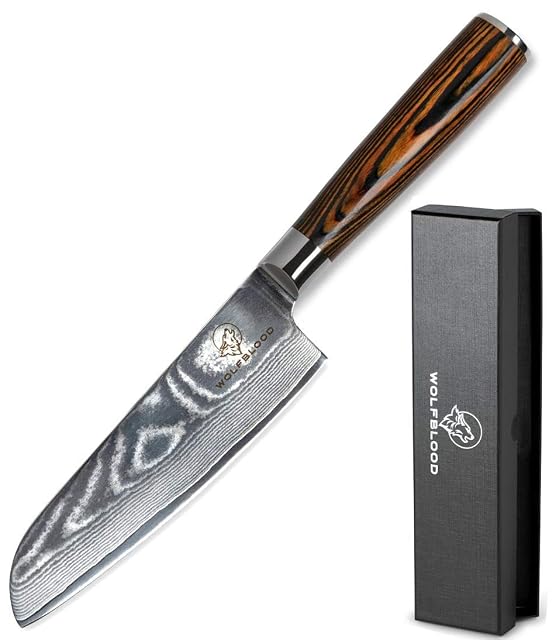
  1. Wolfblood 24 cm (9.4 in) santoku, 67-layer

    24 cm (9.4 in) overall · genuine 67-layer Damascus · TÜV-verified steel stated · hardened in Bavaria

    A 67-layer Damascus santoku whose maker states the steel is TÜV-verified as genuine Damascus — the only verification claim of its kind in this catalog.

    Best for: Someone who wants a verified Damascus blade without paying the top of the range.
    7.2/10

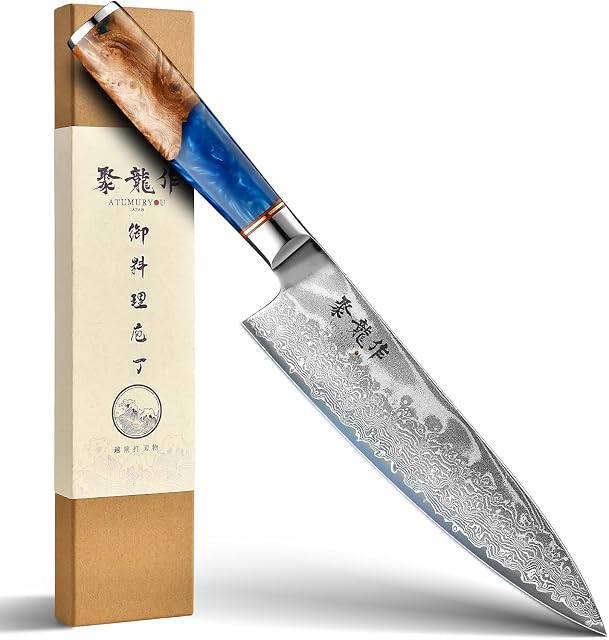
  2. Atumuryou 20 cm (7.9 in) VG-10 core

    20 cm (7.9 in) blade · VG-10 Japanese core · stated 60 HRC · traditional Japanese technique · non-slip handle

    A 20 cm (7.9 in) Damascus chef’s knife with a VG-10 core stated at 60 HRC — the best-known Japanese cutlery steel, named rather than implied.

    Best for: Someone who wants VG-10 specifically, at a domestic price.

    7.8/10

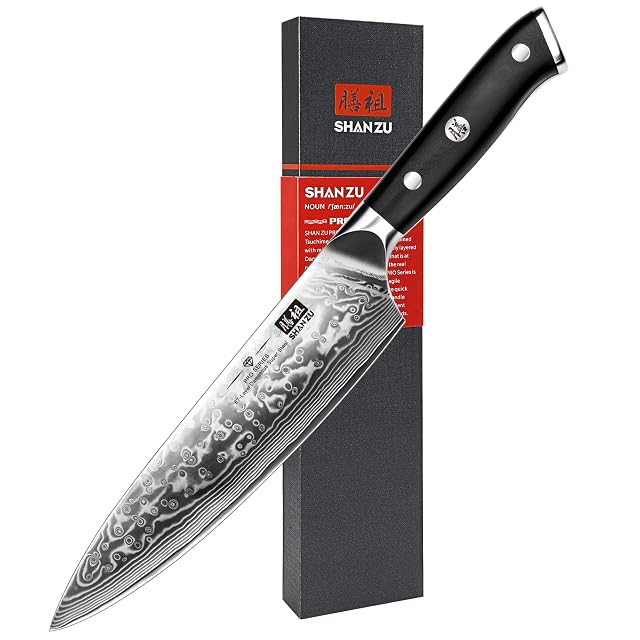
  3. SHAN ZU 20 cm (7.9 in) chef’s knife, 67-layer

    20 cm (7.9 in) blade · Japanese 10Cr15MoV core · stated 62 HRC · 67 forged layers · stated not laser-etched

    A 20 cm (7.9 in) Damascus chef’s knife that publishes everything that matters: a Japanese 10Cr15MoV core at a stated 62 HRC, 67 forged layers, and an explicit statement that the pattern is not etched.

    Best for: A cook who sharpens their own knives and wants a hard, keen main blade.

    7.8/10

    ≈ $70

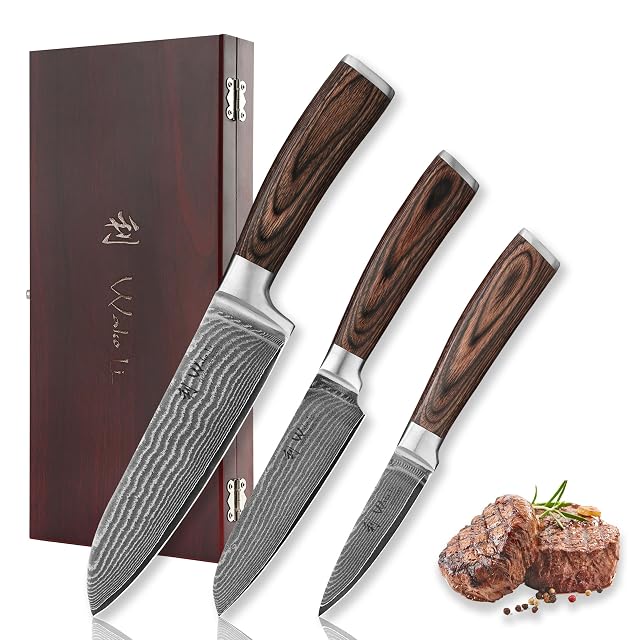
  4. Wakoli EDIB 3-piece set in a wooden box

    SET OF 3 · santoku 17 cm (6.7 in) blade + two others · VG-10 core at a stated 60 ± 2 HRC · pakkawood handles · wooden gift box

    A three-knife Damascus set — not a single knife — with a VG-10 core stated at 60 ± 2 HRC, pakkawood handles and a wooden presentation box.

    Best for: A gift, or a starting set for someone who wants three matched Damascus knives.

    7.8/10

    ≈ $140

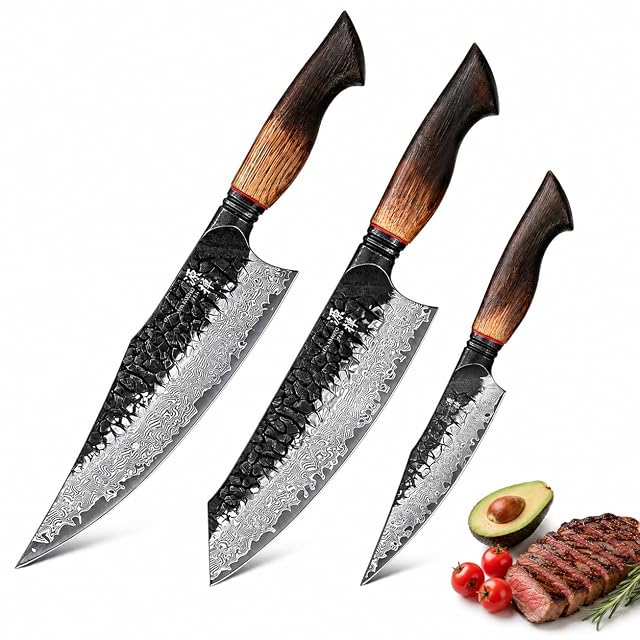
  5. Minamoto Zen OKAMI set, 67-layer VG-10

    SET · genuine 67-layer Damascus · VG-10 core · high-carbon stainless · stated balanced weight distribution

    The most expensive entry in this hub, and a set rather than a single knife: 67-layer Damascus over a VG-10 core, sold on balance and finish.

    Best for: A gift at the top of the range, or a matched set bought once.

    8.4/10

By need, across damascus knives

An edge that lasts

The hardness of the core steel decides how long the edge holds. It is the only characteristic of Damascus that changes anything about the cutting.

SHAN ZU SZPCS-2017-002

A knife that forgives

A less hard steel chips less and is resharpened in a few passes. For household use that is not especially careful, that is a real advantage.

Atumuryou AT8101B

Knowing what lies under the pattern

The visible layering is only cladding: it is the core steel that cuts. The stated core grade, not the number of layers, is what decides edge retention.

SHAN ZU SZPCS-2017-002

Across damascus knives, who each type suits

Seeking cutting performance
What cuts is the hard steel core, not the visible layers. A Damascus knife with a mediocre core cuts mediocrely, whatever its pattern.
Workshop object
The pattern is the result of layering different steels, revealed with acid. It is real work, whose interest is aesthetic.
A gift
It is a significant part of this market, and a legitimate one: a beautiful knife that cuts well gives pleasure. The pattern simply must not stand in for the specifications.

The trade-offs to weigh on damascus knives

Pattern against cutting
The Damascus layers do not improve the edge: they dress a core that decides everything. The price often buys the appearance.
Hardness against fragility
Very hard core steels hold their edge for months and chip on a bone or a fall. It is a knife to treat with care.
A steel you have to wipe every time
Many Damascus cores are barely stainless and mark in damp. Immediate drying is not optional.

What gets asked about damascus knives

Does Damascus cut better?

No. It is the core steel and the sharpening that cut; the Damascus layers are decorative. A good plain knife cuts better than a Damascus knife with a mediocre core.

What are the layers for, then?

They come from layering different steels, revealed with acid. It is real work, whose value is aesthetic.

How do I recognize genuine Damascus?

The pattern goes through the blade and shows on the edge after sharpening. A laser-etched or printed pattern disappears as soon as you sharpen.

What does a high hardness figure mean?

An edge that lasts longer and chips more easily. Above a certain threshold, use has to be careful.

Does Damascus rust?

Many cores are barely stainless. Washing and immediate drying are compulsory, and the dishwasher is out of the question.

Can it be sharpened normally?

Yes, on a stone, respecting the original angle, often tighter than a European knife. European fixed-angle sharpeners alter it.

Is the price justified?

It pays for a longer manufacture and an appearance. If the only aim is to cut, a plain knife in good steel costs less and cuts as well.

Does the pattern fade over time?

The layering runs through the thickness of the flat and does not disappear with sharpening, which only touches the edge. What dulls it is abrasive polishing of the face, best avoided.

The essentials of damascus knives

Damascus is a dressing: what cuts is the core, its hardness and its sharpening. Genuine Damascus is recognized by a pattern that survives sharpening, it often rusts, and it never excuses you from looking at the steel underneath.

Overview: damascus knives

  • Hardness: 60 to 62 HRC, on 3 of the 5 models.

Damascus knives, side by side

There is no table here, and the reason is in the listings. The figure published most often across these 5 products is core steel, given by 3 of them — short of the four in five a column needs to compare rather than to display gaps. Each product page says what its own maker published.

Guides covering damascus knives

Where this comes from

Specifications: manufacturer sheets for cookware and kitchen knives and the matching Amazon product pages. Prices and availability: Keepa.

Most recent revision in this category: September 3, 2026.

What we judge damascus knives on