Skip to content

The best whetstones for 2026

A whetstone gives the sharpest result of any method and asks for the most from the user, because the angle is held by hand. Grit is a progression rather than a number: roughly 400 to 1000 grit reshapes a damaged edge, 1000 to 3000 sharpens, and 5000 upwards polishes an edge that is already sharp. A single 1000/3000 combination stone covers ordinary kitchen use, and a coarser stone only earns its place when a blade has been chipped. Stones dish with use and have to be flattened, which is a consumable cost people do not anticipate. We compare grit progressions, water and oil types, size against blade length, flattening requirements and angle guides.

The models we recommend

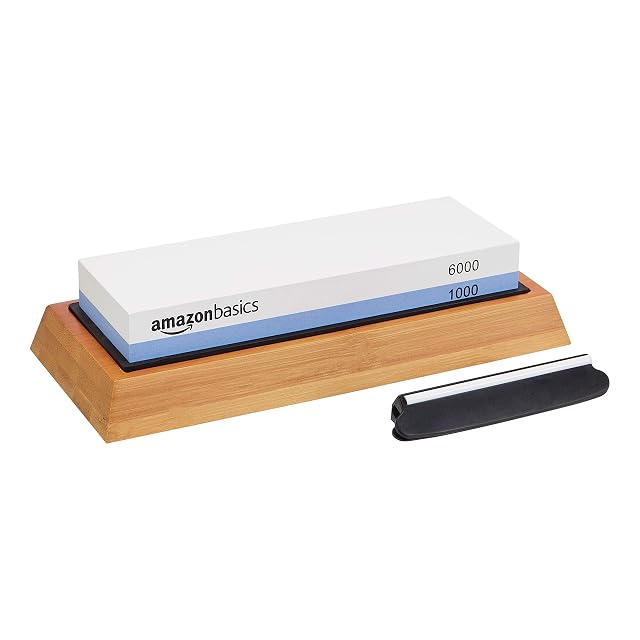
  1. Amazon Basics 1000/6000 double-sided

    Double-sided 1000/6000 grit · angle guide included · non-slip bamboo base

    The combination stone that covers a home kitchen — 1000 to sharpen, 6000 to refine — with an angle guide and a bamboo base, at the lowest price here.

    Best for: A first stone, for knives that are dull but undamaged.

    6.9/10

    ≈ $28

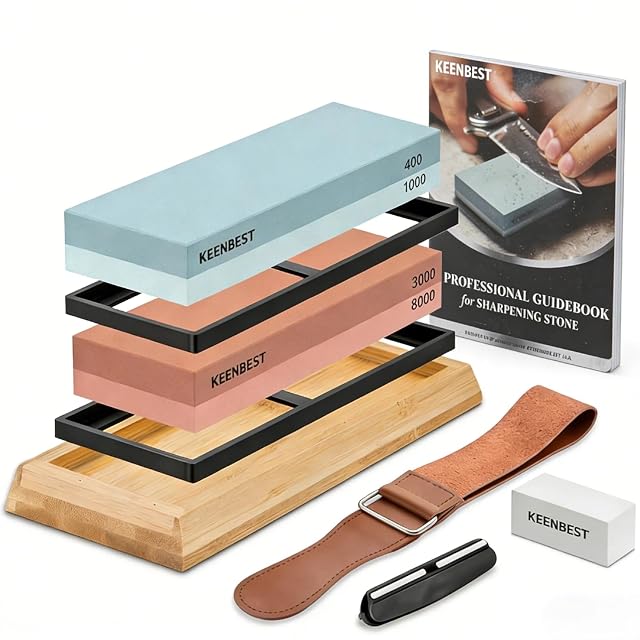
  2. KEENBEST 400/1000 + 3000/8000 starter set

    Two stones 17.8 × 5.6 × 2.8 cm (7 × 2.2 × 1.1 in) · four grits · bamboo base with rubber feet · FLATTENING STONE INCLUDED

    The only stone set here that includes a flattening stone — the consumable nobody anticipates — with published dimensions and a bamboo base.

    Best for: Someone who intends to keep sharpening for years rather than once.

    8.1/10

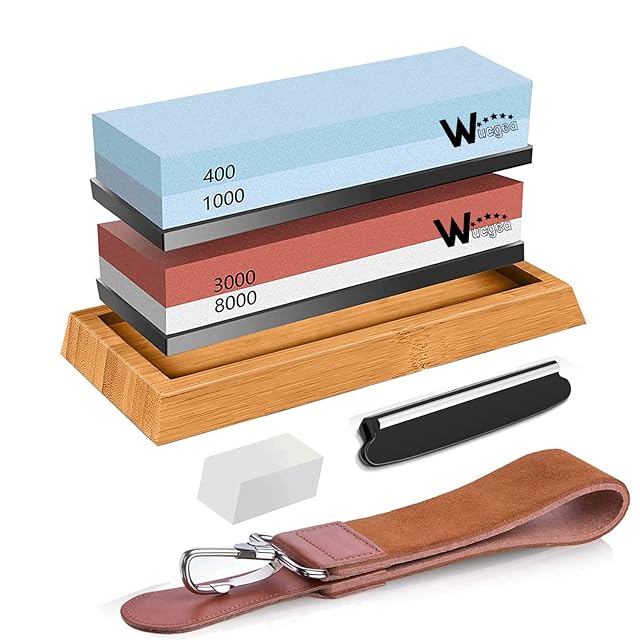
  3. wucgea 400/1000 + 3000/8000 set

    Two stones, four grits · white corundum · soak 5–10 minutes · non-slip silicone holder

    Two double-sided corundum stones covering four grits from 400 to 8000 — the full progression, including the coarse grit that repairs a chipped edge.

    Best for: A kitchen with a chipped knife as well as dull ones.

    7.5/10

    ≈ $22

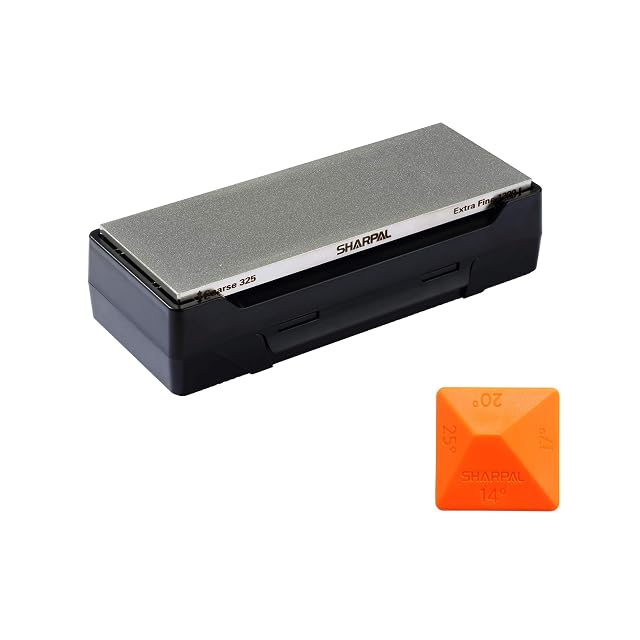
  4. SHARPAL Diamond 325/1200 with storage base

    Dual grit 325/1200 · monocrystalline diamond on a 0.9 cm (0.4 in) steel base · non-slip storage base

    The top of this hub: industrial monocrystalline diamond bonded to a 9 mm (0.35 in) steel plate, in two grits, with a storage base — built to sharpen anything hard.

    Best for: A workshop as much as a kitchen, and any blade a conventional stone struggles with.

    8.7/10

    ≈ $70

By need, across whetstones

Recovering a genuinely damaged blade

A chipped or completely rounded edge calls for removing metal, not polishing. It is the coarsest grit in the range that does that work; starting on a fine grit means spending an hour changing nothing.

SHARPAL 162N

Learning the gesture

Sharpening on a stone is a technique before it is a piece of equipment, and the first blades lose a little of their profile to it. The most affordable model in the range lets you practice without the mistake costing much.

wucgea 8 in 1

Being flattened again after use

A stone hollows in the middle and stops giving a straight edge after a few sharpenings. A stated flattening stone decides how long the set stays usable.

SHARPAL 162N

Across whetstones, who each type suits

European kitchen knives
A two-sided stone covers everything: a medium side to bring the edge back, a fine side to finish it. It is the most common format in the range and it is enough for one household, as long as no blade is chipped.
Hard Japanese blades
They call for finer grits and a tighter angle than European knives — the exact angle comes from the knife’s manufacturer, never from the stone’s. A very fine polishing side makes sense here in a way it does not on an ordinary block knife.
Workshop as well as kitchen
Wood chisels, secateurs, very hard steels: this is the territory of diamond stones, which bite into materials where a classic water stone wears more than it cuts. They do not go as far down in fineness, which matters little on a tool.

The trade-offs to weigh on whetstones

Diamond against water stone
Diamond removes metal fast, does not dish and does not need soaking — you use it when you want, with no preparation. The water stone gives a finer edge, costs less at entry level, and dishes with use, which means it has to be flattened.
Two grits against a full progression
A double-sided stone maintains knives in good condition and does nothing else. A four-grit set lets you start again from a blade in poor condition and go all the way to polishing, at the cost of more equipment, more time per knife, and a flattening stone not to be forgotten.
Angle guide against freehand
The guide gives a reproducible result from the first knife and prevents you learning the angle, which you eventually hold on your own. It adapts poorly to very short or very wide blades, or to those sharpened on one side only.

What gets asked about whetstones

What is each grit for?

Below 500, you repair and reprofile a damaged edge. Between 800 and 1500, you give the edge back to a merely blunt knife — that is the grit used most often. Above 3000, you polish, which makes the cut smoother without making it last longer.

Water or oil?

Whatever the manufacturer states, without improvising. A water stone into which oil has been put is lost: the oil blocks the pores and water will never enter again. Diamond and ceramic stones are most often used with a little water, or dry when that is stated.

How long should the stone soak?

It depends on the model and the listings say so — from a few minutes to a quarter of an hour. The stone is considered ready when it stops giving off bubbles. Splash-and-go stones and diamond stones do not soak at all.

Does a stone really need flattening?

Yes, as soon as it has been used several times: it dishes in the middle, where you pass. A dished stone rounds the edge instead of forming it, and gives the impression that the technique is at fault. A flattening stone, supplied in some sets, corrects that in a few minutes.

Stone or honing steel?

They do not do the same work. The steel straightens a folded edge and removes almost no metal: it is used often, between sharpenings. The stone forms a new edge and is used rarely. One never replaces the other.

How do I know it is sharp?

By the burr: passing a finger gently across the back of the blade, you feel a small lip along the whole edge on the side opposite the one you are working. Until it has appeared along the full length, that side is not finished. You then remove it on the fine grit.

Can I sharpen scissors or a bread knife?

Scissors, yes, working only the bevelled face of each blade and never the flat inside. A serrated blade, no: a flat stone would destroy the teeth. A bread knife is replaced, or sharpened with a round file, tooth by tooth.

How often should I sharpen?

That depends less on the knife than on the board: glass, stone and ceramic fold an edge in a few cuts, wood and plastic spare it. A knife that crushes the tomato instead of entering it calls for the stone, whatever the date of the last sharpening.

The essentials of whetstones

A stone is chosen first on the most damaged blade you intend to recover: that is what imposes a coarse grit, which routine maintenance does not require. The rest of the choice plays out between diamond, fast and with no preparation, and the water stone, finer and needing flattening.

Overview: whetstones

    The whole set of whetstones, as a table

    We show a column only when four utensils in five publish its value. The rest would stay empty and settle nothing.

    ModelPriceGrits
    wucgea 8 in 1$22400/1000 and 3000/8000 — two double-sided stones
    Amazon Basics DS-WSTAMZ003$281000 on one side, 6000 on the other
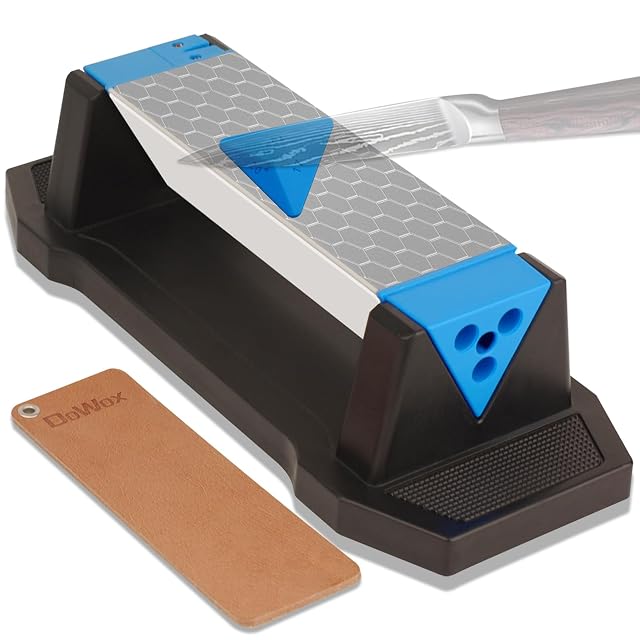
    DOWOX SD1 Pro$39400 diamond, 1000, 8000
    SHARPAL 162N$70325 coarse (45 micron) and 1200 extra fine (12 micron)
    KEENBEST FD-ZJ-221105-093—400/1000 and 3000/8000

    Guides covering whetstones

    Where this comes from

    Specifications: manufacturer sheets for cookware and kitchen knives and the matching Amazon product pages. Prices and availability: Keepa. Every figure in this table names its source.

    Most recent revision in this category: September 3, 2026.

    What we judge whetstones on

    Prices quoted in these summaries are dated readings. The live price is shown next to each product.