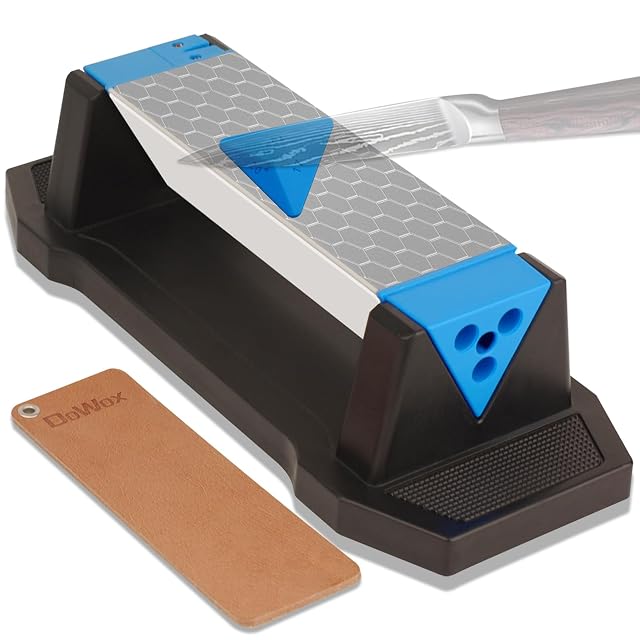
What we would actually buy The right two grits and a guide. Check the length against your chef’s knife before ordering.
What you are getting
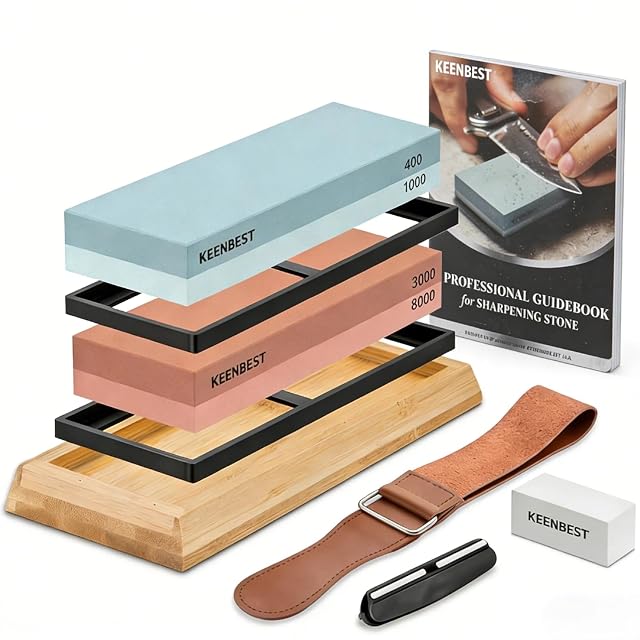
A double-sided water stone, 1000 grit on one face and 6000 on the other, with an angle guide and a non-slip bamboo base.
The two grits
1000 is the sharpening band: it takes a dull edge and makes it cut again. 6000 refines that edge to something smoother than kitchen work strictly needs. Between them they cover everything short of repairing a chip.
The guide
A clip that holds the blade at a set angle. It is the single most useful thing a beginner can have, because holding the same angle for every stroke — not technique in general — is the whole difficulty of freehand sharpening.
What is not published
The stone’s dimensions. It should be longer than the blade you sharpen most, and that is not stated.
Availability
On sale at around $28 on the American Amazon store at the time of checking.
Prices and availability are what Keepa reported on the date this page was updated; both move.
Prices quoted in this text were read on 3 September 2026. The live price is at the top of the page.
What we rate, and what we do not
Strengths
1000/6000 is the combination that covers nearly every home kitchen
An angle guide in the box, which is exactly what a beginner needs
The cheapest stone in this hub
Compromises
No stone dimensions published — length matters against blade length
No flattening plate, and stones dish with use
6000 is finer than kitchen work needs; the 1000 side does the work
Specifications
Grits
1000 on one side, 6000 on the other
Included
Angle guide
Base
Non-slip bamboo
Use
Kitchen knives and other cutting tools
Amazon reference
B089HKKN4Z
EAN
0840095851930
Where this model is listed
A listing is not an offer: the reference exists on these stores, availability changes daily.
France
Germany
Italy
Spain
United Kingdom
United States
The questions that come in
Is 1000/6000 the right pair?
For a knife that is dull but not damaged, yes: 1000 makes it sharp again and 6000 refines it. Coarser grit is only needed when there is a visible chip.
Why does stone length matter?
The stone should be longer than the blade you sharpen most. Sharpening a 20 cm (7.9 in) chef’s knife on a short stone forces a sweeping motion, which is exactly how a consistent angle gets lost.
Our score
6.9/ 10
The right two grits and a guide. Check the length against your chef’s knife before ordering.
This one against the other cookware and knives
Close prices, same category: comparable cookware and knives. We keep only the specifications all of them publish, because a column with gaps compares nothing.
Amazon reports what buyers took in the month before this page was last checked: at least 500.
The figure is a floor, rounded by Amazon, and read through Keepa — it says what buyers picked, not what a maker claims.
Sources
Specifications: the manufacturer sheet for cookware and kitchen knives and the matching Amazon product page. Prices and availability: Keepa. Every figure on this page names its source.
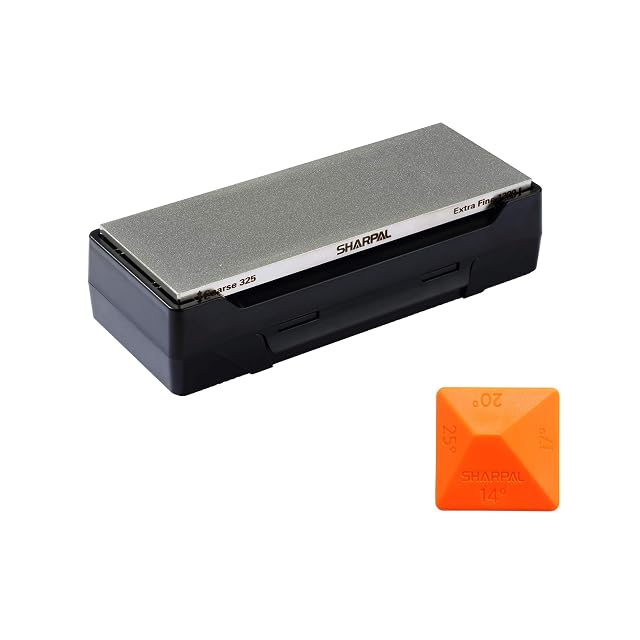
Dual grit 325/1200 · monocrystalline diamond on a 0.9 cm (0.4 in) steel base · non-slip storage base
The top of this hub: industrial monocrystalline diamond bonded to a 9 mm (0.35 in) steel plate, in two grits, with a storage base — built to sharpen anything hard.
Best for: A workshop as much as a kitchen, and any blade a conventional stone struggles with.