Skip to content

The best manual knife sharpeners for 2026

A guided sharpener trades control for repeatability: the angle is set by the device, so the result is consistent and does not depend on a skill that takes weeks to build. The distinction that matters is how much metal it takes. Pull-through sharpeners with carbide blades cut steel quickly and aggressively, restoring a working edge in seconds at the cost of shortening the blade’s life; ceramic or diamond guided systems, including magnetic angle holders, work closer to a stone. The fixed angle also has to suit the knife: a system ground for 20° European blades reprofiles a 15° Japanese one. We compare fixed angles, abrasive stages, metal removal and blade suitability.

The models we recommend

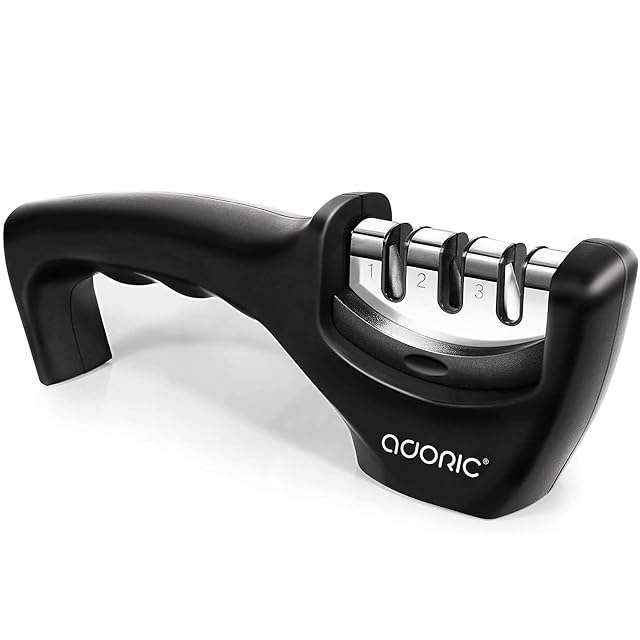
  1. Adoric 3-stage tungsten and ceramic

    Three stages · diamond rod, tungsten carbide, ceramic · removable sharpening head · ABS body

    A three-stage pull-through with a diamond rod, tungsten carbide and ceramic — and a sharpening head that comes off, which is unusual at this price.

    Best for: Soft European kitchen knives that need bringing back quickly.
    7.2/10

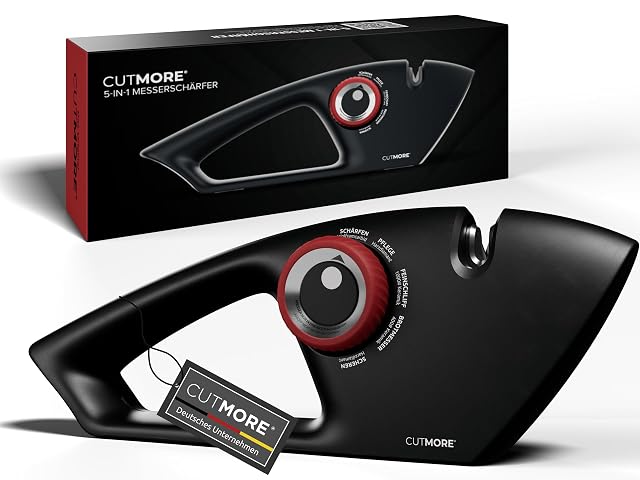
  2. CUTMORE 5-in-1 diamond

    Five stages · diamond, tungsten carbide and fine ceramic · knives, bread knives and scissors · non-slip

    A five-stage sharpener that adds a scissor slot and a dedicated bread-knife stage to the usual three, in industrial-grade abrasives.

    Best for: A drawer with knives, a bread knife and kitchen scissors in it.

    7.8/10

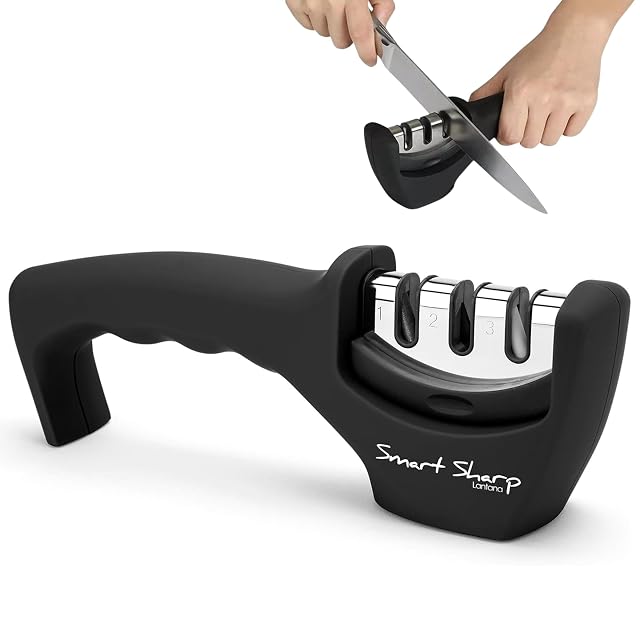
  3. Lantana Smart Sharp 3-stage

    Three stages — prepare, sharpen, finish · left- and right-handed · straight and wide-serrated blades

    A three-stage sharpener that names its stages — prepare, sharpen, finish — and works for either hand, including on wide-serrated bread knives.

    Best for: A household with mixed knives and no interest in a stone.

    7.8/10

    ≈ $16

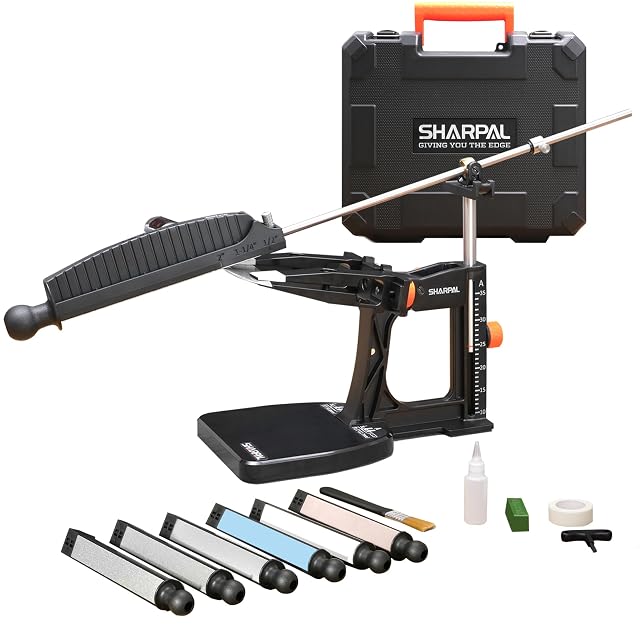
  4. SHARPAL Angle-adjustable system, 10°–35°

    Adjustable 10° to 35° · 7-piece set · monocrystalline diamond plates 220/325/600/1000 · whetstone included

    A guided system with a genuinely adjustable angle from 10° to 35°, four diamond plates and a whetstone — the only sharpener here that can match a Japanese 15° edge.

    Best for: Someone with Japanese knives who wants repeatable results without freehand practice.

    8.4/10

    ≈ $180

By need, across manual knife sharpeners

Sharpening without learning anything

A fixed-angle sharpener gives an immediate result with no technique. That is what sets it apart from the stone, which demands practice.

Lantana Smart Sharp

Matching the angle of your blades

A twenty-degree guide on a Japanese blade ground at fifteen removes metal for nothing and shortens the knife. The stated angle is compared with that of the blades you own.

SHARPAL 202H

Staying put while you pull

A sharpener that slides across the worktop forces you to hold it with one hand and pull with the other, which ruins the angle. Stated non-slip feet or a suction base decide how even the stroke is.

SHARPAL 202H

Across manual knife sharpeners, who each type suits

Family cooking
Three passes give a blunt knife its bite back in a few seconds. For many households, that is exactly the right level of demand.
Quality knives
A fixed-angle sharpener imposes its geometry and removes a lot of metal. On a Japanese blade with a tight angle, it does more harm than good.
Touching up a knife every week
A sharpener does not replace a honing steel: the steel straightens the edge every day, the sharpener creates a new one when it has gone.

The trade-offs to weigh on manual knife sharpeners

Ease against metal removed
Wheel sharpeners cut fast into the steel and shorten the blade’s life. A stone removes ten times less for a better edge.
Imposed angle against original geometry
The fixed angle is what makes the tool simple, and it is also what permanently alters a blade sharpened otherwise.
Speed against fineness
One pass gives a biting, coarse edge. A fine-grit stone gives an edge that cuts paper, in ten minutes of work.

What gets asked about manual knife sharpeners

Does a manual sharpener damage knives?

It removes markedly more metal than a stone and imposes its angle. On ordinary knives that is acceptable; on a Japanese blade, no.

How many passes should I make?

Three to five, without pressing, pulling steadily. Multiplying passes does not make it sharper, it wears the blade.

Can a serrated blade be sharpened?

No. It takes a round file that works each tooth one by one.

What is the difference from a honing steel?

The steel straightens an existing edge without removing metal; the sharpener creates a new edge by removing steel. They do not do the same work.

Do I need both stages, coarse and fine?

The coarse stage is only for a very blunt blade. In routine upkeep, the fine stage alone is enough and preserves the blade.

Is a sharpener suitable for Japanese knives?

Rarely: their angle is tighter than the one imposed by most Western sharpeners. A stone is the right tool.

Why does my knife still not cut?

The edge may be folded rather than blunt, which a honing steel corrects. Otherwise the blade is too damaged for a manual sharpener.

Does a pull-through sharpener damage the blade?

It removes metal at every pass and hollows the profile over the months. On a knife you mean to keep twenty years, it is better used sparingly and followed by a stone.

The essentials of manual knife sharpeners

A manual sharpener buys simplicity by removing metal and imposing its angle: a good tool for ordinary knives, a bad one for a Japanese blade. Three passes without pressing is enough, and the honing steel remains the everyday upkeep.

Overview: manual knife sharpeners

    The whole set of manual knife sharpeners, as a table

    We show a column only when four utensils in five publish its value. The rest would stay empty and settle nothing.

    ModelPriceStages
    Lantana Smart Sharp$16Three: prepare, sharpen, fine finish
    SHARPAL 202H$180—
    Adoric 3-stage—Three: diamond rod for coarse work, tungsten carbide, ceramic for finishing
    CUTMORE 3177964031—Five: sharpening, maintenance, fine finish, bread knives and scissors
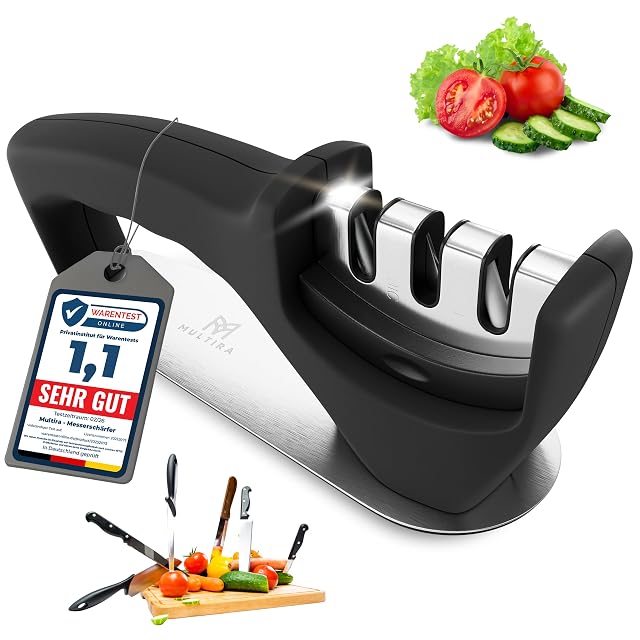
    Multira RA2—Three, for different blades and levels of wear

    Guides covering manual knife sharpeners

    Where this comes from

    Specifications: manufacturer sheets for cookware and kitchen knives and the matching Amazon product pages. Prices and availability: Keepa. Every figure in this table names its source.

    Most recent revision in this category: September 3, 2026.

    What we judge manual knife sharpeners on

    Prices quoted in these summaries are dated readings. The live price is shown next to each product.