Skip to content

The best stockpots for 2026

A stockpot is bought for volume and judged on proportion. A tall, narrow pot exposes less surface to the air, so a stock reduces slowly and keeps its liquid over hours; a wide, low one behaves like a large sauté and boils dry. The other consideration is what a full pot weighs: ten liters of liquid is ten kilograms before the pot, and thin riveted handles are where cheap pots fail. Base thickness matters less than in a frying pan but still decides whether a simmer scorches at the bottom. We compare capacity and height-to-width ratio, base construction, handle strength, lid seal and cupboard footprint.

The models we recommend

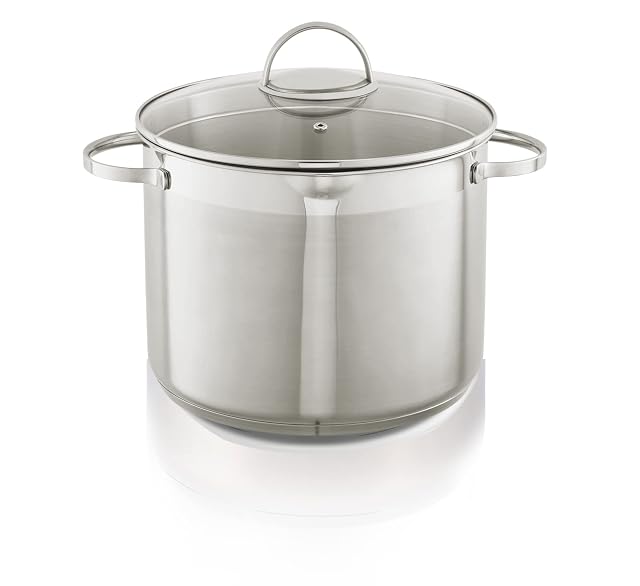
  1. KHG 26 cm (10.2 in), 10 L with level markings

    26 cm (10.2 in) · 10 L · uncoated stainless · fill-level indicator · straining spouts both sides · glass lid with steam vent

    A 10 liter stockpot with a fill-level indicator inside, straining spouts on both sides and a glass lid with a steam vent — three practical details at the entry price.

    Best for: Stock, soup for a crowd, and pasta for six.
    7.2/10

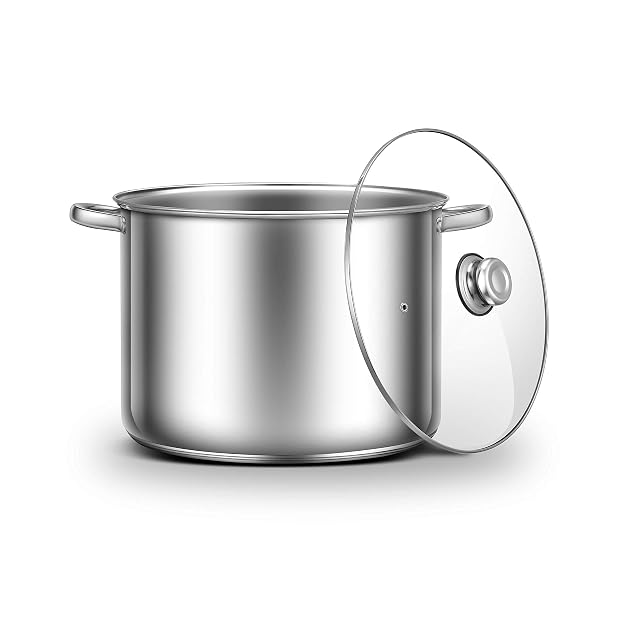
  2. Amazon Basics 7.6 L with glass lid

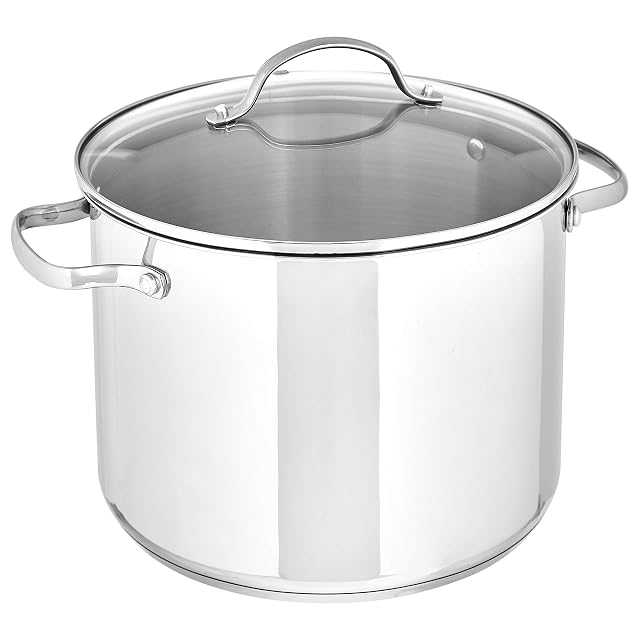
    7.6 L · heavy stainless with aluminum-core base · riveted side handles · glass lid · oven safe to 260 °C (500 °F) without lid

    A 7.6 liter stockpot that publishes an oven limit — 260 °C (500 °F) without the lid — with riveted stainless side handles and an aluminum-core base.

    Best for: Everyday soup and stock, and anything that starts on the hob and finishes in the oven.

    7.8/10

    ≈ $48

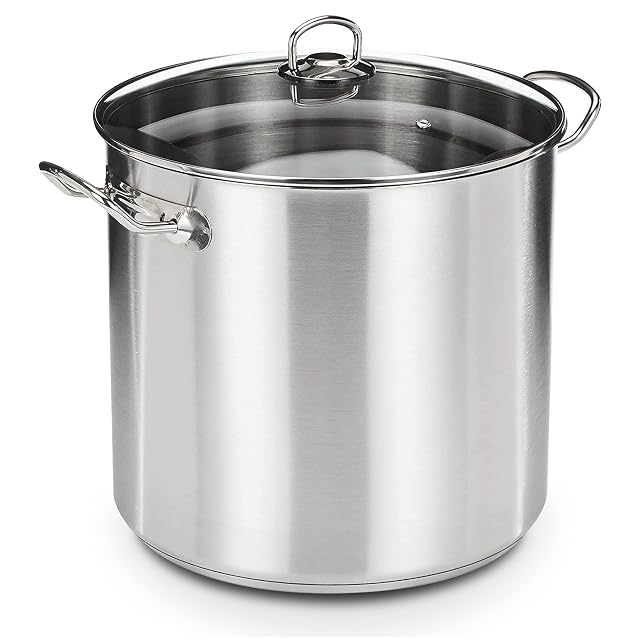
  3. Ribelli 32 cm (12.6 in), 20 L

    32 cm (12.6 in) × 24 cm (9.4 in) high · about 20 L · stainless with aluminum-core base · two side handles · dishwasher safe

    A 20 liter pot for goulash, mulled wine and preserving, on a stainless base with an aluminum core, with two side handles.

    Best for: Preserving, batch cooking and events, not everyday soup.

    7.8/10

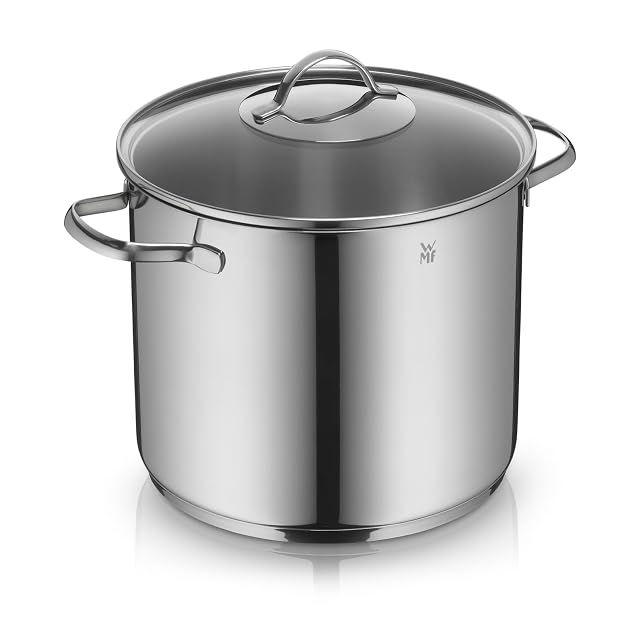
  4. WMF Provence Plus 24 cm (9.4 in), 8.8 L

    24 cm (9.4 in) · 8.8 L · 20.5 cm (8.1 in) high · Cromargan 18/10 uncoated · oven safe to 250 °C (482 °F) · optimal for 22 cm (8.7 in) rings

    An 8.8 liter uncoated stainless pot that publishes its height, its oven limit and the hob ring it is designed for — and has a lid that seals well enough to steam vegetables.

    Best for: Stock and soup, where tall and narrow keeps the liquid in the pot.

    7.8/10

    ≈ $130

By need, across stockpots

Cooking in quantity

Preserving, bone broth, a stew for twelve, pasta for a full table: these uses all run into the same physical limit, the volume of the pot. No other parameter substitutes for missing liters.

GSW 643474

Everyday soup

A twenty-liter pot for two liters of soup heats a mass of steel for nothing, does not fit in the sink and ends up on a high shelf from which it never comes down. The smallest volume in the range covers daily cooking for two to four people.

Amazon Basics ST1903223

Seasonal use

A pot taken out twice a year — jam, pumpkin soup — does not justify a multi-layer base. The most affordable model in the range boils water exactly as well.

Amazon Basics ST1903223

Across stockpots, who each type suits

Small kitchen, induction hob
The diameter of the base counts more than the volume: a pot whose base extends well beyond the ring heats with a cold outer ring and sticks in the center. Some manufacturers state the optimal ring diameter — it is the most useful figure on their listing, and the most rarely read.
Preserving and sterilizing
Here it is the height that decides, not the capacity: the jars have to be fully submerged. Plan on a rack or a cloth in the base too, failing which the glass rests directly on the hottest zone.
Everyday pasta and broth
The details that serve every day lie elsewhere than in the liters: a glass lid to watch without uncovering, internal graduations to measure without scales, a pouring lip to drain without a colander.

The trade-offs to weigh on stockpots

Tall and narrow against wide and low
At equal volume, a tall shape exposes little surface to the air: the liquid evaporates slowly, which is what a broth left to simmer for hours wants. A wide shape reduces fast, which is what a sauce or a jam wants. It is the most structuring choice in the range, and it cannot be read off the capacity.
Volume against real bulk
A pot is also judged by where it will live. Twenty liters fits neither under a sink nor in a domestic dishwasher, and gets washed at arm’s length in a sink basin. Ten liters puts away, and requires cooking in two batches on feast days.
Glass lid against metal lid
Glass lets you watch a boil without losing the steam, and that is comfortable day to day. It does, however, cap the permitted oven temperature, where the body of the pot is often stated far higher. Listings that give an oven limit almost always specify "without the lid".

What gets asked about stockpots

What volume for how many people?

For pasta, the common rule is about one liter of water per hundred grams, which puts six people around six liters of water — hence a markedly larger pot, since the water must not reach the rim. For a soup, count the finished volume plus a third.

Do I need an aluminum-core base?

For water, no. For anything thick — blended vegetable soup, tomato sauce in quantity, chilli — yes: stainless steel alone conducts heat poorly and lets the contents stick above the ring before the rest has heated.

Why does the water take so long to boil?

Because you are heating a large mass of water on a ring often smaller than the base, and most often uncovered. The lid is the most effective lever and the only free one.

Do these pots go in the oven?

Several state so with a figure, provided a glass lid is removed. Check the handles too: it is they, not the body, that set the limit when they contain a plastic material.

Where do the white marks and iridescent sheens come from?

The whitish traces are limescale deposited by the water, the iridescent sheens a coloring of the steel after overheating. Both are cosmetic: white vinegar for the first, a stainless steel cleaner for the second.

Riveted or welded handles?

Rivets are the usual construction on large volumes, and they hold: in exchange they leave a relief on the inside, around which the sponge has to work. Welded handles give a smooth wall and are less easy to inspect by eye.

What should I check for induction?

Two things: that the base is ferromagnetic — a fridge magnet settles it in a second — and that its diameter roughly matches the ring. A base far larger than the ring does not heat faster, it merely heats less evenly.

Does a stockpot replace a casserole?

For boiling, yes. For braising, no: the pot is tall, thin-walled, and its lid rarely closes tightly enough to hold the humid atmosphere of a long braise. They are two neighboring families and two distinct uses.

The essentials of stockpots

A stockpot is chosen on its volume, then on its shape, then on the diameter of its base compared with that of the ring. The rest — pouring lip, graduations, glass lid — belongs to daily comfort, which nonetheless decides how often it comes out of the cupboard.

Overview: stockpots

  • Diameter: 24 to 32 cm (12.6 in), on 3 of the 5 models.
  • Highest figure for volume: Ribelli 500576 (about 20 L).

The whole set of stockpots, as a table

We show a column only when four utensils in five publish its value. The rest would stay empty and settle nothing.

ModelPriceVolumeLidMaterial
Amazon Basics ST1903223$487.6 LTransparent tempered glassHeavy stainless steel
WMF 0723246380$1308.8 LGlass, stated to close wellCromargan 18/10 stainless, polished, uncoated
GSW 643474$20520 LHeat- and impact-resistant glassRustproof stainless steel
KHG XXL 26 cm—10 LHeat-resistant glass with a steam ventUncoated stainless steel
Ribelli 500576—about 20 L——

Guides covering stockpots

Where this comes from

Specifications: manufacturer sheets for cookware and kitchen knives and the matching Amazon product pages. Prices and availability: Keepa. Every figure in this table names its source.

Most recent revision in this category: September 3, 2026.

What we judge stockpots on

Prices quoted in these summaries are dated readings. The live price is shown next to each product.