Skip to content

The best paring knives for 2026

A paring knife is used in the hand as often as on the board, which changes what makes one good: control near the tip, a grip that stays secure when wet, and a blade short enough that the point is always where you think it is. Shape follows the job — a straight spear point handles trimming and general work, a curved bird’s beak follows the round of an apple or a shallot, and a sheep’s foot is safest for board work. This is also the one category where a multipack is not a compromise: several inexpensive knives that are actually sharp beat one expensive knife somebody else is using. We compare blade length and shape, steel, grip and multipack value.

The models we recommend

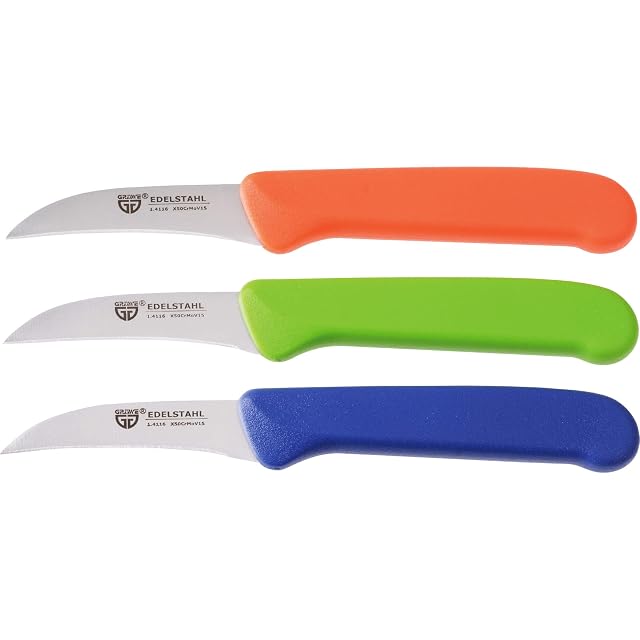
  1. GRÄWE 3-piece paring set

    Set of 3 · stainless · colored handles · ground sharp · small kitchen knives

    Three small stainless knives with colored handles at the price of a coffee — the category where a multipack is genuinely better than one expensive blade.

    Best for: The knife that is always missing when you want it.

    6.9/10

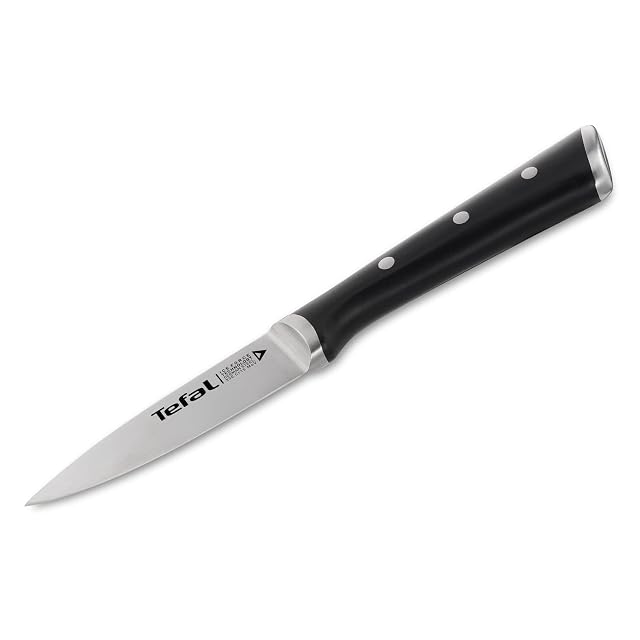
  2. Tefal Ice Force 9 cm (3.5 in) paring knife

    9 cm (3.5 in) blade · ice-hardened to −120 °C (-184 °F) stated · German stainless · finger guard

    A 9 cm (3.5 in) paring knife with the same Ice Force treatment as its santoku sibling, made in German stainless, with a finger guard.

    Best for: Someone who wants one good small knife rather than a multipack.

    7.5/10

    ≈ $34

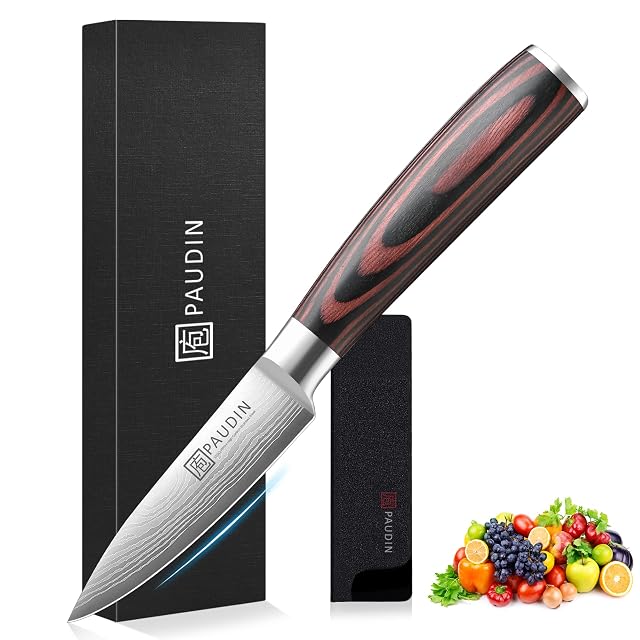
  3. PAUDIN 9 cm (3.5 in) with pakkawood handle

    9 cm (3.5 in) blade · 5Cr15MoV steel · pakkawood handle · left- and right-handed · stated rust resistant

    The top of this hub: a 9 cm (3.5 in) paring knife in named 5Cr15MoV steel with a pakkawood handle, ambidextrous, from the same range as the santoku above.

    Best for: Someone building a matched set rather than buying a multipack.

    8.7/10

By need, across paring knives

Having a knife in each hand

Paring knives are often sold in sets because they are the tool you are always looking for. Having several changes the comfort of a kitchen.

GRÄWE HBITT

Working in the hand

Peeling and turning are done off the board: the shorter the blade, the more controlled and safe the gesture.

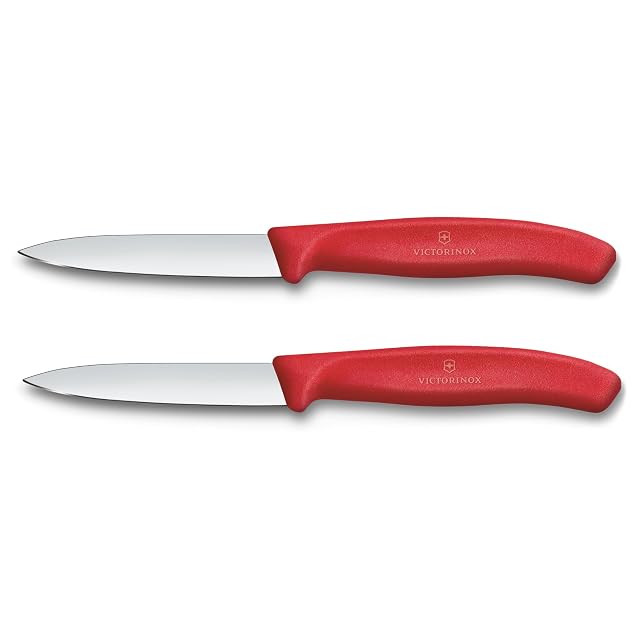
Victorinox 6.7601.2C1

Not rusting at the bottom of a drainer

Carbon steel spots overnight on a knife left wet. The stated steel grade decides the upkeep demanded by a knife used ten times a day.

PAUDIN PD8BMC8CR506

Across paring knives, who each type suits

Peeling and trimming
It is the knife you pick up for all the small work: strawberry hulls, potato eyes, lemon segments.
Precision work
A short, pointed blade lets you remove sinew and bone finely where a large knife becomes dangerous.
The household’s second knife
With a chef’s knife, a paring knife covers almost everything. It is the pair that empties a knife block of its usefulness.

The trade-offs to weigh on paring knives

Set against single piece
A set comes to very little per knife and gathers together average blades. A single well-made paring knife cuts better and is more painful to lose.
Straight blade against curved blade
The straight blade trims and details on a board; the curved one, called a turning knife, follows the roundness of a fruit held in the hand.
Fine point against strength
A very fine point reaches the details and bends at the first lever. It is the part of the knife that breaks first.

What gets asked about paring knives

What length for a paring knife?

8 to 10 cm (3.1 to 3.9 in). Beyond that, control in the hand is lost and the point of the format disappears.

Should I buy several?

It is the knife you are always looking for and lose most often. Two or three in a drawer save you taking out the big knife to peel.

Straight blade or turning blade?

Straight for versatility, curved to peel round fruit in the hand. The straight one is the better first purchase.

Is a serrated paring knife any use?

On tomatoes and thin skins, yes: it grips where a smooth blade slides. It is practically impossible to resharpen.

How do I sharpen it?

Like a large knife, on a stone or a steel, allowing for the small size. Many cheap sets are not worth sharpening.

Can it be used on a board?

Yes, but a chef’s knife will be more efficient and less tiring. The paring knife is at its best held in the hand.

Is it more dangerous than a large knife?

Working in the hand demands vigilance: the blade comes towards the hand. Always cut with the edge moving away from the thumb.

Straight or curved blade?

A straight blade peels flat on a board; a curved one follows the shape of a fruit held in the hand. Many kitchens end up with both, for two different gestures.

The essentials of paring knives

A straight-bladed 8 to 10 cm (3.1 to 3.9 in) paring knife is the indispensable companion to the chef’s knife. Having two or three saves taking out the big knife for a strawberry hull, and working in the hand means cutting away from the thumb.

Overview: paring knives

  • Blade length: 8 to 9 cm (3.5 in), on 3 of the 5 models.
  • Pieces: 2 to 3, on 3 of the 5 models.

The whole set of paring knives, as a table

We show a column only when four utensils in five publish its value. The rest would stay empty and settle nothing.

ModelPriceUse
Tefal K23205$34—
GRÄWE HBITT—Peeling, trimming, precise small work
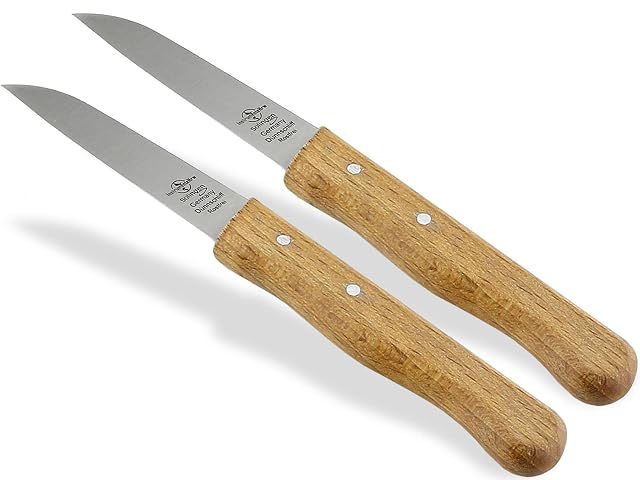
InstrumenteNrw Solingen 2-piece—Fruit, vegetables, general small work
PAUDIN PD8BMC8CR506—Peeling, trimming and small kitchen work
Victorinox 6.7601.2C1—Removing pepper seeds, trimming, precise work

Guides covering paring knives

Where this comes from

Specifications: manufacturer sheets for cookware and kitchen knives and the matching Amazon product pages. Prices and availability: Keepa. Every figure in this table names its source.

Most recent revision in this category: September 3, 2026.

What we judge paring knives on

Prices quoted in these summaries are dated readings. The live price is shown next to each product.