Skip to content

The best crêpe pans for 2026

A crêpe pan is a frying pan with the sides taken off, and that is the whole point: a batter spreader has to reach the rim in one sweep, which a 4 cm (1.6 in) wall makes impossible. The second requirement is flatness — a base with any dome pushes the batter outward and leaves a thin center, and a warped one puts a ridge through every crêpe. Diameter is a matter of appetite and of hob size: a 30 cm (11.8 in) pan on a 16 cm (6.3 in) ring cooks a pale ring around a dark middle. We compare diameter against hob, coating and material, handle attachment and stated handle limits, and induction compatibility. Base thickness is published by no one here; a single maker publishes a weight, which is the nearest thing this hub offers to a measure of mass.

The models we recommend

  1. Russell Hobbs Metallic Marble 25 cm (9.8 in)

    25 cm (9.8 in) · cast aluminum · PFOA-free nonstick stated · flat omelette shape · soft-touch handle · induction

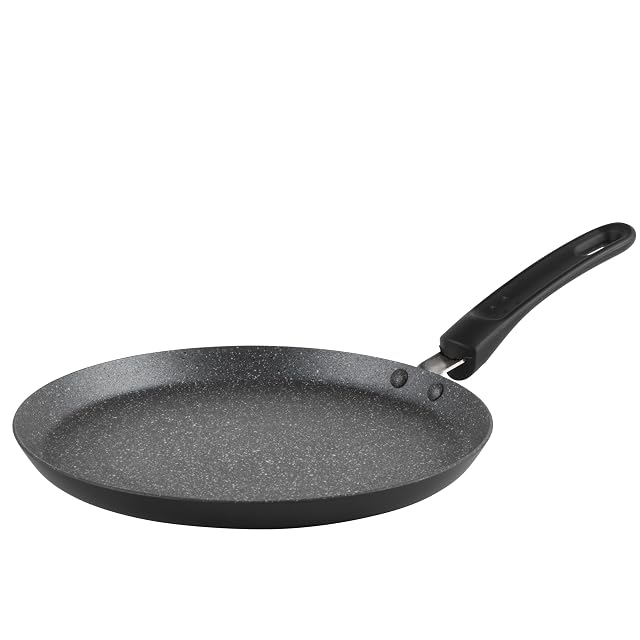
    The cheapest pan in the whole catalog and a straightforward one: 25 cm (9.8 in) of cast aluminum with a marble-effect nonstick surface, flat sides, and every hob type including induction.

    Best for: Pancakes on a Sunday, and a flat pan for omelettes the rest of the week.

    6.9/10

    ≈ $60

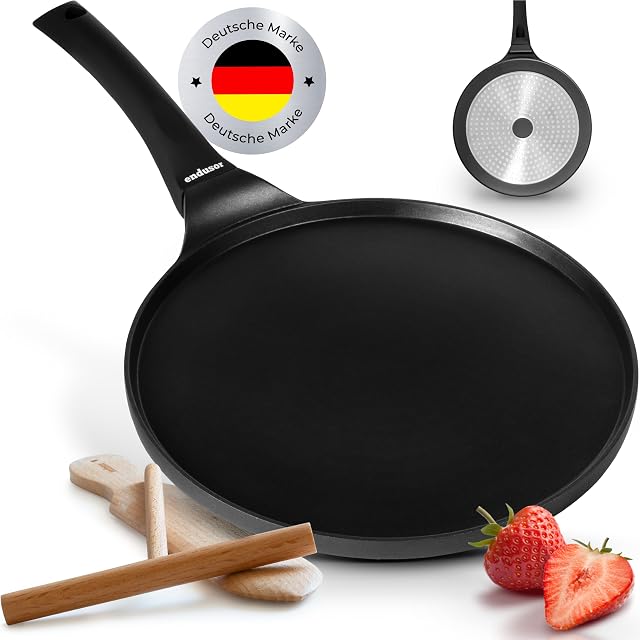
  2. endusor 26 cm (10.2 in) with beech spreader

    26 cm (10.2 in) · cast aluminum, stated 900 g (31.7 oz) · three-layer nonstick · iron-core induction base · beech spatula and spreader

    The only pan in this hub that publishes its weight — a stated 900 g (31.7 oz) — with a three-layer nonstick surface, an iron-core induction base, and German beech tools included.

    Best for: Induction hobs, and anyone who wants the tools and the pan to match.

    8.1/10

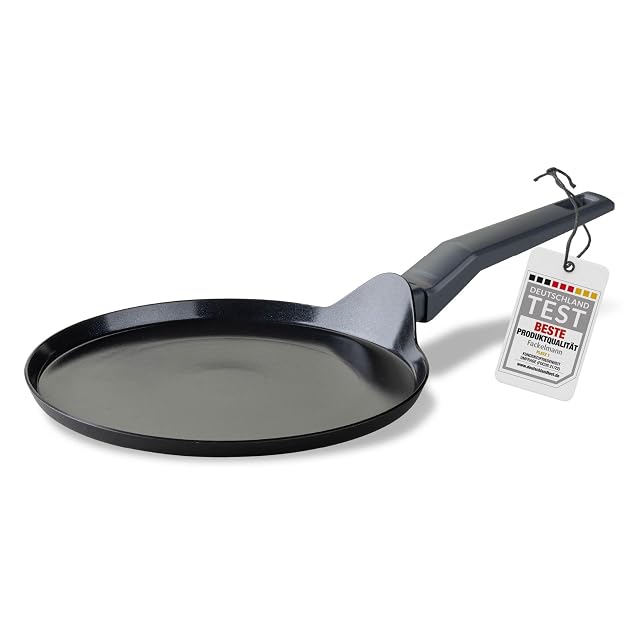
  3. FACKELMANN Statement 25 cm (9.8 in) recycled aluminum

    25 cm (9.8 in) · recycled aluminum · PFAS-free ceramic coating stated · Bakelite handle to 150 °C (302 °F) · 3-year guarantee

    A 25 cm (9.8 in) crêpe pan made from recycled aluminum with a ceramic coating the maker states is PFAS-free, a Bakelite handle rated to 150 °C (302 °F), and a stated three-year guarantee.

    Best for: Someone who wants a PFAS-free surface and reads the small print.

    7.5/10

    ≈ $58

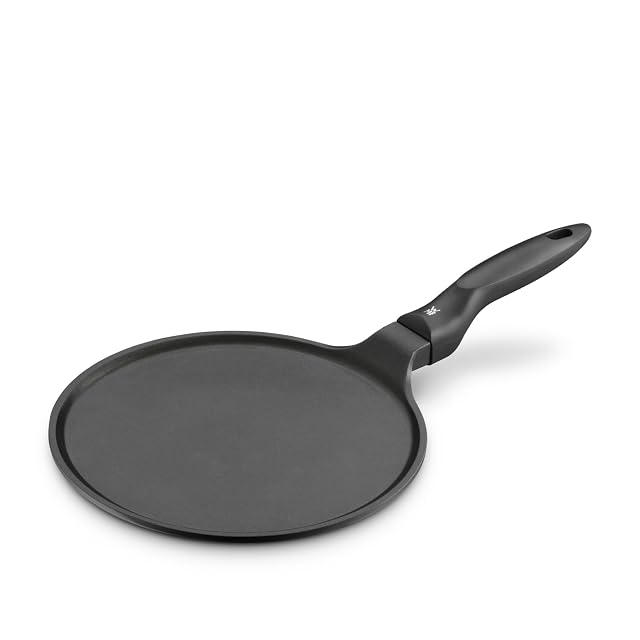
  4. WMF Devil 27 cm (10.6 in) with spreader

    27 cm (10.6 in) · cast aluminum · three-layer PermaDur nonstick · spreader and wooden turner included

    A 27 cm (10.6 in) cast aluminum crêpe pan with WMF’s three-layer PermaDur coating, and — the reason to buy it — a matched batter spreader and wooden turner in the box.

    Best for: Anyone actually making crêpes rather than occasional pancakes.

    7.5/10

    ≈ $99

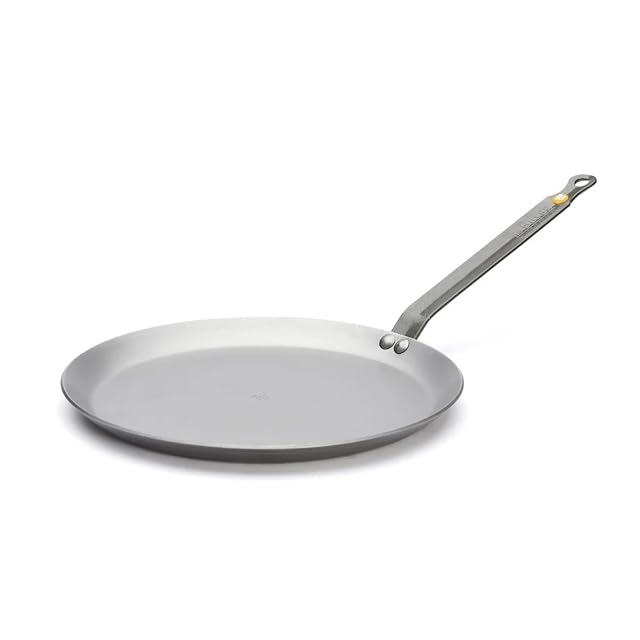
  5. DE BUYER MINERAL B 24 cm (9.4 in) carbon steel

    24 cm (9.4 in) · carbon steel, uncoated · beeswax protected · riveted angled handle · lifetime guarantee · made in France

    The one pan in this hub with no coating at all: French carbon steel protected with beeswax, seasoned by the user, with a riveted handle angled away from the heat and a stated lifetime guarantee.

    Best for: Someone who will season it properly and keep it for thirty years.

    8.7/10

    ≈ $75

By need, across crêpe pans

Crêpes the size you expect

Nothing makes up for a diameter that is too small: a crêpe pan fixes the size of the crêpe once and for all. If the aim is the thin crêpe folded in four, it is the widest in the range you should be looking at.

WMF 0570044291

A pan that also earns its keep the rest of the year

A modest diameter turns the crêpe pan into an omelette and fried-egg pan, the one you take out in the morning. A large crêpe pan only serves crêpes and occupies the cupboard eleven months out of twelve.

DE BUYER 5615.24

Candlemas and nothing else

For two or three sessions a year, an entry-level coated crêpe pan does exactly the job. The premium paid in this family buys a service life, not a better crêpe.

FACKELMANN 66086

Across crêpe pans, who each type suits

Wanting a pan for life
Carbon steel is this family’s historic answer: no layer to wear through, a seasoning that can be redone, and long warranties stated by some manufacturers. In exchange you have to remove the factory protection before first use, accept that the first crêpes stick, and never put it away damp.
A crepe pan on an induction hob
The point to check before anything else. Carbon steel is magnetic by nature; aluminum is not and only takes hold if the manufacturer has added a ferrous base — the listings that target induction say so explicitly, the others say nothing, and silence means no.
Sunday with the family
A coated surface and an insulating handle are enough, with one point of attention: the stated temperature limit for a bakelite handle is often well below that of the pan body. It is the handle that decides whether the whole thing can go in the oven, not the metal.

The trade-offs to weigh on crêpe pans

Carbon steel against a coated surface
Steel does not wear out but has to be earned: seasoning, drying, oil. The coating works from the first minute and ages, whatever its trade name. It is a trade-off between regular upkeep and replacement in due course.
Low rim against versatility
A very low rim lets the spatula slide flat under the crêpe, which is the whole point of the shape. That same rim rules out anything containing liquid. A crêpe pan with a slightly raised rim makes crêpes that are marginally harder and omelettes that are far better.
Spreader against ladle
The wooden spreader gives an even, thin crêpe, provided the batter is fluid enough and the base perfectly flat. Spreading by tilting the pan needs less equipment and less learning, and gives thicker crêpes. The spreaders supplied in the box change nothing about that difference in gesture.

What gets asked about crêpe pans

Is a crêpe pan really different from a frying pan?

On one point that matters: the rim, low and flared, and a flat base with no curve. In an ordinary pan the spatula catches on the curve and tears the crêpe as you turn it.

What diameter for a crepe pan?

That of your ring as much as that of the crêpe. A crêpe pan markedly wider than the ring cooks a disc in the center and leaves the outer crown pale, and no setting corrects that.

How do I prepare a new carbon steel crêpe pan?

First remove the protection applied at the factory — manufacturers say which, often a wax — with very hot water, then season with thin, hot layers of oil. The first crêpes stick: they are part of the seasoning.

Why is the first crêpe always a failure?

Because the pan has not finished evening out its temperature. It serves as a test: it tells you whether the heat is too fierce, whether the batter is too thick, and whether you need more fat. The second one is the real first.

Do I have to grease between each crêpe?

On a coated surface, very little, otherwise the batter slides instead of spreading. On seasoned steel, a cloth or half an onion dipped in oil wiped quickly between two crêpes is enough and maintains the surface.

Can a crepe pan go in the dishwasher?

Carbon steel, never: it rusts and loses its seasoning in one cycle. A coated crêpe pan, only if the manufacturer states it, and knowing that plastic handles and coatings age faster there than by hand.

Does the batter really need to rest?

That is what classic recipes recommend: resting hydrates the flour and gives a more fluid batter, therefore easier to spread. That belongs to the recipe, not to the pan — no crêpe pan makes up for batter that is too thick.

What are coatings advertised as PFAS-free worth?

They describe a composition, not a service life. The framework is the same for all: PFOA has been banned in the European Union since 2020, and a broader restriction on PFAS is under consideration at ECHA. For the rest, you stick to the temperature limits the manufacturer states.

The essentials of crêpe pans

A crêpe pan is chosen on its diameter first, on its material second. Carbon steel is the choice of whoever accepts a routine; the coating, of whoever wants to take the pan out twice a year without thinking about it. Between the two, the only detail that genuinely spoils the purchase is a non-magnetic base on an induction hob.

Overview: crêpe pans

  • Highest figure for diameter: WMF 0570044291 (27 cm (10.6 in)).

The whole set of crêpe pans, as a table

We show a column only when four utensils in five publish its value. The rest would stay empty and settle nothing.

ModelPriceDiameterBodyCoatingHandle
FACKELMANN 66086$5825 cm (9.8 in)Recycled aluminumCeramic interior; maker states PFAS-freeBakelite, stated heat resistant to 150 °C (302 °F)
Russell Hobbs Metallic Marble crêpe pan$6025 cm (9.8 in)Cast aluminum, stated strong and durableMarble-effect nonstick; maker states PFOA-freeSoft-touch
DE BUYER 5615.24$7524 cm (9.4 in)——Riveted, angled upward away from the heat source
WMF 0570044291$9927 cm (10.6 in)Cast aluminum, stated to store and spread heat wellThree-layer PermaDur nonstick, stated durable and scratch resistantBakelite, heat-reducing
endusor P7-CrepesPfanne—26 cm (10.2 in)Cast aluminum, stated for flatness and light handlingThree-layer nonstick—

Guides covering crêpe pans

Where this comes from

Specifications: manufacturer sheets for cookware and kitchen knives and the matching Amazon product pages. Prices and availability: Keepa. Every figure in this table names its source.

Most recent revision in this category: September 3, 2026.

What we judge crêpe pans on

Prices quoted in these summaries are dated readings. The live price is shown next to each product.