Skip to content

The best santoku knives for 2026

A santoku is not a shorter chef’s knife; it is a different motion. Its flat edge meets the board along its whole length, so it cuts by pushing down and forward rather than rocking, which suits a smaller board and a shorter arm. The scalloped dimples along the blade — granton edge — break the suction that makes potato slices cling; they reduce sticking, they do not eliminate it, and the difference is smaller than the marketing suggests. Japanese-made blades are typically harder and ground at a narrower angle than European ones, which cuts better and chips sooner. We compare blade profile and length, dimples, stated steel and hardness, edge angle and handle style.

The models we recommend

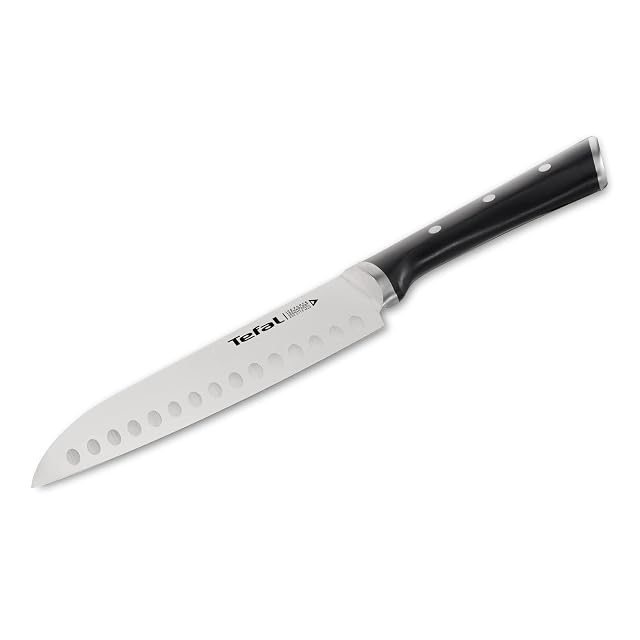
  1. Tefal Ice Force 18 cm (7.1 in) santoku

    18 cm (7.1 in) blade · ice-hardened to −120 °C (-184 °F) stated · German stainless · finger guard · stated 2× longer life

    An 18 cm (7.1 in) santoku with Tefal’s Ice Force treatment — the blade cooled to a stated −120 °C (-184 °F) — made in Germany, with a finger guard.

    Best for: A first santoku, for someone who chops rather than rocks.

    7.2/10

    ≈ $47

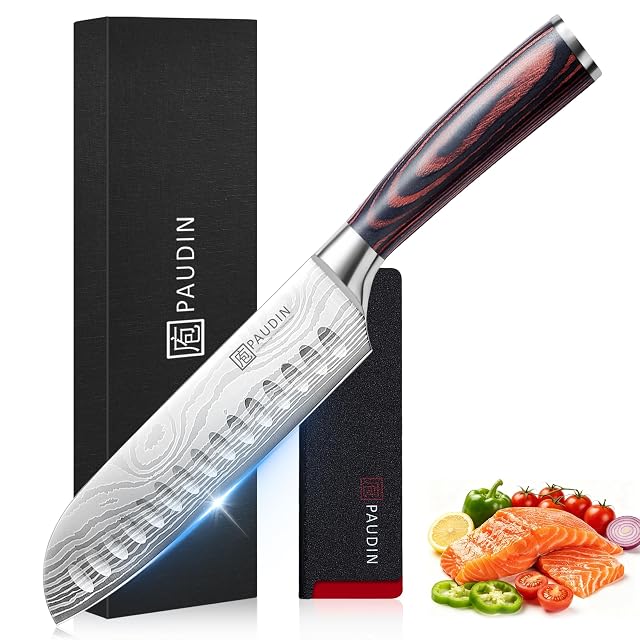
  2. PAUDIN 17.8 cm (7 in) santoku

    17.8 cm (7 in) blade · 5Cr15MoV steel · 13° double bevel · pakkawood handle · left- and right-handed

    A 17.8 cm (7 in) santoku in 5Cr15MoV steel ground at a stated 13° per side, with a pakkawood handle and a symmetrical bevel that suits either hand.

    Best for: Vegetables and fish, from someone who will keep it off bones.

    7.8/10

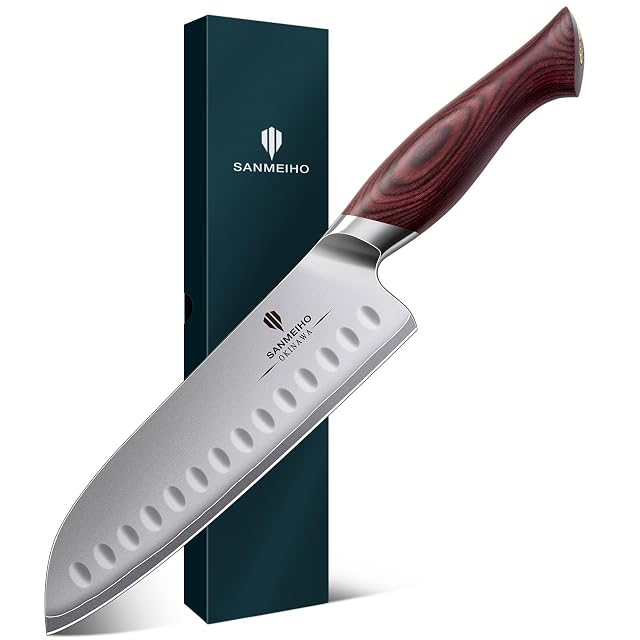
  3. SANMEIHO 18 cm (7.1 in) laminated santoku

    18 cm (7.1 in) blade · 10Cr15MoV Japanese steel · stated HRC 62 · 5-layer laminated · stated 12° edge

    An 18 cm (7.1 in) santoku in 10Cr15MoV Japanese steel stated at HRC 62, with a five-layer laminated blade and a stated 12° edge — the hardest blade in this hub.

    Best for: A cook who sharpens their own knives and will keep this one for vegetables and fish.

    7.8/10

    ≈ $70

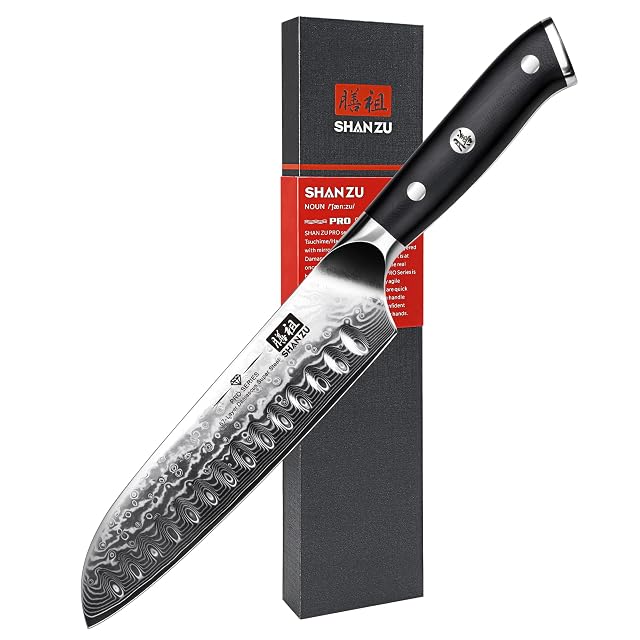
  4. SHAN ZU Damascus 18 cm (7.1 in) santoku

    18 cm (7.1 in) blade · Japanese 10Cr15MoV Damascus core · 67 forged layers · stated genuine, not etched

    A Damascus-clad santoku with a 10Cr15MoV Japanese core and 67 forged layers, and a maker who states explicitly that the pattern is forged rather than laser-etched.

    Best for: Someone who wants a beautiful knife and wants to know what is underneath the pattern.

    8.4/10

    ≈ $90

By need, across santoku knives

Cutting large items in one go

The santoku works by pushing down rather than rocking. Its length directly determines the width of what it can slice in one pass.

SHAN ZU SZPCS-2017-004

A knife that handles well every day

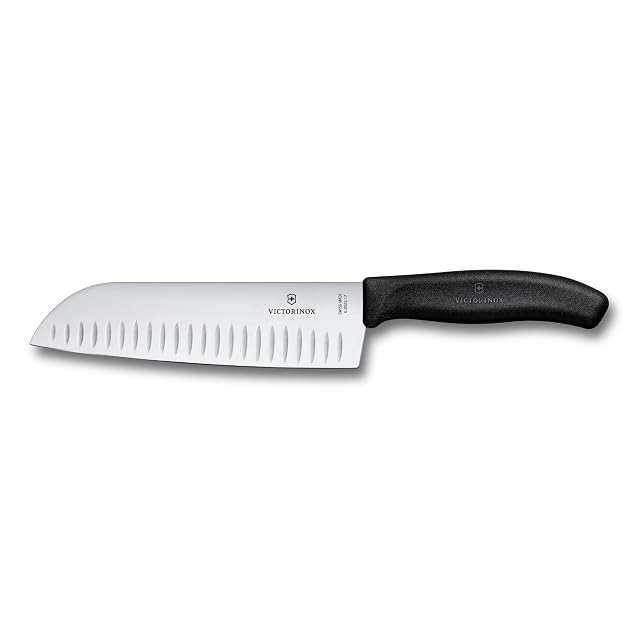
A shorter blade is better controlled in fine slicing, which is this profile’s favored ground.

Victorinox 6.8523.17B

Being resharpened at home

Very hard steel holds an edge for a long time but needs a stone and some method to get it back. The stated hardness decides who can maintain the blade, and at what cost.

SANMEIHO SMHCS-2025-06-2

Across santoku knives, who each type suits

Slicing vegetables
The flat profile and the hollows make the santoku the most pleasant tool for fine slicing. That is its real specialty.
Vertical gesture
Anyone who cuts by pushing down rather than rocking takes to it immediately. Anyone who rocks a chef’s knife will find the santoku less natural.
Everyday cooking
A 17 cm (6.7 in) santoku covers almost everything, being lighter and shorter than a chef’s knife.

The trade-offs to weigh on santoku knives

Flat profile against rocking
The flat edge cuts cleanly and does not allow the chef’s knife rocking motion. It is a way of cutting, not a superiority.
Hollows against real effectiveness
The hollows reduce the slices' grip without removing it. On a damp potato, the difference stays modest.
Thinness against sturdiness
A santoku is thinner than a European chef’s knife: sharper, less tolerant of a bone or a sideways impact.

What gets asked about santoku knives

What is the difference from a chef’s knife?

The santoku is shorter, flatter in the edge and thinner. It cuts by pushing down where the chef’s knife rocks on its tip.

What are the hollows for?

To limit slices sticking to the blade. The effect is real but partial: damp slices still stick.

What length should I choose?

17 cm (6.7 in) is the reference size. 18 to 20 cm (7.1 to 7.9 in) for larger items, without exceeding the width of the board.

Can it cut through bone?

Never. The thin edge chips permanently on bone or a stone. A cleaver or a boning knife is made for that.

Is sharpening different?

The angle is often tighter than on a European knife, which gives a finer edge. A European fixed-angle sharpener can alter that geometry.

Is a santoku enough on its own?

For vegetables and boneless meat, yes. A bread knife and a paring knife still need adding.

Do I need Japanese steel?

Hard steels hold the edge longer and demand more care. A well-sharpened European steel cuts very well and forgives more.

What are the dimples on the blade for?

They create air pockets that reduce the grip of a thin slice without removing it. It is a real convenience on potato, marginal on tomato.

The essentials of santoku knives

The santoku is a shorter, thinner chef’s knife that cuts straight down rather than rocking: a way of cutting, not a superiority. Never bone or stones, and a sharpening angle to respect.

Overview: santoku knives

  • Highest figure for blade length: Tefal K23206 (18 cm (7.1 in)).

The whole set of santoku knives, as a table

We show a column only when four utensils in five publish its value. The rest would stay empty and settle nothing.

ModelPriceBlade length
Tefal K23206$4718 cm (7.1 in)
SANMEIHO SMHCS-2025-06-2$7018 cm (7.1 in)
SHAN ZU SZPCS-2017-004$9018 cm (7.1 in)
PAUDIN PD8BMC8CR503—17.8 cm (7 in)
Victorinox 6.8523.17B—17 cm (6.7 in)

Guides covering santoku knives

Where this comes from

Specifications: manufacturer sheets for cookware and kitchen knives and the matching Amazon product pages. Prices and availability: Keepa. Every figure in this table names its source.

Most recent revision in this category: September 3, 2026.

What we judge santoku knives on

Prices quoted in these summaries are dated readings. The live price is shown next to each product.