Skip to content

The best cast iron skillets for 2026

Cast iron is bought for one property: thermal mass. It takes minutes to heat and gives that heat back when cold food lands on it, which is why a steak browns in cast iron and steams in a thin pan. The cost is literal weight, and the trade is worth understanding before buying a 30 cm (11.8 in) piece nobody can lift one-handed. The finish decides how it starts: a machined smooth surface releases food earlier, a rough sand-cast one improves over a season of use. We compare diameter, factory seasoning, surface finish — ground smooth against as-cast — spouts and handle design, and whether the maker states an oven or fire limit. No maker here publishes a weight in grams; one states only that its pan is lighter than conventional cast iron, which is a comparison rather than a figure.

The models we recommend

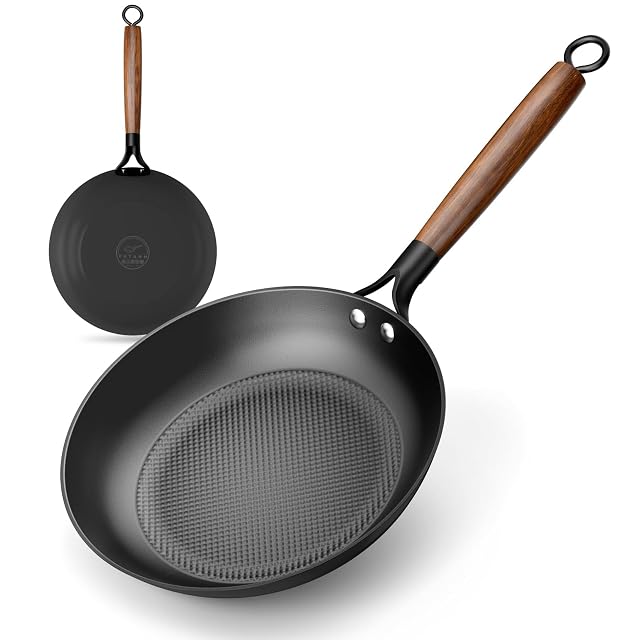
  1. YUTANN 20 cm (7.9 in) lightweight cast iron

    20 cm (7.9 in) · cast iron, stated 30% lighter · thick base, thinner walls · hardwood handle · three sizes

    A cast iron skillet built deliberately light — the maker states about 30% lighter than conventional cast iron, with a thick base and thinner walls, and a hardwood handle rather than bare metal.

    Best for: One or two eggs, a single steak, and anyone who has found a full-size skillet too heavy.
    7.2/10

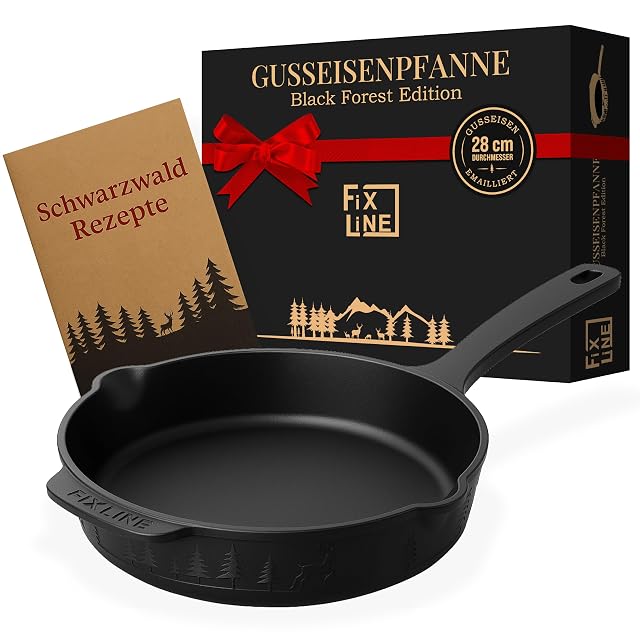
  2. FIXLINE BLACK FOREST 28 cm (11 in) enamelled

    28 cm (11 in) · enamelled cast iron · no seasoning required · oven safe without lid · dishwasher safe stated

    Enamelled rather than bare: the maker states no seasoning is needed, the interior enamel gives a natural release with preheating and a little oil, and the pan is stated dishwasher safe.

    Best for: Someone who wants cast iron’s heat without cast iron’s maintenance.

    7.8/10

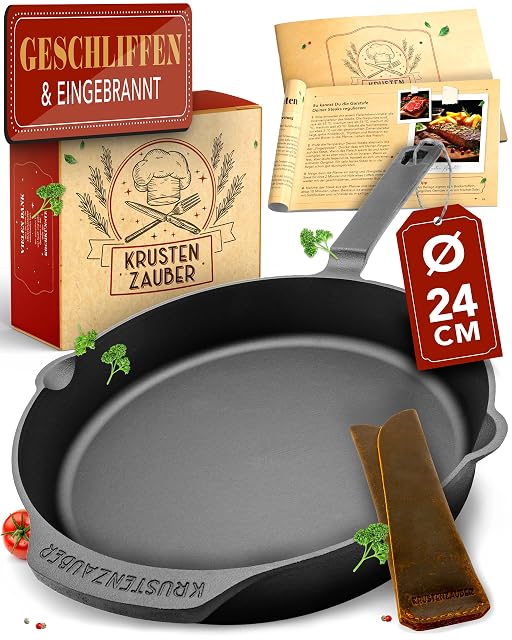
  3. KRUSTENZAUBER 24 cm (9.4 in) ground cast iron

    24 cm (9.4 in) · ground smooth cast iron · hob, oven, grill and open fire · recipe book included

    A 24 cm (9.4 in) cast iron skillet with a ground-smooth interior rather than the usual sand-cast texture, sold with instructions and a recipe book — which is the part beginners actually need.

    Best for: A first cast iron pan for someone who wants to learn it properly.

    7.8/10

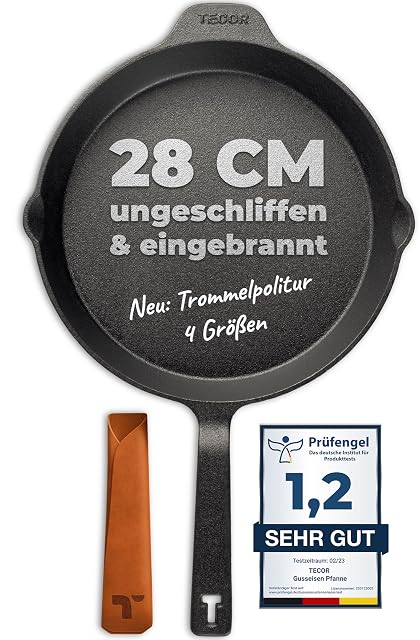
  4. TECOR 28 cm (11 in) unground cast iron

    28 cm (11 in) · unground cast iron · pre-seasoned with vegetable oil · high sides · 20-year money-back stated

    A 28 cm (11 in) cast iron skillet left unground, pre-seasoned with vegetable oil, with high sides — and a stated 20-year money-back promise, which is the longest in this catalog.

    Best for: Someone who will use it weekly and let the surface build.

    7.8/10

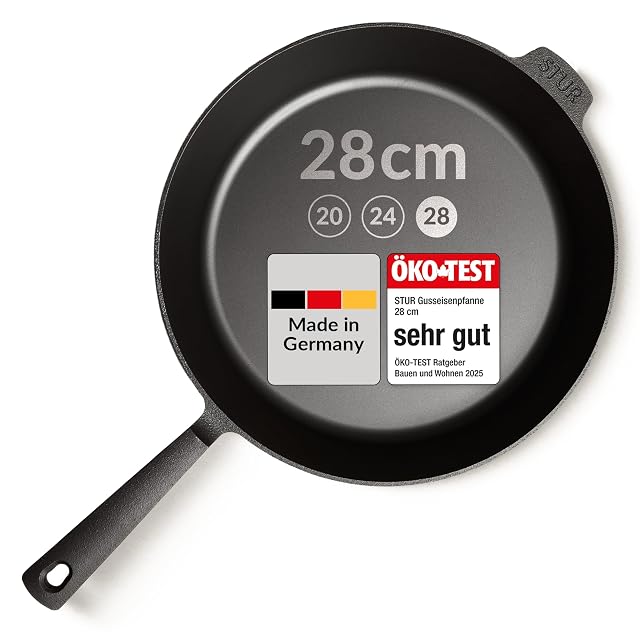
  5. STUR 28 cm (11 in) made in Germany

    28 cm (11 in) · pre-seasoned bare cast iron · hob, oven and grill · cast in Rhineland-Palatinate · no PTFE, PFOA or PFAS

    The most expensive skillet in this hub and the only one that names its foundry region: cast in Rhineland-Palatinate, pre-seasoned, with the maker stating no chemical coatings of any kind.

    Best for: A pan bought as a thirty-year object, by someone who cares where it was made.

    8.4/10

By need, across cast iron skillets

Searing several pieces at once

Cast iron builds a crust because it gives back its heat without collapsing. An overfilled pan cancels that advantage: the pieces touch, the water they release no longer evaporates, and you braise instead of searing. It is the diameter that sets how many pieces fit with space between them.

STUR 28 cm cast iron

A pan you reach for every day

In this family the obstacle to daily use is not the price but the weight, and the weight follows the diameter. An egg, a single steak or two slices of bread cook just as well in the smallest model in the range, which lifts one-handed to turn and to wash.

YUTANN BLK-ZN-1

Across cast iron skillets, who each type suits

Wanting cast iron without the upkeep
Look at enamelled cast iron: nothing to season, acid does not attack it, it washes normally. What it asks in exchange is not to be knocked and not to be heated empty on a high flame — a chip in the enamel exposes the iron, and that patch will rust.
Induction cooking
Cast iron is ferromagnetic, so compatibility is never the question. The question is the glass: you place and you lift, you never slide. And you raise the power in stages, because a ring smaller than the pan concentrates the heat in the center while the rim stays cold.
Cooking over wood or a fire bowl
This is bare cast iron’s ground: nothing to damage, a surface that rebuilds itself with every cooking. Check that the manufacturer states use over direct flame, and prefer a one-piece cast handle to an added wooden one, which rules out the oven and the fire.

The trade-offs to weigh on cast iron skillets

Bare cast iron against enamelled
Bare cast iron improves with use and can always be recovered: even rusted, it comes back after stripping and seasoning. Enamelled is ready straight away and takes tomato or wine without flinching, but a chip cannot be repaired. You are choosing between a surface you maintain and a surface you spare.
Machined surface against raw casting
A machined pan is smooth out of the box and turns non-stick quickly. A raw casting keeps the grain of the mold, takes longer to smooth out, and afterwards holds the seasoning more firmly. The difference plays out over the first few months, not in the cooking.
Thermal mass against handling
The mass that stops the temperature collapsing when the meat goes in is exactly the mass you have to lift to turn the pan over the sink. Models described as lightened thin the walls while keeping a thick base: they keep most of the useful mass and lose a little of the heat that climbs the sides.

What gets asked about cast iron skillets

Is a pre-seasoned pan ready to use?

It is usable, not finished. Factory seasoning is a protective layer, not the non-stick surface that use builds. The first fatty cookings — bacon, onions, potatoes — build it faster than any oven procedure.

Can it be washed with dish soap?

Yes, a mild soap does not remove polymerized seasoning. What destroys it is soaking, the dishwasher and leaving it wet on the rack. The rule fits in one sentence: wash, dry on the heat, wipe on a film of oil.

Does rust write off the pan?

No, and that is the property that sets cast iron apart from everything else. You scour with steel wool down to grey metal, rinse, dry and re-season. A pan found in an attic is usable again in one evening.

Can you cook a tomato sauce in it?

A short cooking, yes. An hour-long simmer, no: the acid dissolves the seasoning and takes on a metallic taste. That is precisely what enamelled cast iron settles, having no seasoning to protect.

Should it be preheated on high?

No, on medium and without hurrying. Cast iron conducts poorly and holds well: a high flame gives a scorching center and a lukewarm rim, and that gap can no longer be closed once the meat is in.

Metal utensils: allowed or not?

On bare cast iron, yes — a metal spatula even helps smooth the surface. On enamelled, no: enamel is a glass, and it chips when struck on a rim or in a corner.

What should I do when food sticks?

Three causes, in this order: pan not hot enough, seasoning still young, food turned too early. A piece of meat releases itself when the crust has formed; if it resists, it is not the pan that needs correcting but the waiting.

Is the dishwasher an option?

Never for bare cast iron: the detergent strips the seasoning and the piece comes out rusted. For enamelled, only if the manufacturer states it, and knowing that the unenamelled rim, for its part, is not protected.

The essentials of cast iron skillets

A cast iron pan is chosen on its diameter and on the surface you accept maintaining, not on a brand. The rest — the non-stick behavior, the crust, the longevity — comes from use and not from the box. The one mistake that is hard to undo is buying too large for your arms.

Overview: cast iron skillets

  • Highest figure for diameter: TECOR TC03_22 (28 cm (11 in)).

The whole set of cast iron skillets, as a table

We show a column only when four utensils in five publish its value. The rest would stay empty and settle nothing.

ModelPriceDiameterMaterial
FIXLINE BLACK FOREST Edition 28 cm—28 cm (11 in)Enamelled cast iron
STUR 28 cm cast iron—28 cm (11 in)Bare cast iron, pre-seasoned
KRUSTENZAUBER 24 cm ground finish—24 cm (9.4 in)Cast iron with a ground smooth cooking surface
TECOR TC03_22—28 cm (11 in)Pure cast iron, unground, no coating
YUTANN BLK-ZN-1—20 cm (7.9 in) (also offered in 24 and 28 cm)Cast iron, stated approximately 30% lighter than conventional cast iron

Guides covering cast iron skillets

Where this comes from

Specifications: manufacturer sheets for cookware and kitchen knives and the matching Amazon product pages. Prices and availability: Keepa. Every figure in this table names its source.

Most recent revision in this category: September 3, 2026.

What we judge cast iron skillets on