What we would actually buy The published temperature is a nice piece of honesty. The durability claim is relative to Tefal’s own range and should be read that way.
What you are getting
An 18 cm (7.1 in) santoku in German stainless with Tefal’s Ice Force treatment — the blade cooled to a stated −120 °C (-184 °F) after heating — and a finger guard.
Reading the claim properly
Tefal states up to twice the life of its other stainless ranges. That is a comparison with itself, which is honest and is not the same as a claim against other makers. It tells you this is the better of Tefal’s knife ranges.
The shape
A santoku has a flat edge and cuts by pushing down and forward rather than rocking. If you rock a knife through herbs by habit, this will feel wrong within a week.
What is not published
Hardness and edge angle. Both would tell you more than a process name, and neither appears.
Availability
On sale at around $47 on the American Amazon store at the time of checking.
Prices and availability are what Keepa reported on the date this page was updated; both move.
Prices quoted in this text were read on 3 September 2026. The live price is at the top of the page.
What we rate, and what we do not
Strengths
Publishes the actual cryogenic temperature, −120 °C (-184 °F), rather than a process name alone
A finger guard, which few santokus have
The cheapest santoku here, made in Germany
Compromises
The "2× longer" claim is against Tefal’s own other ranges, not against the market
No hardness figure
No edge angle published
Specifications
Blade length
18 cm (7.1 in)
Treatment
Ice Force: blade cooled to a stated −120 °C (-184 °F) after heating
Steel
Stainless, made in Germany
Guard
Finger guard
Claim
Maker states up to twice the life of its other stainless ranges
Amazon reference
B07BCSHLF4
EAN
3168430274266
Where this model is listed
A listing is not an offer: the reference exists on these stores, availability changes daily.
France
Germany
Italy
Spain
United Kingdom
United States
The questions that come in
What does cryogenic treatment do?
It is a step in heat treatment that transforms retained austenite in the steel, and makers associate it with hardness and corrosion resistance. Tefal publishes the temperature; the resulting hardness is not stated.
Is a santoku better than a chef’s knife?
It is different. A flat edge chops straight down; a curved chef’s knife rocks. Buy the one that matches how your hands already work.
Our score
7.2/ 10
The published temperature is a nice piece of honesty. The durability claim is relative to Tefal’s own range and should be read that way.
What use this one answers, among cookware and knives
A first santoku, for someone who chops rather than rocks.
Where this model is cited, among our cookware and knives guides
Specifications: the manufacturer sheet for cookware and kitchen knives and the matching Amazon product page. Prices and availability: Keepa. Every figure on this page names its source.
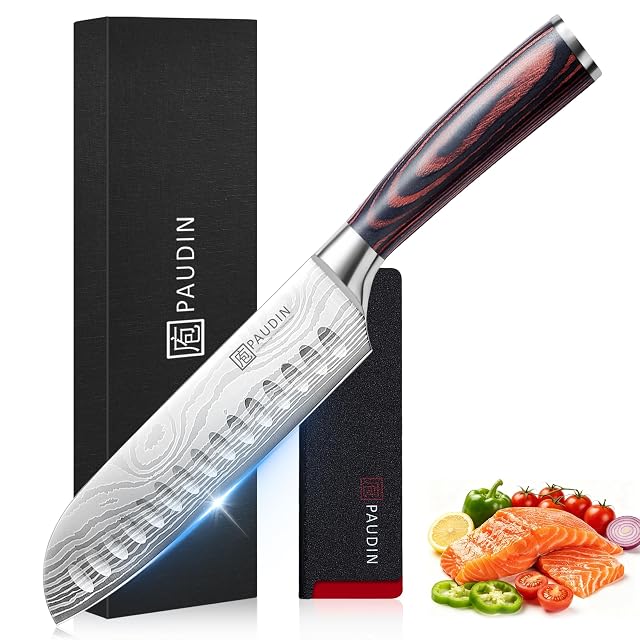
18 cm (7.1 in) blade · 10Cr15MoV Japanese steel · stated HRC 62 · 5-layer laminated · stated 12° edge
An 18 cm (7.1 in) santoku in 10Cr15MoV Japanese steel stated at HRC 62, with a five-layer laminated blade and a stated 12° edge — the hardest blade in this hub.
Best for: A cook who sharpens their own knives and will keep this one for vegetables and fish.
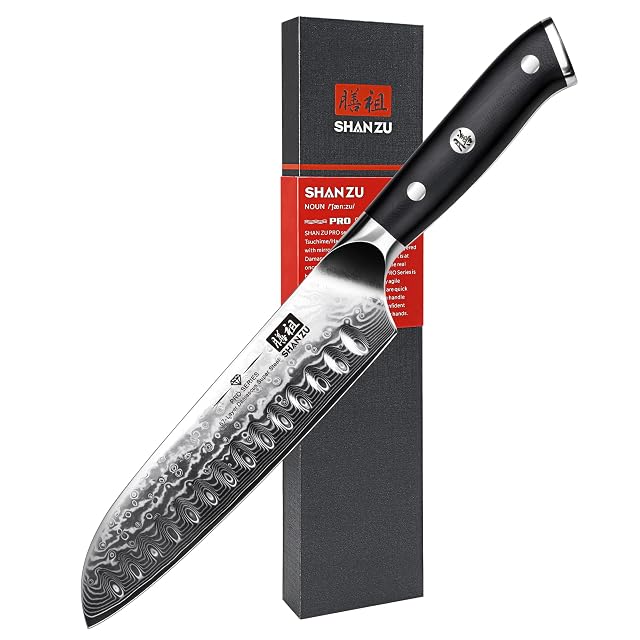
18 cm (7.1 in) blade · Japanese 10Cr15MoV Damascus core · 67 forged layers · stated genuine, not etched
A Damascus-clad santoku with a 10Cr15MoV Japanese core and 67 forged layers, and a maker who states explicitly that the pattern is forged rather than laser-etched.
Best for: Someone who wants a beautiful knife and wants to know what is underneath the pattern.