What we would actually buy 60 HRC in VG-10 is arguably the most usable hard Japanese specification there is. The unaddressed etching question is the gap.
What you are getting
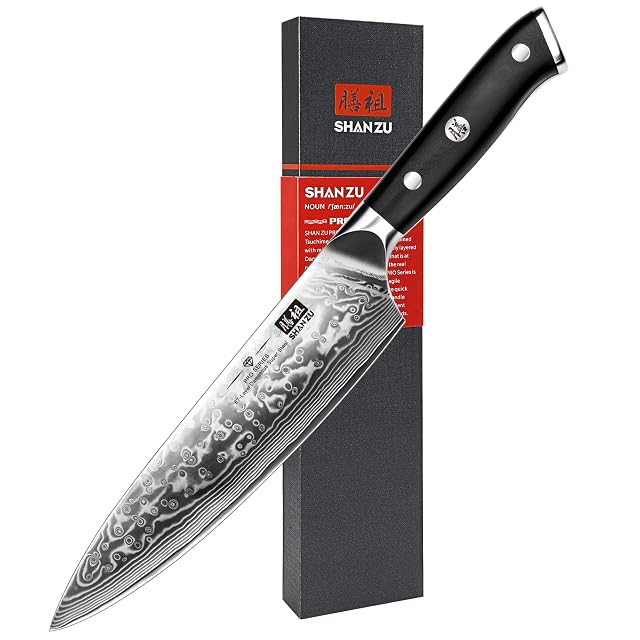
A 20 cm (7.9 in) Damascus-clad chef’s knife with a VG-10 core stated at 60 HRC, finished using what the maker describes as traditional Japanese techniques, with an ergonomic non-slip handle.
VG-10, named
The best-known Japanese kitchen core steel. It takes a very keen edge, holds it well, and resists corrosion better than carbon steels. Naming it puts this knife in a category you can reason about.
60 HRC in practice
The balance point of hard Japanese blades: keen enough to feel completely different from a European knife, and less prone to chipping than a 62 HRC blade. Still not a knife for bones.
What the listing does not say
The layer count, and whether the pattern is forged or etched. Given that the core is named and the hardness published, the omission is more likely to be brevity than concealment — but it is not stated.
Availability
Not found on the American Amazon store, where the buy link falls back to a local search rather than to a page that does not exist.
Prices and availability are what Keepa reported on the date this page was updated; both move.
What we rate, and what we do not
Strengths
VG-10 is the reference Japanese kitchen steel, and it is named
Publishes a hardness figure
60 HRC is the sweet spot: keen, and less brittle than 62
Compromises
No edge angle published
No layer count given despite the Damascus description
Nothing stated about whether the pattern is forged or etched
Specifications
Blade length
20 cm (7.9 in)
Core steel
VG-10
Hardness
Stated 60 HRC
Finish
Stated made using traditional Japanese techniques
Handle
Ergonomic, non-slip, stated balanced
Amazon reference
B0GGC99685
EAN
0739290506014
Where this model is listed
A listing is not an offer: the reference exists on these stores, availability changes daily.
France
Germany
Spain
The questions that come in
What is VG-10?
A Japanese stainless cutlery steel with vanadium and cobalt, widely used for kitchen knife cores. It is well understood, takes a keen edge, and is commonly hardened to around 60 HRC.
Is 60 HRC better than 62?
Less brittle, slightly shorter edge retention. For a household knife that will occasionally meet something it should not, 60 is the more forgiving choice.
Our score
7.8/ 10
60 HRC in VG-10 is arguably the most usable hard Japanese specification there is. The unaddressed etching question is the gap.
What use this one answers, among cookware and knives
Someone who wants VG-10 specifically, at a domestic price.
Where this model is cited, among our cookware and knives guides
Amazon reports what buyers took in the month before this page was last checked: at least 200.
The figure is a floor, rounded by Amazon, and read through Keepa — it says what buyers picked, not what a maker claims.
Sources
Specifications: the manufacturer sheet for cookware and kitchen knives and the matching Amazon product page. Prices and availability: Keepa. Every figure on this page names its source.
20 cm (7.9 in) blade · Japanese 10Cr15MoV core · stated 62 HRC · 67 forged layers · stated not laser-etched
A 20 cm (7.9 in) Damascus chef’s knife that publishes everything that matters: a Japanese 10Cr15MoV core at a stated 62 HRC, 67 forged layers, and an explicit statement that the pattern is not etched.
Best for: A cook who sharpens their own knives and wants a hard, keen main blade.