“This innovative double-sided cutting board separates raw and cooked food efficiently. One side is made of food-grade 99.9% pure titanium, ideal for cutting cooked meat. The other side is crafted from decade-aged African ebony wood, perfect for raw meat and vegetables”
“Titanium is renowned for its stability… offering safety, stability, and exceptional corrosion resistance… Its exquisite brushed finish provides an anti-slip surface”
“Crafted from meticulously selected African ebony, our cutting board stands apart from traditional bamboo or wood. Each board is carved and polished from a single log. Ebony… is naturally rot-resistant, water-resistant, and boasts a high-density surface highly resistant to knife marks”
“Food-grade safe. A smooth, hard surface that resists scratches”
“an ergonomic handle for easy maneuvering and a surrounding juice groove”
Not really a wooden board
One face is 99.9 percent pure titanium. The other is African ebony, carved from a single log.
Which makes it the odd item on a shelf of bamboo and acacia — and the only one here that is half metal.
The idea is good: two faces, two jobs
Separates raw and cooked food efficiently.
That is the cheap version of what a color-coded set does, in one object. Raw chicken on one face, the cooked chicken you then slice on the other, and no chance of confusing them because they look nothing alike.
Only Farberware on this shelf is otherwise reversible, and it makes the same argument — one side for raw, one for bread.
But the assignment is the less usual one
Hilmon puts titanium for cooked and ebony for raw.
The reasoning holds as far as it goes: cooked food is ready to eat, so the surface it touches should be the most completely cleanable — and a non-porous metal plate scrubs to sterile in a way wood does not.
The conventional food-safety view runs the other way: put raw meat on the non-porous surface, because that is where the pathogens are, and keep them off anything absorbent.
Both arguments concern the same risk from opposite ends, and the page does not acknowledge that there is a choice. What is not in doubt is that two dedicated faces beat one shared one.
Cutting on metal, honestly
Pure titanium is softer than a hardened knife blade — well below the 58 to 62 HRC of a decent kitchen knife — so it will not chip an edge the way glass, stone or ceramic will.
But metal on metal still dulls faster than end-grain hardwood or polypropylene, which are the two surfaces genuinely kind to blades.
Follow the listing’s own division: the titanium face is for cooked meat, which you slice. Keep the cleaver work on the ebony.
The brushed finish is given as anti-slip, which is the right treatment for a metal cutting face.
Single log, which is the real distinction
Five of the nine boards on this shelf are bamboo — a grass, sliced into strips and glued side by side, with glue lines that open up after a dishwasher cycle or a damp winter.
Carved and polished from a single log. No laminations, nothing to delaminate.
And the ebony claims are fair: tropical ebony is genuinely very dense, which resists knife scoring, and dense tropical hardwoods do resist rot and water.
What is not published
No care instructions at all, on a board with a solid hardwood face. It still needs oiling, and it must never go in a dishwasher — Allsum is the only listing on this shelf to state that ban outright, and it applies here.
No finish on the wood. No weight, where the acacia sets here publish 3,175 and 4,318 g. No warranty — three boards here have one.
Twenty millimeters thick, which is at the substantial end of this shelf.
Availability
On sale at about $24 on Amazon.com when we read the listing on October 31, 2026.
Price and availability were read on Amazon.com on October 31, 2026; both move.
Prices quoted in this text are dated readings and can differ from the live price in the buy box.
What we rate, and what we do not
Strengths
Separates raw from cooked by face rather than by board, which is a genuinely useful idea
The ebony is carved from a single log, so there are no glue lines — unlike the five bamboo boards here
A juice groove all the way round and a handle, on a twenty-millimeter board
Compromises
Assigns the titanium face to cooked food and the wood to raw, which is the opposite of the usual advice
A metal face is harder on a knife edge than any wood or plastic board
No care instructions, no weight, no wood finish and no warranty
Specifications
Face one
Food-grade 99.9 percent pure titanium, stated for cutting cooked meat
Face two
Decade-aged African ebony, stated for raw meat and vegetables
Wood
Carved and polished from a single log, not a laminate
Ebony properties
Stated naturally rot-resistant, water-resistant and high-density, resisting knife marks
Titanium properties
Stated stable, safe and exceptionally corrosion resistant, with a brushed anti-slip finish
Purpose of two faces
Separating raw from cooked food
Handle
Ergonomic, for manoeuvring
Juice groove
Surrounding the board
Thickness
0.79 in (20 mm)
Dimensions
15 × 10 × 0.79 in (381 × 254 × 20 mm)
Weight
Not published by the maker
Care instructions
None published
Finish on the wood
Not published by the maker
Warranty
Not published by the maker
Amazon reference
B0FMK81N1M
EAN
0684646686066
The questions that come in
Is the side assignment the right way round?
It is arguable, and the listing takes the less common view. Hilmon puts titanium for cooked meat and ebony for raw meat and vegetables. The reasoning behind that is sound as far as it goes: cooked food is ready to eat, so the surface it touches should be the most completely cleanable, and a non-porous metal plate scrubs to sterile in a way wood does not. The conventional food-safety view runs the other way — put raw meat on the non-porous surface, because that is where the pathogens are, and keep them off anything absorbent. Both arguments are about the same risk from opposite ends. What is not arguable is that two faces for two jobs is better than one face for both, which is the point of the board.
Will cutting on titanium ruin my knives?
It is harder on an edge than wood or plastic, and the honest answer depends on what you do with it. Pure titanium is softer than a hardened knife blade — commercially pure titanium is far below the 58 to 62 HRC of a good kitchen knife — so it will not chip an edge the way glass, stone or ceramic will. But metal on metal is still metal on metal: it dulls faster than end-grain hardwood or polypropylene, which are the two surfaces genuinely kind to blades. The listing’s own use is the one to follow: it assigns the titanium face to cooked meat, which you slice rather than chop. Keep the cleaver work on the ebony, and keep a honing rod.
What is special about African ebony?
Density, and the fact that it is one piece. Hilmon states the board is "carved and polished from a single log", which matters on this shelf because five of the nine boards here are bamboo — a grass, sliced into strips and glued side by side, with glue lines that open up after a dishwasher cycle or a damp season. Ebony has none. The listing’s claims about the wood are also fair: it is genuinely very dense, which resists knife scoring, and dense tropical hardwoods are naturally resistant to rot and water. What the page never publishes is a finish or any care instruction, and a solid hardwood board still needs oiling and must never see a dishwasher — Allsum on this shelf is the only listing that states that ban outright.
Our score
7.8/ 10
Titanium on one face and African ebony on the other, carved from a single log — a board that assigns raw and cooked to opposite sides. It is not really a wooden board, and the side assignment is worth thinking about.
This one against the other cookware and knives
Close prices, same category: comparable cookware and knives. We keep only the specifications all of them publish, because a column with gaps compares nothing.
What sets the models apart, in cookware and knives
If price decides: Farberware Bamboo 4-Piece Reversible, at $17.
What use this one answers, among cookware and knives
A cook who wants raw and cooked on one board — and will slice rather than chop on the metal
Sources
Specifications: the manufacturer sheet for cookware and kitchen knives and the matching Amazon product page. Prices and availability: Keepa. Every figure on this page names its source.
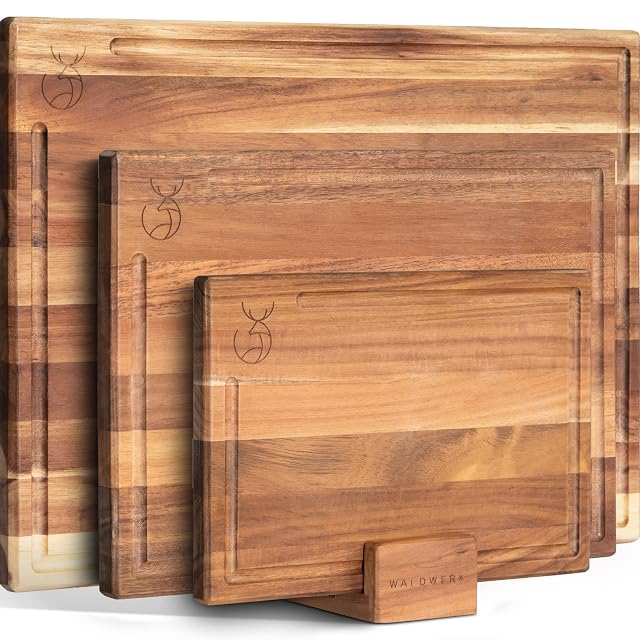
Three solid acacia cutting boards of 15.7 × 12, 13 × 9.5 and 10 × 7 in finished with natural beeswax rather than varnish or plastic coating, with a milled juice groove and an included board stand for quick drying, and a 60-day money-back guarantee
Three solid acacia boards finished in natural beeswax, with a drying stand and a 60-day refund.
Best for: A board kept for twenty years — the only finish on this shelf you can renew with confidence
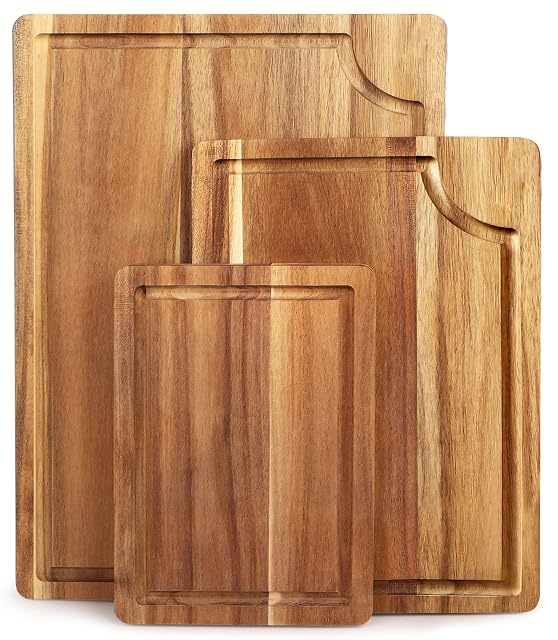
A three-piece set of 100 percent acacia wood cutting boards measuring 15 × 10, 12 × 8 and 9 × 6 in, with deep juice grooves on all three, stated to resist water and stains
Three solid acacia boards — 15 × 10, 12 × 8 and 9 × 6 in — with deep juice grooves, for twenty dollars.
Best for: Solid hardwood on a budget — real acacia for the price of a bamboo set