Mixing bowls
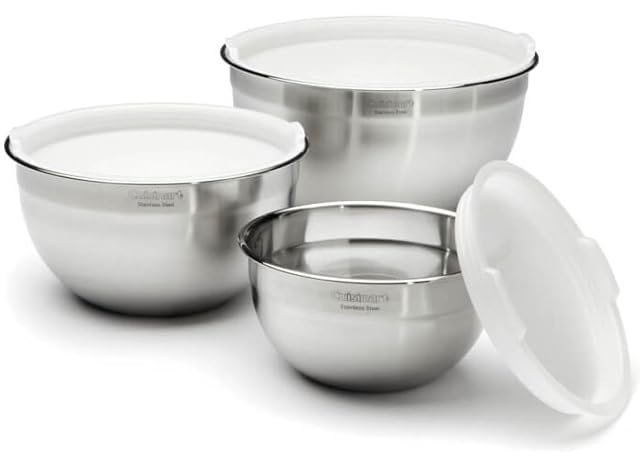
Cuisinart 1.5, 3, 5 qt, 1769 g (62.4 oz)
Three nesting steel bowls of 1.5, 3 and 5 quarts, fridge and freezer safe, at 1769 grams.
Specifications
- Pieces
- THREE bowls — 1.5, 3 and 5 quarts
- Material
- High-quality stainless steel, stated not to retain flavors
- Refrigerator
- Safe
- Freezer
- Safe
- Dishwasher
- Safe
- Storage
- Nesting
- Weight
- 1769 g (62.4 oz) for three — about 590 g (20.8 oz) a bowl
- Cost per bowl
- $13.00
- Same capacities as
- The OXO plastic set, $9.04 cheaper
- Microwave
- Not claimed — correctly, for steel
- Lids
- None, where six sets here have them
- Non-slip base
- None, where six sets here have one
- Pour spout
- None
- Warranty
- Not published by the maker
- Amazon reference
- B004YZEO9K
- EAN
- 0086279039842
What you are getting
Three nesting stainless steel bowls — 1.5, 3 and 5 quarts — dishwasher safe, refrigerator and freezer safe, stated not to retain flavors. 1,769 g (62.4 oz).
It claims the fridge and the freezer and stops there
Which is correct, and worth noticing on a shelf where claims are loose.
Safe for use in the refrigerator and freezer. No microwave claim — because metal does not belong in one. The same is true of all six steel sets here, and none of them claims it.
Glass is the material that does: both Pyrex sets publish microwave safety, as do two plastic sets. That is the honest reason to own glass alongside steel.
And steel does not retain flavors
Built for everyday mixing… without retaining flavors.
The real argument against plastic. A plastic bowl that has held a garlic dressing or a turmeric marinade keeps a trace of both; steel and glass do not.
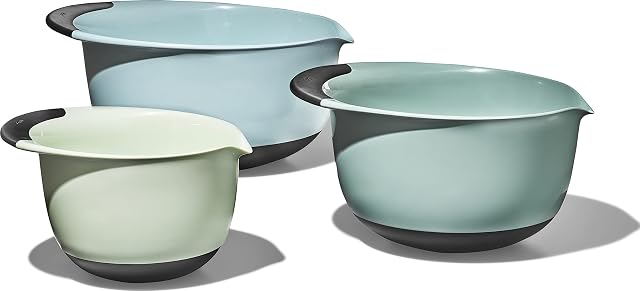
The same three sizes as the OXO plastic set
Cuisinart, steel — 1.5, 3, 5 qt — $38.99
OXO, plastic — 1.5, 3, 5 qt — $29.95
Nine dollars, and the cleanest material comparison on the shelf. OXO gives you a pour spout and a non-slip base; Cuisinart gives you no staining, no smell and the freezer.
One thousand seven hundred and sixty-nine grams
One of only three published weights here, and the useful one: about 590 g (20.8 oz) a bowl of steel, which is enough to resist spinning — which matters, because this set has no non-slip base.
What is not published
No lids, where six sets here have them. No non-slip base, which six have. No pour spout. No measurement marks. No warranty. Thirteen dollars a bowl, the second most expensive on this shelf.
Availability
On sale at around $39 on the American Amazon store at the time of checking.
Prices and availability are what Keepa reported on the date this page was updated; both move.
Prices quoted in this text were read on 4 October 2026. The live price is at the top of the page.
The questions that come in
Why does it not claim the microwave?
Because metal does not belong in one, and Cuisinart is right to stop at the freezer. The listing publishes "safe for use in the refrigerator and freezer" and no microwave claim — and the same is true of all six stainless sets on this shelf: not one claims it. Metal reflects microwaves rather than transmitting them, which at best heats nothing and at worst arcs against the oven wall. The materials that do go in are glass — both Pyrex sets publish it — and some plastics, with Zulay and COOK WITH COLOR claiming it here. That is the honest reason to own a glass bowl alongside a steel set rather than instead of one: you mix and chill in steel, and melt or warm in glass.
Is it worth nine dollars more than the OXO?
It is the cleanest comparison on the shelf, because the capacities match exactly: Cuisinart, steel, 1.5/3/5 qt, $38.99 against OXO, plastic, 1.5/3/5 qt, $29.95. What steel gives you is permanence: it never stains, never holds a smell, and does not warp in a dishwasher — which is how most plastic sets stop nesting. What OXO gives you is a pour spout and a non-slip base, neither of which any steel set here has, because a spout is molded and steel is pressed. So: if the bowls are for mixing and chilling and you expect to keep them twenty years, the steel. If they are for batter you pour out of, the plastic.
Does 1,769 grams tell you anything useful?
Yes — it is one of only three published weights on this shelf, and it works out at about 590 g (20.8 oz) a bowl, which is substantial for pressed steel. That matters here for a specific reason: this set has no non-slip base, where six of the thirteen sets do, and a light steel bowl spins on a worktop the moment a whisk bites. Mass is the only thing holding it still. For comparison, Viking publishes 2,722 g (96 oz) for ten pieces (bowls and lids) and Pyrex Colors 4,019 g (141.8 oz) for three glass bowls — about 1.3 kg (2.9 lb) each, which is why glass stays put. Boskermeal publishes 454 g (16 oz) for five steel bowls plus graters, which cannot be right.