What the maker puts in writing
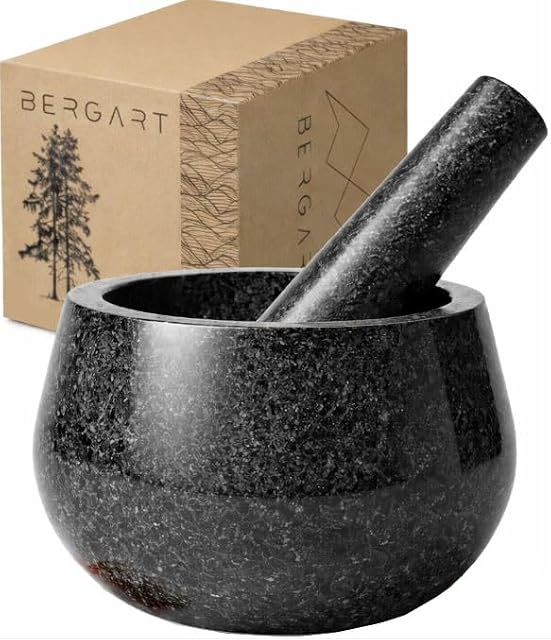
- “This granite mortar and pestle set features a compact three and three quarter inch diameter stone grinding bowl, perfectly sized for preparing spices, herbs, and aromatics in small kitchens”
- “crafted from durable granite stone with a polished exterior finish, providing long-lasting performance and traditional molcajete-style grinding capabilities”
- “includes a rough textured interior surface and ergonomically designed comfortable pestle that effectively crushes and grinds ingredients while releasing oils and enhancing flavors”
- “works perfectly for crushing garlic, ginger, pepper, herbs, vanilla, and other ingredients”
- “comes beautifully packaged in a stylish gift box”
The only listing here that gets the finish right in both halves
“a polished exterior finish”
“a rough textured interior surface”
That is exactly the correct combination, and nobody else on this shelf publishes both.
The outside is what you see and hold, so polish is right there.
The inside is the working surface, and a polished working surface is useless: food slides round the wall instead of being crushed against it. Grinding needs friction.
This is the thing most buyers get backwards — the instinct is to want the smoothest bowl available, which is the opposite of useful.
Across the fourteen listings here, six state an interior finish: this one, ChefSofi and PriorityChef (“unpolished granite”) and the three HIC porcelains (“textured interior”).
And two describe themselves only as “smooth” — the Fasolahome marble and the HPYNPES ceramic — without saying anything about the inside at all.
Granite, and why it beats the marble on this shelf
WALDWERK is the only listing here that explains the material choice: granite is one of the oldest and hardest rocks in the world. It hardly absorbs any water.
Granite is quartz and feldspar — around 6 to 7 on the Mohs scale.
Marble is calcium carbonate, around 3. So it is softer under the pestle, more absorbent, and it reacts with acid: lemon, vinegar and tomato etch a dull patch into it.
Two mortars on this shelf are marble: HIC’s Carrara, which correctly says hand wash… and dry thoroughly, and the Fasolahome, which says dishwasher safe — which it is not.
Granite asks for none of that care.
Three and three-quarter inches, which is a choice
Compact… perfectly sized for preparing spices, herbs, and aromatics in small kitchens.
And the named uses back it: garlic, ginger, pepper, herbs, vanilla. All small-quantity jobs.
A small bowl does those better than a big one. A single clove of garlic in an 8-inch molcajete slides about and never comes under the pestle properly.
For scale on this shelf: UMIEN is 8 inches and 3.5 cups, the two Priority Chefs 5.1 and 5.5 inches at 1.5 cups, HIC’s smallest porcelain 2.75 inches.
If you want salsa for four, buy a bigger bowl.
One thousand and seventy grams
Enough that you will not have to hold it, not enough to be immovable.
Weight is the functional specification on a mortar — a heavy bowl stays put, so both hands go to the pestle:
- 4,569 g (161.2 oz) — UMIEN · 3,200 g (112.9 oz) — ChefSofi
- 2,490 and 2,420 g (85.4 oz) — the Priority Chefs
- 1,270 g (44.8 oz) — Fasolahome · 1,070 g (37.7 oz) — this
- 862 g (30.4 oz) — Tera · 840 g (29.6 oz) — HPYNPES · 164 g (5.8 oz) — HIC’s small porcelain
ChefSofi states the benefit: as granite is inherently durable and heavy, this mortar will not slip on your kitchen counters.
The thing it says that most listings miss
releasing oils and enhancing flavors
Which is the actual argument for a mortar over a grinder. A blade cuts a spice; a pestle crushes it, rupturing the cells and releasing the volatile oils that carry the aroma. That is why pounded cumin smells different from blitzed cumin — and why ChefSofi draws the same contrast with “an electric grinder or crusher”.
What is not published
No pestle length — where HIC’s pour-spout mortar publishes 6.375 inches and both Priority Chefs 6.2 to 6.5. WALDWERK is the only maker here to name why it matters: a short pestle means your hand… collide[s] with the edge of the mortar.
No capacity in cups. No non-slip base and no countertop protectors, on a kilo of stone — where both Priority Chef listings include two protectors and say why, and both WALDWERK mortars sit on a wood base.
No warranty, like twelve of the fourteen here.
Availability
On sale at around $19 on the American Amazon store at the time of checking.
Prices and availability are what Keepa reported on the date this page was updated; both move.
Prices quoted in this text were read on 4 October 2026. The live price is at the top of the page.