What the maker puts in writing
- “Mortar and pestle set… has been used for THOUSANDS of years as THE way to crush, grind and powder herbs and dry spices. Contrary to an electric grinder or crusher…”
- “Use your mortar to pulverize nuts, seeds, ginger root and garlic and make homemade salad dressing, sauces and condiments”
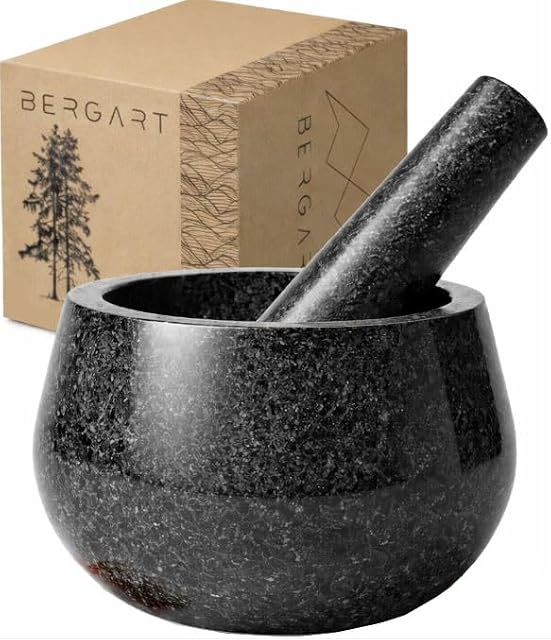
- “Made from unpolished granite, you will waste no time fumbling or stabilizing your pestle, as our mortar’s cup interior provides the best, metate-like natural [grinding surface]”
- “As granite is inherently durable and heavy, this mortar will not slip on your kitchen counters, remaining still throughout the grinding process. Our pestle offers foolproof grip, gliding across the mortar’s interior”
- “We want you to be absolutely elated… which is why we are offering you a Risk-Free purchase. In the unlikely event our set fails to meet or exceed your expectations, you are welcome to return it for a hassle-free [return]”
A metate is the flat volcanic-stone slab used for grinding in Mesoamerica — deliberately rough, so maize or cacao is abraded against it rather than sliding over it.
ChefSofi applies the word to its interior, and pairs it with the one that matters: unpolished.
That is the specification most buyers get backwards. You cannot grind on a smooth surface. A polished bowl lets food slide round the wall instead of being crushed against it.
At least six of the sixteen listings on this shelf state an interior finish. IMUSA publishes both halves properly — polished exterior finish and rough textured interior surface. PriorityChef says “unpolished grey granite”. HIC says “textured interior” on three porcelain mortars.
Two listings here describe themselves only as “smooth”.
And it states the benefit of mass
“As granite is inherently durable and heavy, this mortar will not slip on your kitchen counters, remaining still throughout the grinding process.”
Which is the clearest statement of why weight matters on a mortar, and nobody else on this shelf puts it so plainly.
A heavy bowl stays put, so both hands go to the pestle and you can lean your weight into the stroke. A light one slides, so one hand holds the bowl for the whole job.
At 3,200 g (112.9 oz) this is the second heaviest here:
- 4,569 g (161.2 oz) — UMIEN · 3,200 g (112.9 oz) — this
- 2,490 and 2,420 g (85.4 oz) — the two Priority Chefs
- 1,270 g (44.8 oz) — Fasolahome · 1,070 g (37.7 oz) — IMUSA · 907 g (32 oz) — HIC Carrara
- 164 g (5.8 oz) — HIC’s small porcelain
The right argument for a mortar over a machine
Contrary to an electric grinder or crusher…
The listing leaves the sentence half-finished, but the point behind it is sound and IMUSA completes it on this shelf: grinding releases oils and enhances flavors.
A blade cuts a spice. A pestle crushes it, rupturing the cells and releasing the volatile oils that carry the aroma. That is why pounded cumin smells different from blitzed cumin, and why a pesto made in stone tastes unlike one made in a processor.
The value question, honestly
$32.99 for a stated 2 cups — $16.50 a cup.
- $8.57 a cup — UMIEN, 8 in, 3.5 cups, 4,569 g (161.2 oz), $29.99
- $14.66 — PriorityChef, 1.5 cups, $21.99
- $16.50 — this
- $17.33 — Priority Chef Heavy, 1.5 cups, $25.99
So the UMIEN is more bowl, more stone and less money. What it does not do is state its interior finish at all, where this page describes it precisely. That is the trade.
Granite, on the merits
WALDWERK is the only listing here that explains the material: one of the oldest and hardest rocks in the world. It hardly absorbs any water.
Granite is 6 to 7 on the Mohs scale; the two marble mortars on this shelf are calcium carbonate at about 3 — softer, absorbent, and etched by lemon or vinegar.
The bullets, which are hard work
Across five bullets the page writes mortero, morter, pessel, motar, pedestal, mortor, mocajetes, pestal and moter.
Those are misspellings of “mortar and pestle” and “molcajete” that people type into a search box. It says something about how the listing was written and nothing about the stone, which is described accurately where it counts.
It does leave the guarantee vague — a Risk-Free purchase… a hassle-free [return], with no period stated — where WALDWERK on this shelf commits to 60 days, the full amount, without conditions.
What is not published
No diameter, so this cannot be placed against the 5.1, 5.5 and 8 inch bowls here. No pestle length, where WALDWERK explains why reach matters: a short pestle means your hand… collide[s] with the edge of the mortar.
No washing instruction, where UMIEN says hand wash — sensible for textured stone, which holds detergent.
No non-slip base and no countertop protectors, on 3.2 kg of unpolished granite. Both Priority Chef listings include two and say why: heavy stone could cause scratches to your countertop.
Availability
On sale at around $33 on the American Amazon store at the time of checking.
Prices and availability are what Keepa reported on the date this page was updated; both move.
Prices quoted in this text were read on 4 October 2026. The live price is at the top of the page.