What the maker puts in writing
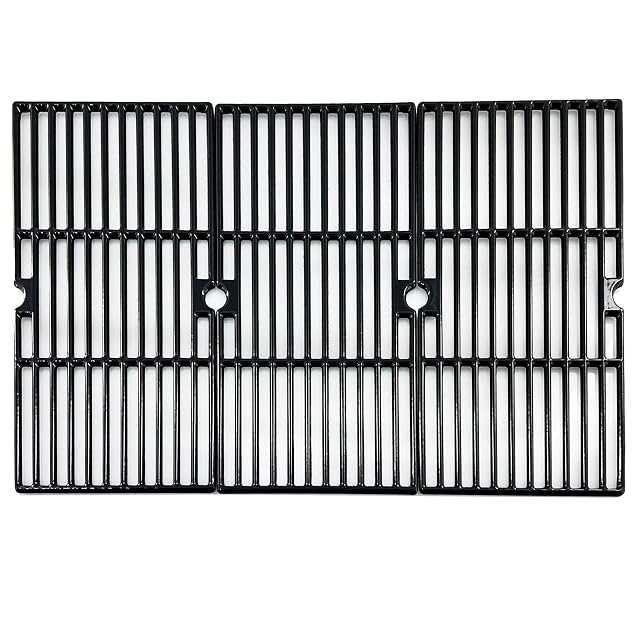
- “1 porcelain coated cast iron cooking grid”
- “Reversible design with a pointed side for professional searing marks and a concaved side to channel juices and promote vaporization”
- “Fits Broil King Baron 300/400/500 series 2013 and newer, Crown 300/400/500 series 2012 and newer”
- “17.5 in. x 6.17 in.”
Read the first bullet before the price
One cooking grid. Not a set.
At 17.5 × 6.17 inches that is about 108 square inches, and a three-burner Baron or Crown takes three of them — so the real cost is around $63 for 324 square inches.
Against the rest of this shelf:
- $0.068 an inch — Direct Store, three grids, 472 sq in, $31.99
- $0.080 — COGRICHBF, two grates, 450 sq in, $35.99
- $0.096 — QuliMetal set, 417 sq in, $39.99
- $0.194 — this, per grid
So this is not the entry price it looks like. The genuine cheap option on this shelf is the Direct Store three-grid set.
What it is instead: the only reversible grate here
A pointed side and a concave side, cast into one grid.
And both reasons given are mechanically right.
The pointed side concentrates contact pressure on a narrow apex. That is what makes a dark, hard sear line rather than a wide grey band — the same reason a hot pan browns better than a warm one.
The concave side is the more interesting one. Channel juices and promote vaporization.
On a round or flat bar, dripping fat falls straight through to the burner below. A concave bar is a shallow trough: it catches the fat, holds it on hot cast iron, and the fat vaporizes there and rises back up through the food.
That is where grill flavor comes from. No other grate on this shelf is designed for it.
Steaks on the pointed side. Chicken thighs and sausages on the concave side.
Porcelain coating, and the argument on this shelf
QuliMetal, a few dollars above this, states flatly that bare cast iron outperform[s] enamel-coated versions in heat retention, durability, and searing ability and won’t chip or rust easily.
The first half is defensible. Bare iron touches food directly with no glass layer, so it sears harder, and there is no coating to chip.
The last three words are not. Bare cast iron rusts — that is its one weakness. The two listings on this shelf that publish detailed anti-rust routines, COGRICHBF and KAMaster, are both for bare and coated iron respectively, and QuliMetal publishes none at all.
Porcelain coating trades a little searing for food release, easy cleaning and no rust. Its weakness is chipping, and a chip rusts.
Sixteen point eight grams per square inch
No listing here publishes a casting thickness, so the weight and area stand in for it:
- EasiBBQ — 18.1 g (0.6 oz)/sq in (the densest)
- This — 16.8
- Weber Crafted 7853 — 15.6
- Aura — 10.0 (the lightest)
Thickness is stored heat, which is what keeps a grate hot when cold food lands on it. This grid is well up that list for twenty-one dollars.
What is not published
No care instructions, where COGRICHBF publishes a standing-water limit and KAMaster six numbered anti-rust tips.
No warranty. Four bullets — the fewest on this shelf.
And it fits Broil King Baron and Crown only. For any other grill, nothing on this page applies.
Availability
On sale at around $21 on the American Amazon store at the time of checking.
Prices and availability are what Keepa reported on the date this page was updated; both move.
Prices quoted in this text were read on 4 October 2026. The live price is at the top of the page.
The questions that come in
How many do I need?
As many as your grill has grids, and the price only makes sense once you have counted. This listing is for one porcelain-coated cast iron grid measuring 17.5 × 6.17 inches — about 108 square inches. A three-burner Baron or Crown typically takes three of them, so the real cost is around $63 for 324 square inches, or nineteen cents an inch. For comparison on this shelf, the Direct Store three-grid set is $31.99 for 472 square inches — under seven cents an inch — and the COGRICHBF two-pack $35.99 for 450. So this is not the cheap option it looks like at $20.99. What it is, is the only grate here that gives you two cooking surfaces in one casting, and it is the correct part for a Broil King.
What does the concave side actually do?
It turns dripping fat into smoke, which is where grill flavor comes from, and Broil King is the only maker here to design for it deliberately. The bullet says the concave side "channel[s] juices and promote[s] vaporization". On a round or flat bar, fat drips straight through onto the burner or the flavourizer below. A concave bar is a shallow trough: it catches the fat, holds it on hot cast iron, and the fat vaporizes there and rises back through the food. That is the mechanism behind the taste people associate with grilling. The pointed side does the opposite job — a narrow apex concentrates contact pressure, so it makes a dark hard sear line instead of a wide grey band. Two different cooks, one casting, flipped over.
Is porcelain coating better than bare cast iron?
It depends which failure you mind more, and one listing on this shelf picks a fight about it. QuliMetal states that bare "solid cast iron grill grates outperform enamel-coated versions in heat retention, durability, and searing ability. They won’t chip or rust easily." The first half is defensible: bare iron touches the food directly with no glass layer between, so it sears harder, and there is no coating to chip. The last three words are not — bare cast iron rusts, which is its one weakness, and the two listings here that publish detailed anti-rust routines are both for bare iron. Porcelain coating trades a little searing for food release, easier cleaning and no rust; its own weakness is chipping, and a chip rusts.