What the maker puts in writing
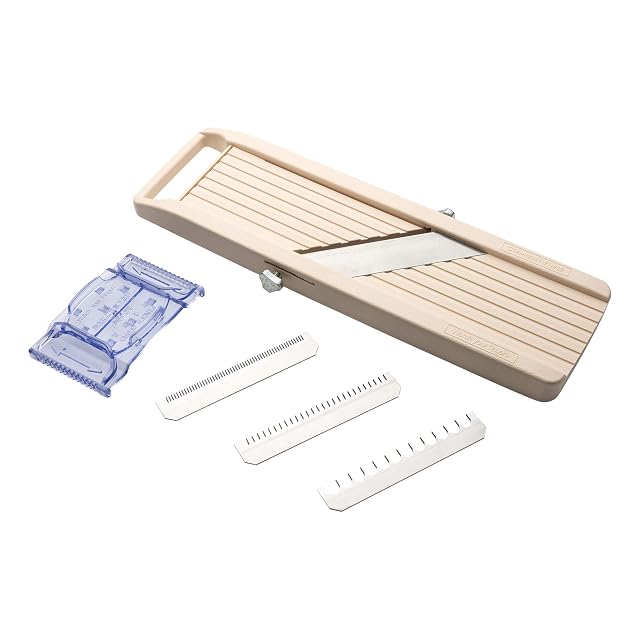
- “Benriner’s beige Mandoline Slicer creates wide slices, chunky cuts, and long narrow julienne strips that are equally sized to cook evenly”
- “Made with handcrafted Japanese stainless steel blades with BPA-free plastic body; measures 12.75 x 3.625-inches with 2.5-inch wide slicing surface”
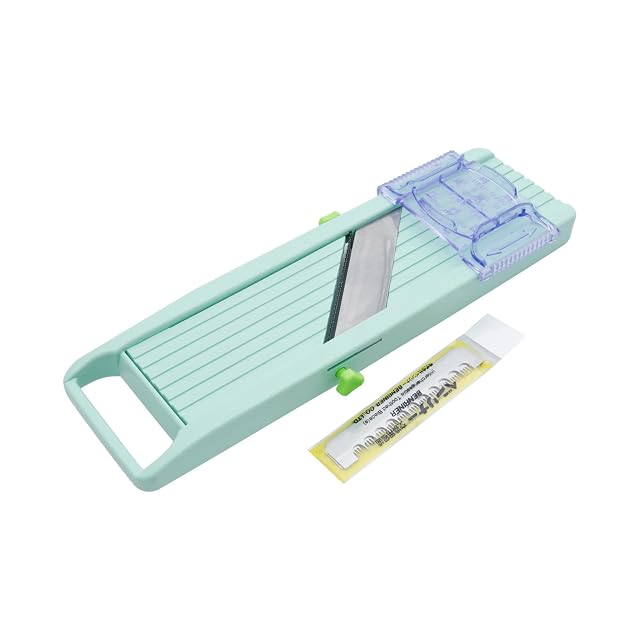
- “Includes 1 fixed straight blade, 3 interchangeable blades (coarse, medium, fine tooth), large open handle for comfort, and non-skid rubber base”
- “Safety guard holds smaller pieces and protects fingers; hooks onto bowls to collect slices; easy-turn dial adjusts thickness (0.5 to 8-millimeters)”
- “Ideal for chips, French fries, hash browns, stir fry, snacks, garnish, and more; disassembles for easy cleaning; top-rack dishwasher safe”
Half a millimeter
The one thickness a mandoline exists for, and nothing else on this shelf reaches it.
The dial runs 0.5 to 8 mm (0.02 to 0.31 in) — a sixteen-fold range, and the only setting here below 1 mm (0.04 in).
Half a millimeter is crisp thickness: potato that fries translucent, fennel and radish that collapse into a dressing, citrus thin enough to candy, raw beetroot you can see light through. No knife gets there consistently.
The rest of the shelf starts at 1 mm (0.04 in): Fullstar 1, 2, 3, 4 · OXO 1, 2.5, 4 on two models · Ibergrif 1, 2, 4 · Mueller Austria a dial from 1 to 9.
And at the far end, 8 mm (0.31 in) is chip thickness.
Two and a half inches, published
The only slicing surface width on this shelf, and the figure that decides what actually fits.
12.75 × 3.625 inches with 2.5-inch wide slicing surface.
That is narrow by design. A short blade is a rigid blade, which is why a Benriner cuts cleanly where a wide cheap mandoline flexes mid-stroke and gives you a wedge instead of a slice.
The cost is real: a large baking potato will not go across it, nor an aubergine, nor a swede. You halve them first — and a halved potato is harder to hold safely.
For wide produce, Gramercy’s steel-framed bench unit or the Mueller choppers. Twelve listings here publish no width at all.
Four blades, and what each is for
One fixed straight blade — flat slices, at whatever the dial says.
Three interchangeable toothed blades — coarse, medium and fine — which cut julienne at three widths.
The listing describes the result properly: long narrow julienne strips that are equally sized to cook evenly. That is the point of julienne rather than knife-cut strips — uniformity, so nothing burns while the rest is raw.
The things that make it usable
A safety guard that holds smaller pieces. A non-skid rubber base. Hooks onto bowls to collect slices. A large open handle. Disassembles for cleaning, and top-rack dishwasher safe.
Four listings here specify top-rack, which is the right qualification for a plastic body — the bottom rack runs hotter and nearer the element, and warps it.
Against the old version beside it
This — $29.99 — 346 g. Old version — $27.00 — 290 g.
Three dollars, and the old page publishes none of the above: no thickness range, no surface width, no body material, no guard, no base, no dishwasher statement. Four bullets, two of which are the product’s name.
Buy this one.
What is not published
No steel grade — “handcrafted Japanese stainless steel” is an origin. Only Gramercy (4CR15) and Fullstar (420) publish a grade here, and those are the same hardenable martensitic family.
No warranty. And note that a dial gives any thickness but no guaranteed return to the same one — which is what clicks are for.
Availability
On sale at around $30 on the American Amazon store at the time of checking.
Prices and availability are what Keepa reported on the date this page was updated; both move.
Prices quoted in this text were read on 4 October 2026. The live price is at the top of the page.
The questions that come in
Why does 0.5 mm (0.02 in) matter?
Because it is the one thickness a mandoline exists for and nothing else here reaches it. Benriner publishes an "easy-turn dial [that] adjusts thickness (0.5 to 8-millimeters)" — a sixteen-fold range, and the only setting on this shelf below 1 mm (0.04 in). Half a millimeter is crisp thickness: potato that fries translucent, fennel and radish that go limp in a dressing, citrus thin enough to candy, raw beetroot you can see through. No knife gets there consistently. For comparison, the rest of the shelf starts at 1 mm (0.04 in): Fullstar at 1, 2, 3, 4 mm (0.16 in), OXO at 1, 2.5, 4 on two models, Ibergrif at 1, 2, 4, Mueller Austria on a dial from 1 to 9. And at the other end, 8 mm (0.31 in) is thick enough for chips.
Is a 2.5 inch slicing surface a problem?
It is the real limit of the type, and Benriner is the only maker on this shelf honest enough to publish it. The listing gives "12.75 x 3.625-inches with 2.5-inch wide slicing surface" — so the runway the food passes along is two and a half inches across. That is narrow by design: it keeps the blade short, which keeps it rigid, which is why a Benriner cuts cleanly where a wide cheap mandoline flexes. The cost is that a large baking potato will not go across it, nor an aubergine, nor a swede — you have to halve them first, and a halved potato on a mandoline is harder to hold. For wide produce the Gramercy steel-framed bench unit or the Mueller choppers are the alternatives. Twelve listings here publish no width at all.
Dial or clicks?
A dial gives you any thickness; clicks give you the same thickness twice. Benriner and Mueller Austria (1 to 9 mm (0.04 to 0.35 in)) are the two continuous dials here. Fullstar (four settings), OXO (three, on two models) and Ibergrif (three) are discrete. The case for clicks is repeatability: a gratin wants 2 mm (0.08 in) on Monday and 2 mm (0.08 in) again on Friday, and a click delivers that without judgment. The case for a dial is reach and precision: only a dial gets you to 0.5 mm (0.02 in), and only a dial lets you split the difference when 2 mm (0.08 in) is slightly too thin for what you are doing. In practice a dial with a scale you can read is the better tool, and this is the one with the widest scale on the shelf.