What the maker puts in writing
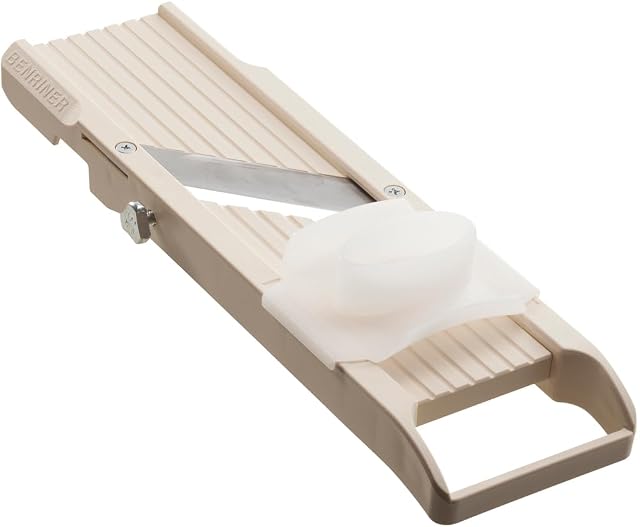
- “Benriner Mandolin Slicer”
- “Adjustable blade makes slices of varying thickness; Ranging from fine to medium”
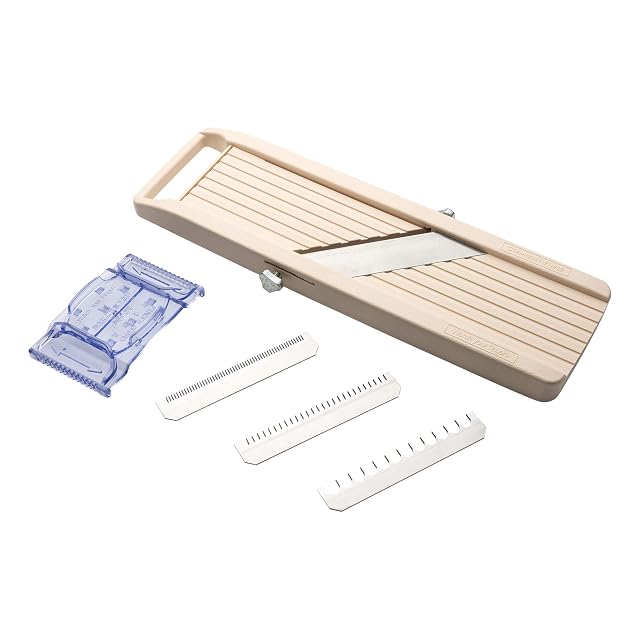
- “Also with the coarse replaceable blades the Benriner is capable of cutting slices of three different sizes”
- “Benriner Vegetable Slicer”
Four bullets, two of which are the product’s own name.
Buy the current version instead
Benriner has two listings on this shelf, three dollars apart, and the newer one publishes nearly everything this one leaves out:
This — old version — $27.00 — 290 g
Four-blade current version — $29.99 — 346 g
What the current page adds:
- a thickness dial from 0.5 to 8 mm (0.02 to 0.31 in) — the widest range on this shelf, and the only setting below 1 mm (0.04 in)
- a published 2.5-inch slicing surface width — the only one on the whole shelf
- a BPA-free plastic body
- a safety guard that holds smaller pieces
- a non-skid rubber base
- the ability to hook onto bowls to collect slices
- top-rack dishwasher safety
- one fixed straight blade plus three interchangeable toothed blades: coarse, medium, fine
This page offers an adjustable blade, coarse replaceable blades, and the name twice.
Why a Benriner is worth having
Not the features — the blade and the runway.
A Benriner is a narrow flat plastic body with a Japanese stainless steel blade set across it and a dial that raises or lowers the bed. It is simple, rigid, and the edge is genuinely sharp in a way most inexpensive mandolines are not.
The current version publishes the number that explains the type: a 2.5-inch wide slicing surface. Narrow by design.
That narrowness is the trade. It will not take a large potato broadside or an aubergine — for those, Gramercy’s steel-framed bench unit or the Mueller choppers on this shelf. In exchange you get something light, rigid, cheap to re-blade and quick to clean.
Two Benriner listings here publish an origin rather than a grade — “handcrafted Japanese stainless steel”. Only Gramercy (4CR15) and Fullstar (420) publish an actual grade on this shelf, and those are the same hardenable family.
And the guard this page does not mention
The current version states one: safety guard holds smaller pieces and protects fingers. This listing says nothing.
That matters because a mandoline is the commonest source of serious cuts in a home kitchen. The blade is fixed and razor sharp, and the injury comes at the last slice — when what is left is too small to hold and the fingertips pass over the edge. A Benriner’s edge is keener than most.
Eleven of thirteen listings here describe a holder. The serious ones:
Gramercy — cut-resistant gloves in the box, the only listing that does.
Joseph Joseph — three grips: pinch for small, center for round, flat for long.
Fullstar — steel-tipped guard rather than plastic.
Ibergrif — a blade lock for storage and cleaning.
Buy a cut-resistant glove with whatever you choose.
What is not published
No thickness range in millimeters (“fine to medium”). No slicing surface width. No body material. No non-skid base stated. No dishwasher statement. No warranty.
Two hundred and ninety grams, which puts it among the handhelds here (70 to 350 g (2.5 to 12.3 oz)) rather than the bench units (921 to 1,324 g (32.5 to 46.7 oz)).
Availability
On sale at around $27 on the American Amazon store at the time of checking.
Prices and availability are what Keepa reported on the date this page was updated; both move.
Prices quoted in this text were read on 4 October 2026. The live price is at the top of the page.
The questions that come in
Should I buy this or the current version?
The current one, for three dollars. Benriner has two listings on this shelf: this old version at $27.00 and the four-blade current version at $29.99 — and the newer page publishes almost everything this one omits. The current version gives you a thickness dial from 0.5 to 8 mm (0.02 to 0.31 in) (the widest range on this shelf and the only setting below 1 mm), a published 2.5-inch slicing surface width (the only one here at all), a BPA-free plastic body, a safety guard, a non-skid rubber base, the ability to hook onto bowls, top-rack dishwasher safety, and one fixed plus three interchangeable blades (coarse, medium, fine). This listing publishes an adjustable blade, coarse replaceable blades, and the words "Benriner Mandolin Slicer" twice.
Why is a Benriner worth having at all?
Because it is the slicer professional kitchens use, and the reason is the blade and the runway rather than the features. A Benriner is a narrow flat plastic body with a Japanese stainless blade set across it and a dial that raises or lowers the bed — simple, rigid, and the blade is genuinely sharp in a way most cheap mandolines are not. The current version publishes the detail that explains the type: a 2.5-inch wide slicing surface, which is narrow by design. That narrowness is the trade — it will not take a large potato broadside or an aubergine, where Gramercy’s steel-framed bench unit or the Mueller choppers will — and in exchange you get a tool that is light, rigid, cheap to re-blade and easy to clean.
Does it have a hand guard?
This listing does not say, and the current version does: "safety guard holds smaller pieces and protects fingers." That omission matters because a mandoline is the commonest source of serious cuts in a domestic kitchen — the blade is fixed and razor sharp, and the injury comes at the last slice, when what is left is too small to hold. A Benriner in particular is known for an exceptionally keen edge. At least eleven of the eighteen listings on this shelf describe a holder of some kind, and the best go further: Gramercy includes cut-resistant gloves, Joseph Joseph supplies three grip styles, Fullstar fits steel tips, Ibergrif adds a storage blade lock. Buy a cut-resistant glove with any of them.