What the maker puts in writing
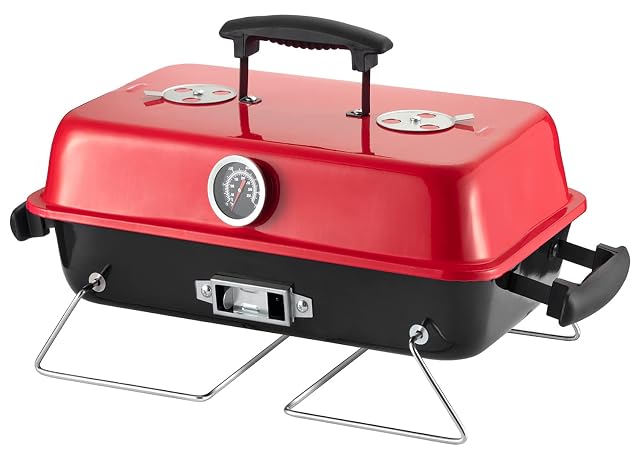
- “Made from high-quality rust-resistant, heat-resistant, and scratch-proof stainless steel”
- “Enjoy a generous 17.3″ x 11.4″ (45.9 x 27.4 cm (18.1 × 10.8 in)) grilling space, ideal for burgers, steaks, fish, hot dogs, corn, vegetables, and more”
- “This foldable charcoal grill requires no assembly; simply unfold the legs for instant outdoor grilling”
- “Split design and food-grade stainless steel cooking grid allow effortless grease management and quick cleaning”
- “Features five side vents to regulate airflow, promoting efficient charcoal burning and even heat distribution”
Ten cents a square inch
The cheapest cooking area on this shelf by a long way.
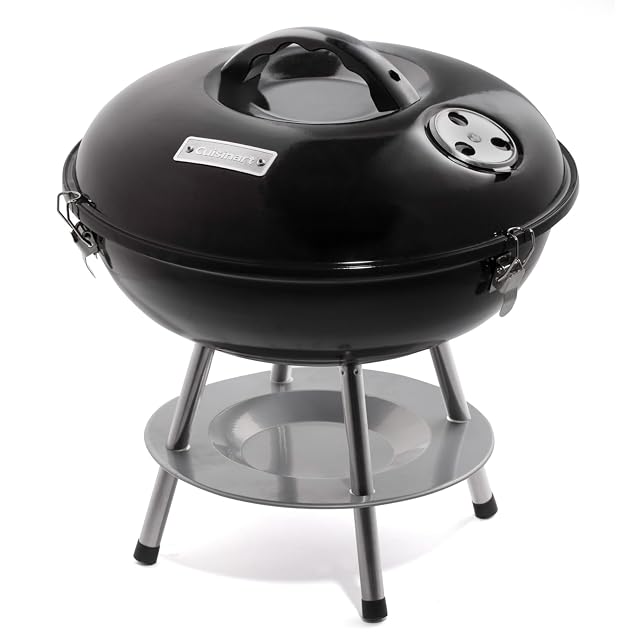
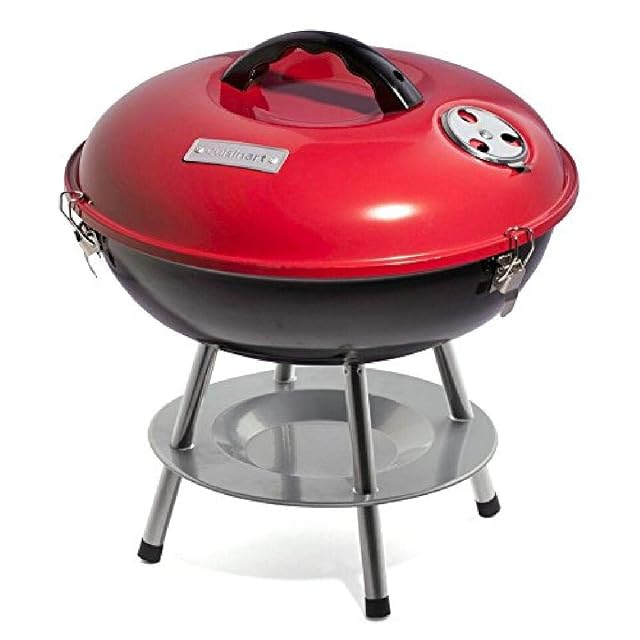
17.3 × 11.4 inches is about 197 square inches — effectively the same as the two Cuisinart grills here, which publish 196 sq in and cost twice as much.
Against the rest:
- $0.10 — this, 197 sq in
- $0.20 — Cuisinart, 196 sq in
- $0.33 — Royal Gourmet, 303 sq in including its warming rack
- $0.38 — Feasto, 265.5 sq in of actual grilling
- $0.91 — Oklahoma Joe’s, 218 sq in
Nine times the price per inch between the two ends of this shelf.
Five vents, which is the most here
More than the two Cuisinarts (“dual vents”), more than the Royal Gourmet (two dampers), and more than the $199 Oklahoma Joe’s, which publishes no vent count at all.
On an open grill, side vents feed the coals from the sides. Five of them give an even bed rather than a hot spot over one hole, which is a real benefit on a long narrow firebox.
What they cannot do is throttle the fire. A fire with no lid has unlimited exhaust, so closing the intakes does not slow it much — the coals keep burning from above.
Airflow control needs a lid. Which brings us to the real limit.
No lid
The honest boundary of a twenty-dollar grill. What you have is a brazier: coals below, food above, heat going straight up.
That cooks burgers, sausages, skewers, corn and fish very well — and that is most of what anyone actually grills at a picnic table.
What it cannot do:
Nothing indirect. No roasting a chicken. No holding 250 °F for ribs. No smoking. No closing the lid to finish a thick steak after searing it.
The Royal Gourmet on this shelf describes the configuration that does control a fire: two air dampers, one on the main body and the other on the top lid. An intake and an exhaust. That is the pair.
Stainless rather than painted steel
Worth something at this price. The cheap alternative in this category is painted mild steel, which blisters off around the firebox in a season and then rusts.
Minxchen claims rust-resistant, heat-resistant, scratch-proof stainless, with a food-grade stainless cooking grid and a split design so the grease and ash parts come apart to wash.
The Zarkind at $39.90 is the other stainless grill here, and it adds a fitted oxford carry bag and a flat-fold structure.
The dimension that cannot be right
The catalog lists 50 × 50 × 50 mm (1.97 × 1.97 × 1.97 in) — a two-inch cube — for a grill whose own bullet gives a 17.3 by 11.4 inch surface.
That is a placeholder, not a measurement, so this page tells you nothing about how slim it folds. The Zarkind publishes 671 × 210 × 205 mm (26.4 × 8.27 × 8.07 in), about eight inches thick, if packed size is what you are buying for.
No weight published either, on a shelf that runs from a stated four pounds to twenty-two kilograms.
No warranty — true of seven of the eight grills here. Only the Oklahoma Joe’s publishes one.
Availability
On sale at around $18 on the American Amazon store at the time of checking.
Prices and availability are what Keepa reported on the date this page was updated; both move.
Prices quoted in this text were read on 4 October 2026. The live price is at the top of the page.
The questions that come in
How much does having no lid cost you?
Everything except direct grilling, and it is the honest limit of a twenty-dollar grill. Without a lid you have a brazier: coals underneath, food above, heat going straight up into the air. That cooks burgers, sausages, skewers, corn and fish very well, which is most of what anyone grills at a picnic table. What it cannot do is anything indirect — no roasting a chicken, no holding 250 °F for ribs, no smoking, and no finishing a thick steak after the sear. The five vents also only work in one direction: they are all intake, because there is no lid to have an exhaust in. Compare the Royal Gourmet on this shelf, which describes the pair that actually controls a fire — "one on the main body and the other on the top lid".
Is five vents better than two?
More intake, yes; more control, not necessarily. Minxchen publishes "five side vents to regulate airflow", which is the highest count on this shelf — the two Cuisinarts have "dual vents", the Royal Gourmet two dampers, and the $199 Oklahoma Joe’s publishes no vent count at all. On an open grill, side vents feed air to the coals from the sides, and five of them give an even bed of heat rather than a hot spot over a single hole. That is genuinely useful. What they cannot do is throttle the fire down, because a fire with no lid has unlimited exhaust: close the side vents on an open grill and the coals still burn from above. Airflow control needs a lid.
Can it really measure 50 mm (1.97 in)?
No, and it is worth naming rather than repeating. The catalog lists this grill at 50 × 50 × 50 mm (1.97 × 1.97 × 1.97 in) — a two-inch cube — for a product whose own bullet publishes a grilling surface of 17.3 × 11.4 inches. That is a placeholder rather than a measurement, so there is no way to tell from this page how slim it folds. The Zarkind on this shelf publishes a credible folded figure — 671 × 210 × 205 mm (26.4 × 8.27 × 8.07 in), so about eight inches thick — and includes a carry bag. If packed size is what you are buying for, that is the one with the numbers. No weight is published here either, where the shelf runs from a stated 4 lb Cuisinart to a 22 kg (48.5 lb) Oklahoma Joe’s.