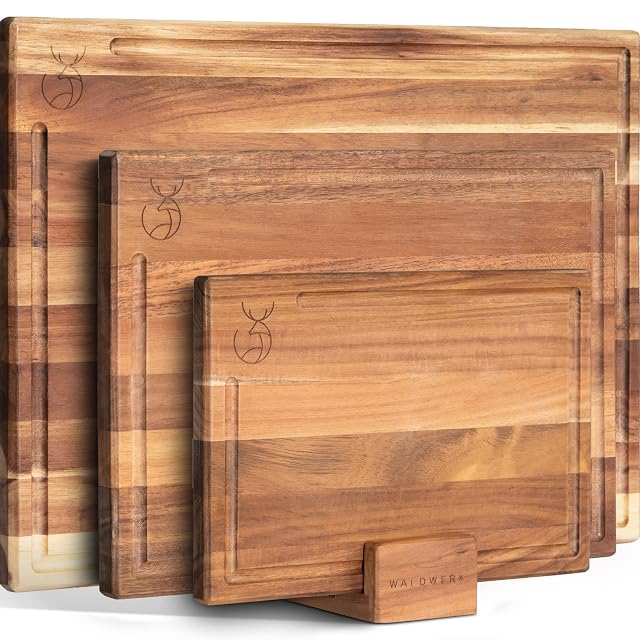
“Crafted from durable acacia wood with a warm, modern grain that stays counter worthy between uses”
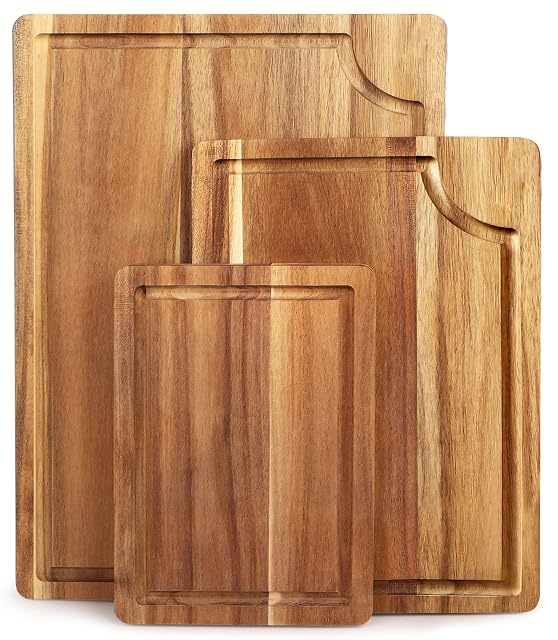
“Set includes large (15.7 × 11.8″), medium (13 × 9.5″), and small (10.2 × 7″) boards”
“Built-in juice grooves catch liquids from meats and fruits… All boards include serving compartments. A bonus storage stand keeps your boards dry, organized, and easy to [reach]”
“These boards resist cracking and warping over time. Acacia wood is naturally strong yet gentle on knife blades”
“A deep juice groove catches drippings from meat, fruit, and vegetables before they reach your counter, while non slip feet keep the board steady during heavy chopping”
The only non-slip feet on this shelf
One board in nine. And it is the feature a wood board needs more than people expect.
A wet acacia board at 2.3 lb (1.1 kg) has less grip on a wet countertop than its weight suggests, and a sliding board with a knife on it is the one genuine hazard in this category. Feet also lift the board off the counter, so air gets underneath and the underside dries.
The cost is that a board with feet on one face cannot be used on the other. Only Farberware on this shelf is reversible, and it publishes neither feet nor a juice groove — that is the trade it made.
A stand, and the right reason for it
“A bonus storage stand keeps your boards dry, organized, and easy to [reach]”
Dry comes first, and that is correct.
A board left flat — on a countertop, or propped against a wall — dries on one face while the other stays damp, and that moisture difference across the thickness makes it cup. Within a week it rocks on the counter.
WALDWERK, the only other board here with a stand, says exactly the same: for quick drying and elegant storage. Those two are the most expensive boards on this shelf, and they are the two that solve the problem.
Allsum describes it from the other end: keep it away from humid environment when storage.
Solid acacia, which is the real material
Five of the nine boards on this shelf are bamboo — a grass, sliced into strips and glued side by side, with glue lines that open up after a dishwasher cycle or a damp winter.
Acacia is solid hardwood. No glue lines. And it is slightly softer than bamboo, which is better for knives: an edge is blunted by what it cuts into, and bamboo measures harder than maple.
At 2.3 lb (1.1 kg) a board this is nearly twice the mass per board of the bamboo sets here (Royal Craft Wood’s are 619 to 621 g (21.8 to 21.9 oz)). Only WALDWERK is heavier, at 3.2 lb (1.4 kg).
Sixteen sixty-five a board
$4.25 — Farberware, four bamboo · $6.66 — AIDEA, three acacia
$9.98 — Royal Craft Wood, three bamboo · $13.97 — Allsum, one 18 in board
$16.65 — this · $20.00 — WALDWERK, three acacia
So the comparison that matters is with AIDEA: the same material, the same three sizes, the same juice grooves, for thirty dollars less. What the thirty dollars buys is the feet, the stand, the serving compartments and a published weight.
What is not published
No finish. That decides whether a board can be maintained: oil and wax soak in and can be renewed indefinitely, where a varnish sits on top, chips, and lets water underneath where nothing reaches it. WALDWERK is the only listing here to address it — natural beeswax, and “no cheap varnish or plastic coating”.
No care instructions at all. Solid wood must never go in a dishwasher, and Allsum is the only board on this shelf to say so outright.
Buy food-grade mineral oil and treat it monthly.
No warranty — Royal Craft Wood offers one year and WALDWERK sixty days.
Availability
On sale at about $45 on Amazon.com when we read the listing on October 31, 2026.
Price and availability were read on Amazon.com on October 31, 2026; both move.
Prices quoted in this text are dated readings and can differ from the live price in the buy box.
What we rate, and what we do not
Strengths
The only board on this shelf with non-slip feet, which is what a wet countertop actually needs
A stand included, and the listing names drying as the reason rather than tidiness
Solid acacia at 1,058 grams a board — nearly twice the mass per board of the bamboo sets here
Compromises
Non-slip feet on one face mean the board cannot be used the other way up
No finish and no care instructions published, on solid hardwood
Sixteen sixty-five a board, against $6.66 for the acacia set at the bottom of this shelf
Specifications
Pieces
THREE boards — large 15.7 × 11.8, medium 13 × 9.5, small 10.2 × 7 in
Cost per board
$16.65
Material
Solid acacia wood — a hardwood, not a laminate
Non-slip feet
Yes — the only board on this shelf with them
Stand
A bonus storage stand, to keep the boards dry and organized
Juice grooves
Deep, catching drippings before they reach the counter
Serving compartments
On all boards
Durability
Stated to resist cracking and warping over time
On knives
Stated naturally strong yet gentle on blades
Weight
7.0 lb (3.2 kg) for three — 2.3 lb (1.1 kg) a board
Stacked dimensions
17.3 × 13 × 4.33 in (440 × 330 × 110 mm)
Finish
Not published by the maker
Care instructions
None published
Dishwasher
Not stated
Warranty
Not published by the maker
Amazon reference
B0DP3DDM89
EAN
8594213221243
The questions that come in
Why does a stand matter more than it sounds?
Because it is how a wood board survives. A board left flat — on a countertop, or stood against a wall — dries on one face while the other stays damp, and the moisture difference across the thickness makes it cup. Within a week it rocks. EDELHAUS states the right reason: the stand "keeps your boards dry, organized, and easy to [reach]" — drying first. WALDWERK, the other board here with a stand, says the same: "for quick drying and elegant storage". Those are the two most expensive boards on this shelf, and they are the two that solve the problem. Allsum describes it from the other end: "keep it away from humid environment when storage". On a board with no stand, prop it on edge against a tile.
Are non-slip feet worth losing reversibility?
On a wood board, probably yes — and this is the only one here that offers the choice. Feet lift the board off the counter, which does two good things: they stop it sliding while you chop, and they let air under so the underside dries. The cost is that a board with feet on one face cannot be used on the other face flat, so it is not reversible. On this shelf only Farberware is reversible, and it publishes neither feet nor a juice groove — that is the trade it made. The reason feet matter more on wood than on plastic is weight and friction: a wet acacia board at 2.3 lb (1.1 kg) has less grip on a wet countertop than you expect, and a sliding board with a knife on it is the one real hazard here.
Is it worth $30 more than the cheap acacia set?
For the feet and the stand, arguably. The three acacia sets on this shelf are AIDEA at $24.99, this at $44.95 and WALDWERK at $59.99 — all three-piece, all solid acacia, all with juice grooves, and with near-identical board sizes. What this adds over AIDEA: non-slip feet (unique here), a storage stand, serving compartments, and a published 7.0 lb (3.2 kg). What it still does not publish is a finish or any care instruction, both of which WALDWERK does — natural beeswax, with "no cheap varnish or plastic coating", plus a 60-day refund. So AIDEA is the bare wood, this is the bare wood with the right accessories, and WALDWERK is the one that tells you how it is finished.
Our score
8.1/ 10
The only board on this shelf with non-slip feet, plus a storage stand that the listing correctly says is there to keep the boards dry. Three solid acacia boards at 3,175 grams, with serving compartments.
This one against the other cookware and knives
Close prices, same category: comparable cookware and knives. We keep only the specifications all of them publish, because a column with gaps compares nothing.
Model
Price
Pieces
Cost per board
Material
Non-slip feet
EDELHAUS Acacia 3-Piece with Stand
$45
THREE boards — large 15.7 × 11.8, medium 13 × 9.5, small 10.2 × 7 in
Specifications: the manufacturer sheet for cookware and kitchen knives and the matching Amazon product page. Prices and availability: Keepa. Every figure on this page names its source.
Three solid acacia cutting boards of 15.7 × 12, 13 × 9.5 and 10 × 7 in finished with natural beeswax rather than varnish or plastic coating, with a milled juice groove and an included board stand for quick drying, and a 60-day money-back guarantee
Three solid acacia boards finished in natural beeswax, with a drying stand and a 60-day refund.
Best for: A board kept for twenty years — the only finish on this shelf you can renew with confidence
A three-piece set of 100 percent acacia wood cutting boards measuring 15 × 10, 12 × 8 and 9 × 6 in, with deep juice grooves on all three, stated to resist water and stains
Three solid acacia boards — 15 × 10, 12 × 8 and 9 × 6 in — with deep juice grooves, for twenty dollars.
Best for: Solid hardwood on a budget — real acacia for the price of a bamboo set
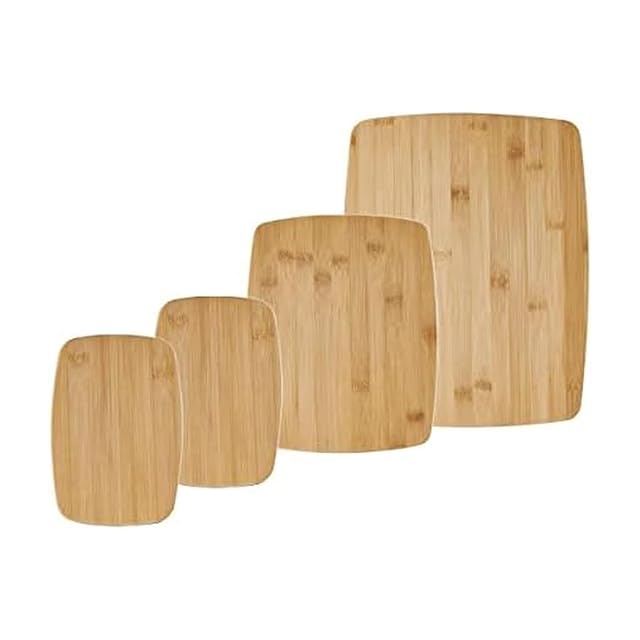
A four-piece bamboo cutting board set with a reversible surface on each board, stated harder and more durable than traditional wood, to be hand washed in warm water with mild detergent and dried immediately
Four reversible bamboo boards for seventeen dollars — the cheapest per board on this shelf.
Best for: A kitchen that wants four boards and will flip them — raw on one side, bread on the other