What the maker puts in writing
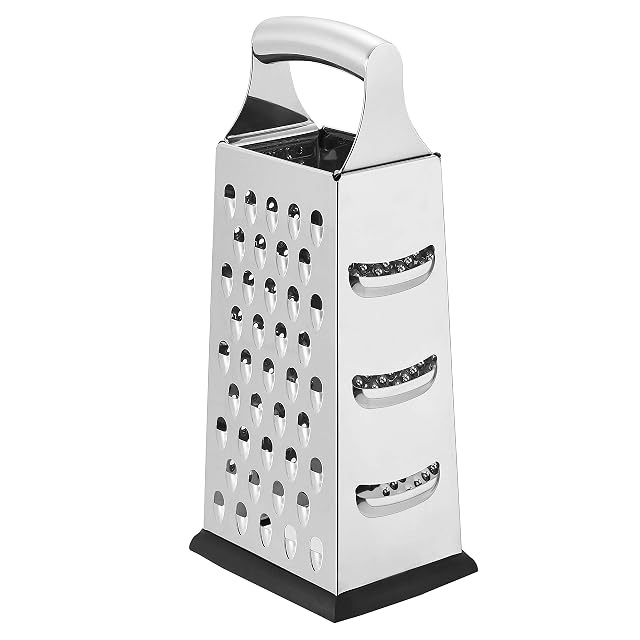
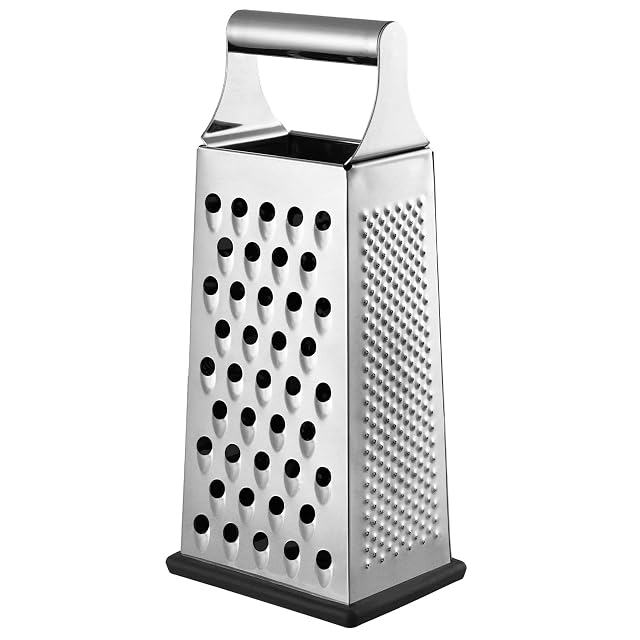
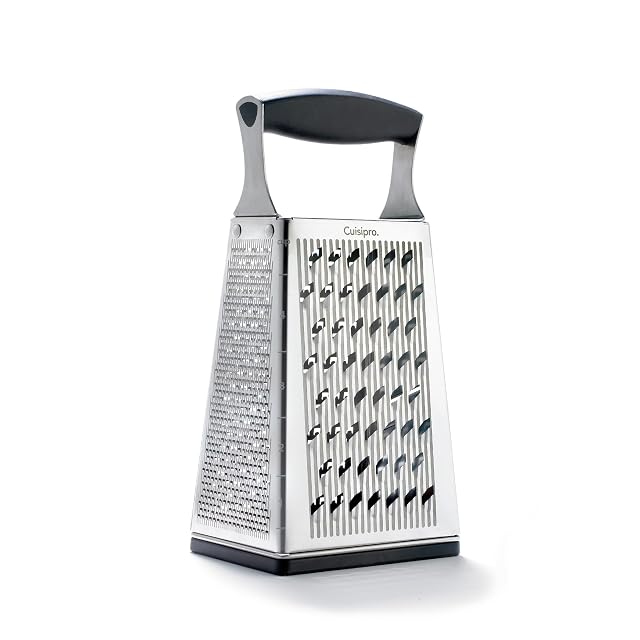
- “Made of 304 stainless steel (95%), the heavy-duty cheese graters provide rugged strength and long-lasting performance”
- “Coarse, medium, and fine grating surfaces, and slicing surface. Sharp stainless-steel shredding holes on 4 sides”
- “the comfortable non-slip handle provides a safe, secure grip and ultimate control”
- “Black TPE material (5%) on the base helps keep the grater securely in place while in use. Attachable container for catching, measuring, and storing freshly grated foods”
- “works well for grating cheese and hard or soft vegetables… Dishwasher-safe”
The only material breakdown on this shelf
Ninety-five per cent 304 stainless steel, five per cent TPE.
No other grater here publishes a composition. Three publish a steel grade — this, Cuisipro and WALDWERK, all 304 — and the remaining ten say only “stainless steel”.
That matters more than it sounds. 304 is the standard food-grade austenitic grade, with nickel in it, and it resists corrosion at cut edges — which is precisely where a grater is exposed, because every hole in it is a cut edge.
The cheaper grade sold as stainless is 430: ferritic, no nickel, magnetic, and it will freckle with rust along the punched edges after enough dishwasher cycles.
For a ten-dollar grater to publish 304 and then give the percentage is unusual.
Thirty-three grams per dollar
The most metal for the money on this shelf, by a third:
- 33.1 g (1.2 oz)/$ — this, 330 g (11.6 oz), $9.98
- 25.7 — Spring Chef standard · 22.9 — KitchenAid Gourmet · 22.8 — GORILLA GRIP
- 20.3 — Martha Stewart · 20.0 — KitchenAid 4-Sided
- 15.6 — WALDWERK (includes an oak base)
- 13.5 — Cuisinart · 11.4 — KitchenAid measuring · 11.2 — Cuisipro
- 10.3 — Norpro
Mass on a box grater is panel stiffness. A thin-gauge grater flexes when you press a hard block of cheddar against it, and a flexing panel makes the cutting edges skip — which is what “feels blunt” usually is.
The base does two jobs and the listing names one
Black TPE material on the base helps keep the grater securely in place.
True and important: a grater that slides is both irritating and a real risk, because your other hand is pushing cheese against a sharp surface.
The second job goes unmentioned here, and Spring Chef names it on this shelf: a rubber bottom also prevents food from escaping out the bottom of the grater. An open-bottomed box on a board lets grated cheese squirt out underneath, which is where half of it goes.
And GORILLA GRIP adds the detail both of them miss: its border is removable for cleaning, because a fixed rubber rim traps cheese where no brush reaches.
Four sides, like all thirteen
Coarse, medium, fine and a slicer. Every grater on this shelf has the same four, so the function is not what separates them.
What is not published
The blade process. Only WALDWERK on this shelf addresses it, and does so by naming the alternative: other manufacturers cheaply stamp the blades out of the material. We etch them. The difference is real — a stamped hole cuts with the burr raised around it, which folds over and dulls, while an etched edge is chemically formed and defined. Twelve listings here, including this one, do not say.
The container capacity, and no graduations are described. KitchenAid’s 4-Sided grater is the only one on this shelf that publishes a volume: three cups.
No warranty. Only WALDWERK (60 days unconditional) and one of the three KitchenAid listings publish one.
Availability
On sale at around $10 on the American Amazon store at the time of checking.
Prices and availability are what Keepa reported on the date this page was updated; both move.
Prices quoted in this text were read on 4 October 2026. The live price is at the top of the page.
The questions that come in
Why does 304 stainless steel matter?
Because "stainless steel" on its own covers grades that behave very differently, and ten of the thirteen graters on this shelf give no grade at all. 304 is the standard food-grade austenitic grade — the one with nickel in it — and it resists corrosion at cut edges, which is exactly where a grater is vulnerable: every hole is a cut edge. The cheaper alternative sold as stainless is 430, a ferritic grade with no nickel, which is magnetic and will show rust spots along the punched edges after enough dishwasher cycles. Only Urbanstrive, Cuisipro and WALDWERK publish 304 here. This one goes further than either and gives the whole composition: 95 per cent 304 stainless steel and 5 per cent TPE, which is unusually precise for a ten-dollar product.
How does it compare on metal for the money?
It leads this shelf, and by a clear margin. At 330 g (11.6 oz) for $9.98 that is 33.1 grams of grater per dollar. The rest: Spring Chef’s standard model 25.7, KitchenAid’s Gourmet 22.9, GORILLA GRIP 22.8, Martha Stewart 20.3, KitchenAid’s 4-Sided 20.0, WALDWERK 15.6 (which includes an oak base), Cuisinart 13.5, Norpro 10.3. Mass on a box grater is panel stiffness — a thin-gauge grater flexes under a hard block of cheese, which makes the cutting edges skip and the whole thing feel vague. It is not the only thing that matters: how the blades are cut matters more, and this listing does not say. But at this price nothing else gives you as much.
What is the TPE base for?
Two jobs, and this listing names one of them. TPE is a soft thermoplastic elastomer, and Urbanstrive states the obvious use: it "helps keep the grater securely in place while in use". A box grater that slides on a worktop is both annoying and genuinely a risk, because your other hand is pushing a block of cheese against a sharp surface. The second job goes unmentioned here and Spring Chef names it on this shelf: a rubber bottom "also prevents food from escaping out the bottom of the grater". An open-bottomed box on a board lets grated cheese squirt out underneath. The other detail worth having is GORILLA GRIP’s: its border is removable for cleaning, because a fixed rubber rim traps cheese where no brush reaches.