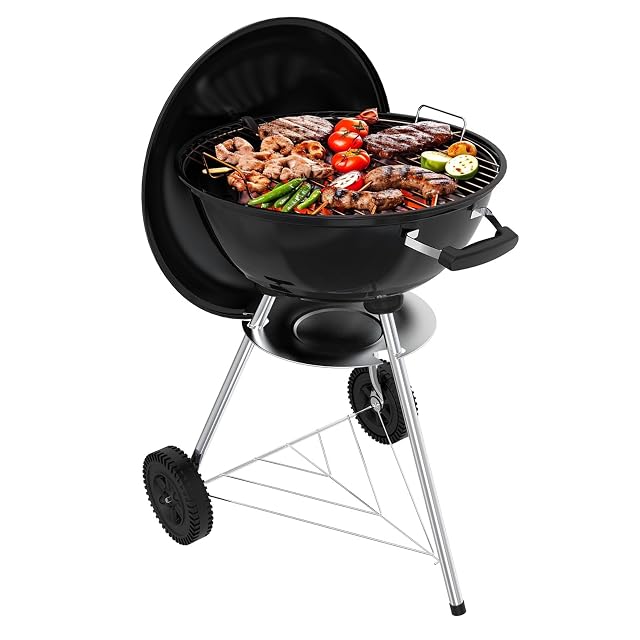
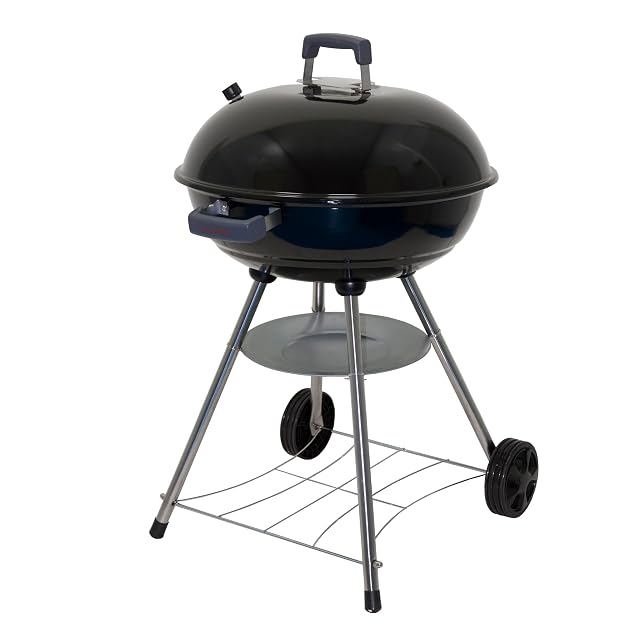
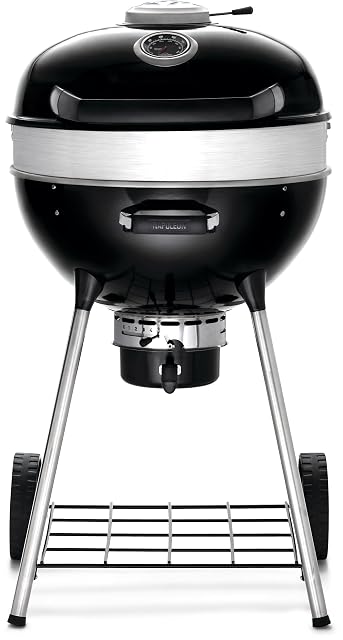
What the maker puts in writing
- “Space to hold up to 13 burgers made with a Weber burger press; The durable-plated steel cooking grate… stands up to the demands of frequent grilling”
- “The One-Touch cleaning system… has a removable aluminized, high-capacity ash catcher allowing for efficient and less frequent removal of ash”
- “Porcelain-enameled lid and bowl are engineered to withstand high temperatures and retain heat… resist rust and won’t peel”
- “Reinforced with high-quality, glass-infused nylon, ensuring they can withstand the demands of frequent use and exposure to heat”
- “Built-in Lid Thermometer takes the guesswork out of grilling, displaying the internal temperature”
- “Rust-resistant aluminum damper… Angled lid hook… All-weather wheels… Tool hooks”
- “a hinged cooking grate allowing you to easily add charcoal while grilling”
Seventy dollars for two mechanisms
Over the $149 Original Kettle this adds four things, and two of them matter:
A built-in lid thermometer. A hinged cooking grate. A removable high-capacity ash catcher rather than a fixed one. And glass-infused nylon handles, which the $149 listing also claims — so treat that as shared.
The capacity is the same. Both say up to 13 burgers, as do the $98, $289 and $309 Webers on this shelf.
Why the hinge is the real upgrade
On a kettle without one, adding charcoal means lifting the entire grate with the food on it. You need somewhere to put a hot grate covered in half-cooked chicken, and then you have to put it back.
Nobody does that twice. What happens instead is that you cook on one load of fuel — and a single chimney of briquettes gives about an hour of useful heat.
The hinge lifts two crescents at the edges of the grate, so charcoal drops in at the sides while the food stays in the middle.
For searing burgers it changes nothing at all. For roasting, for smoking, or for feeding a crowd in shifts, it is the thing that makes it possible.
And why the thermometer goes with it
The two upgrades are the same upgrade, really: this is the first kettle on this shelf that can be used as an oven rather than as a grill.
A lid thermometer reads the air under the dome — not the meat, but the oven. Which is exactly right for holding 225 to 250 °F for ribs or 350 for a chicken: you set the vents, you read the dial, you adjust.
It will not tell you when the meat is done. For that you want a probe, and on this shelf only the Napoleon has dedicated probe doors so the cable is not pinched under the lid.
What this page does not say
No warranty. And the kettle seventy dollars below it on this shelf — the Original Kettle at $149 — publishes ten years limited, the only warranty on any of these eight pages.
No vent count. The Master-Touch publishes “3 air vents regulated by 3 arched, swiveling damper blades”; this says only “rust-resistant aluminum damper”.
No Tuck-Away holder. The lid parks on an angled hook here. The $289 Master-Touch slides it into a holder on the side instead, which is the tidier of the two.
14,651 g. Worth noting because the $149 Original Kettle is listed at 1,500 g, which is impossible for the same bowl and lid. This is what a 22-inch enamelled kettle actually weighs.
Availability
On sale at around $220 on the American Amazon store at the time of checking.
Prices and availability are what Keepa reported on the date this page was updated; both move.
Prices quoted in this text were read on 4 October 2026. The live price is at the top of the page.
The questions that come in
What does the hinged grate actually change?
It is the difference between a one-hour grill and a three-hour one. On a kettle without a hinge, adding charcoal means lifting the entire grate with the food on it — so you find somewhere to put a hot grate covered in half-cooked chicken, top up the coals, and put it back. Nobody does that twice. What happens instead is that you cook on one load of fuel, and a single chimney of briquettes gives you roughly an hour of useful heat. The hinge lifts two crescents at the edges of the grate, so charcoal drops in at the sides while the food stays put in the middle. For searing burgers it changes nothing. For roasting, smoking or cooking for a crowd in shifts, it is the feature that makes it possible.
Is it worth $70 more than the $149 kettle?
If you cook with the lid down, yes; if you sear with it off, no. Over the Original Kettle this adds exactly four things: the lid thermometer, the hinged grate, a removable high-capacity ash catcher instead of a fixed one, and glass-infused nylon handles (which the $149 listing also claims, so treat that as shared). The capacity is identical — both say up to 13 burgers — and so is the porcelain enamel, the aluminum damper, the angled lid hook, the tool hooks and the wheels. The one real cost of trading down is that the $149 model is the only kettle on this shelf with a published warranty: ten years limited. This page publishes none.
How accurate is a lid thermometer?
Accurate enough for what it is for, and not a substitute for a food probe. A lid thermometer reads the air temperature under the dome, several inches above the grate and offset from the coals, so it tells you what the oven is doing rather than what the meat is doing. That is exactly the right measurement for lid-down cooking: holding 225 to 250 °F for ribs, or 350 for a chicken, is a setting you reach by moving the vents and then reading the dial. Where it will mislead you is as a guide to doneness — for that you want a probe in the meat. On this shelf the Napoleon is the only grill with dedicated probe doors in its stainless ring, so a probe cable does not get pinched under the lid.