What the maker puts in writing
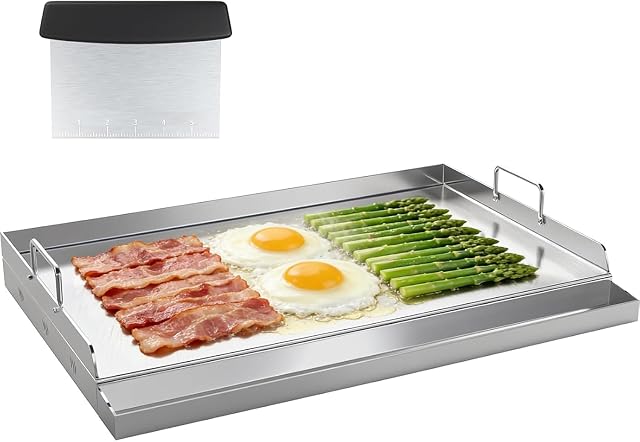
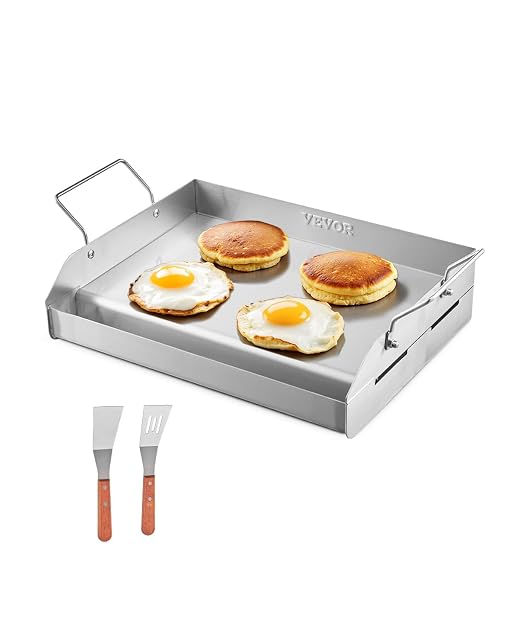
- “Made from durable stainless steel, this griddle for gas grill can handle temperatures up to 500℉. The bottom x-shaped reinforcement resists to deform”
- “The grease trough and drip hole allow excess oils to drain away… the sidewalls help keep food in place, preventing spills”
- “The griddle top offers a large cooking area, providing ample space to cook multiple servings at once”
- “The cast iron construction is built to last and easy to maintain”
- “Whether you have a gas, electric stovetop, this griddle for gas grill is compatible with all”
Bigger than the plate above it, and cheaper
The clearest buying decision on this shelf.
VEVOR 18 × 16 in — 288 sq in — $51.90 — 4,300 g
VEVOR 23 × 16 in — 368 sq in — $41.31 — 4,649 g
Eighty square inches more for $10.59 less. Twenty-eight per cent more surface at a twenty per cent lower price.
The bullets between the two are identical word for word — same grease trough, same sidewalls, same X-brace, same 500 °F rating. The only published differences are the size and the weight.
On the figures available, anyone looking at the 18 × 16 should buy this one. Prices move; check both on the day.
Eleven cents a square inch
The best value anywhere on this shelf:
- $0.112 — this, 368 sq in
- $0.139 — VEVOR 36 × 22, 792 sq in
- $0.152 — COZEER 23 × 16, 368 sq in
- $0.162 — VEVOR 32 × 16, 512 sq in
- $0.163 — VEVOR 17 × 13, 221 sq in
- $0.180 — VEVOR 18 × 16, 288 sq in
- $0.498 — DeintYei 17 × 13, 221 sq in
The two ends of that list differ by a factor of four and a half.
What you give up for the price
Metal. No listing here publishes a plate thickness, but the weights and areas give it to you:
12.6 grams per square inch — against 20.8 for VEVOR’s own 17 × 13 plate and 17.3 for the COZEER of exactly this size.
A griddle cooks by stored heat. A thin plate loses its temperature when cold food lands on it, so the food steams instead of browning. A thick plate keeps going.
For eggs, onions, vegetables and reheating, thin is fine — and it heats faster. For a batch of smash burgers, the thicker plates on this shelf will do it better.
Five hundred degrees
Can handle temperatures up to 500℉.
VEVOR publishes this on at least five of the seven plates and nobody else on this shelf publishes any limit.
Read it as a constraint, not a reassurance. 500 °F is about the surface temperature a smash burger wants, and a gas grill on full will go past it — so this is not a plate to leave over wide-open burners.
Twenty-three inches will cover most of a three-burner grill
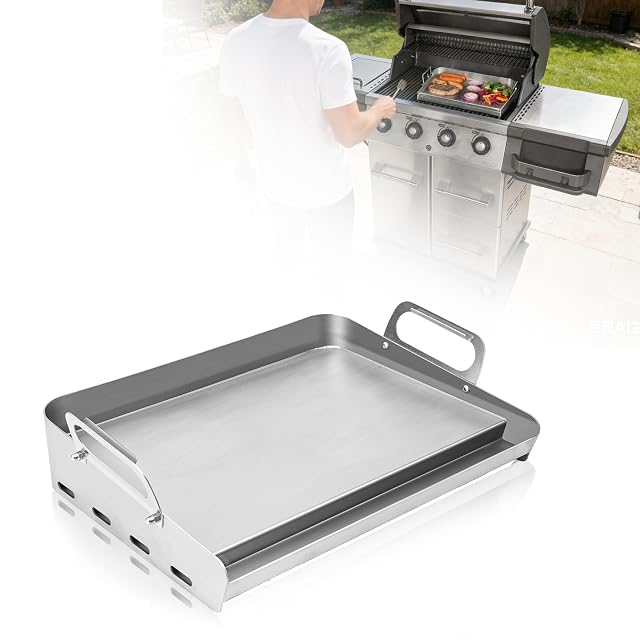
Which is worth thinking about. A solid plate across all the burners blocks the convection path a gas grill is designed around.
DeintYei argues exactly this on this shelf: Unlike oversized griddles, our compact size preserves your grill’s heat flow and long-term performance. And VEVOR’s own 17 × 13 plate is the one with “hollow vents for even airflow”.
On a four or five burner grill, 23 inches leaves a strip of grate free — which is the useful compromise.
And the page contradicts itself
Bullet 1: stainless steel. Bullet 4: cast iron.
The title says “Stainless Steel Griddle”, and all five VEVOR plates here carry the identical bullet set — so bullet 4 is a copy-paste from another line.
It matters for care: bare cast iron must be seasoned and oiled or it rusts; stainless needs neither. Treat it as stainless.
No scraper included — COZEER is the only plate here that ships with one, and a griddle is unusable without a scraper.
Availability
On sale at around $41 on the American Amazon store at the time of checking.
Prices and availability are what Keepa reported on the date this page was updated; both move.
Prices quoted in this text were read on 4 October 2026. The live price is at the top of the page.
The questions that come in
Why is it cheaper than the smaller plate?
There is no stated reason, and it is the clearest buying decision on this shelf. VEVOR sells five plates here, and two of them sit oddly against each other: the 18 × 16 in (288 sq in) at $51.90 and this 23 × 16 in (368 sq in) at $41.31. That is eighty square inches more for $10.59 less — twenty-eight per cent more cooking surface at a twenty per cent lower price. The bullets are word-for-word identical between the two, the same grease trough, sidewalls, X-brace and 500 °F rating. The only published difference beyond size is weight, 4,300 g (151.7 oz) against 4,649. On the figures available, anyone considering the 18 × 16 should buy this instead. Prices move, so check both on the day.
How thick is the plate?
Not published, like every listing on this shelf — but the weight and area give you the comparison. At 4,649 g (164 oz) over 368 square inches this is 12.6 g (0.4 oz) per square inch, which is at the thin end of the range: VEVOR’s own 17 × 13 plate is 20.8, the COZEER of exactly this size is 17.3, and only the big 36 × 22 is thinner at 12.4. That matters because a griddle cooks by stored heat: put six cold burgers on a thin plate and the surface temperature drops, so the meat steams rather than browns. For eggs, onions, vegetables and reheating, thin is fine and heats faster. For searing a batch of burgers, the thicker plates here will hold their temperature better.
Will it fit my grill?
Measure the grate, and expect this to cover most of it. At 23 by 16 inches this is a plate for a three or four burner gas grill, and it will sit over most of the cooking area rather than half of it. That is worth a thought, because a solid plate across all the burners blocks the convection path a gas grill is built around — DeintYei on this shelf makes exactly that argument for its smaller plate: "Unlike oversized griddles, our compact size preserves your grill’s heat flow and long-term performance." The 17 × 13 VEVOR is the one with "hollow vents for even airflow" if that worries you. On a large grill, 23 inches still leaves a strip of grate free, which is the useful compromise.