What the maker puts in writing
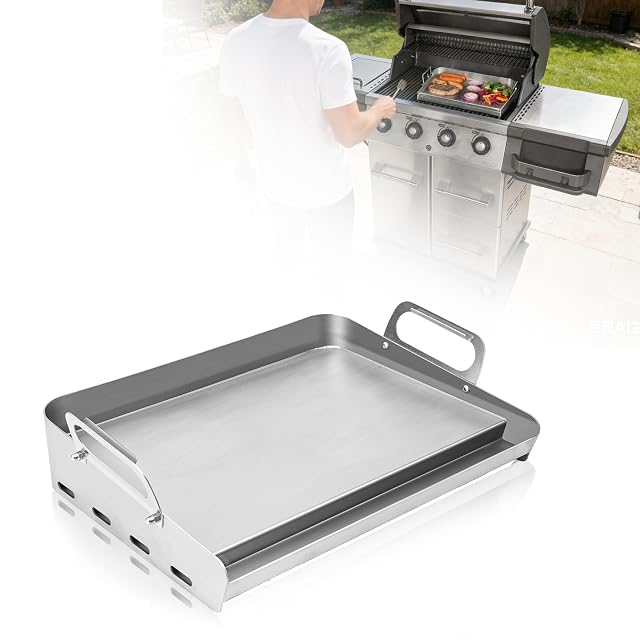
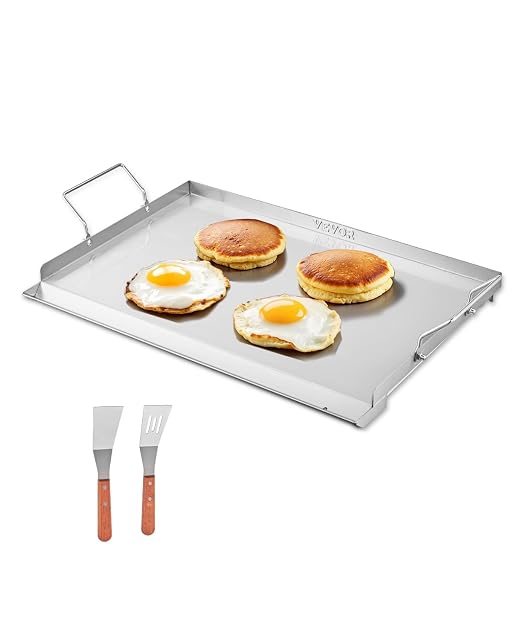
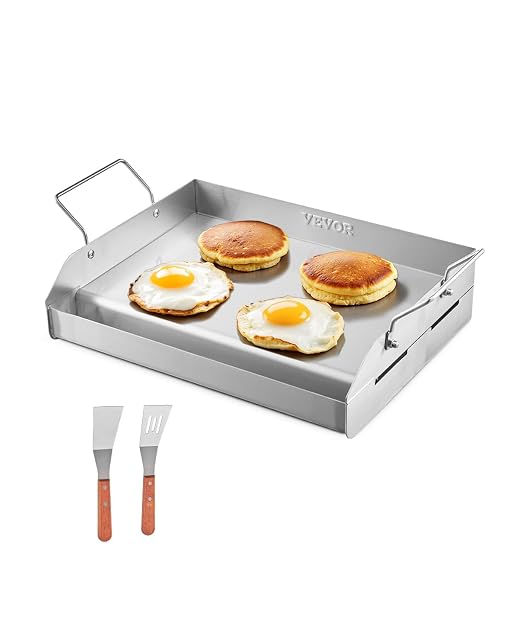
- “This stainless steel griddle features a 23″ wide x 16″ deep cooking surface, delivering ample room to prepare large batches of food all at once”
- “Crafted from high-quality stainless steel, this griddle for gas grill combines excellent durability, rust resistance and easy cleaning”
- “The smooth stainless steel surface resists food sticking and is simple to wipe clean after use”
- “The whole surface of the griddle has been polished when the factory is delivered, so you don’t have to worry about scratching the skin during use”
- “Our stove top griddle comes with a food grade griddle scraper that serves dual purposes”
- “made of food-grade thickened material. It features durability, no deformation and easy cleaning”
The cleanest comparison on this shelf
Two plates, the same dimensions:
VEVOR 23 × 16 in — 368 sq in — $41.31 — 4,649 g — 12.6 g/sq in
COZEER 23 × 16 in — 368 sq in — $55.99 — 6,350 g — 17.3 g/sq in
Thirty-seven per cent more metal for the same surface, at $14.68 more.
No listing on this shelf publishes a plate thickness, so mass per area is the only way to read it. And on a griddle, thickness is the specification that decides everything: the plate cooks by stored heat, so when six cold burgers land on it the surface either holds its temperature or collapses. A thin plate steams food grey; a thick one browns it.
For scale, VEVOR’s own 17 × 13 plate is the densest here at 20.8 g (0.7 oz)/sq in, and its 36 × 22 the thinnest at 12.4.
The scraper, which six of seven plates leave out
A food grade griddle scraper that serves dual purposes. And in the description: without the need for additional purchases.
That is not a token accessory. A griddle does not work without a scraper.
It is your spatula — what you push under a smash burger to lift it without tearing the crust, what you move onions with — and it is your cleaning tool, dragged across the cooling plate to push residue and grease into the groove. A kitchen spatula will not do the second job.
COZEER is the only plate on this shelf that includes one.
Polished edges, and why that is worth a bullet
So you don’t have to worry about scratching the skin during use.
A stainless plate leaves the press with a mill finish and sheared edges, and a sheared edge on a few millimeters of steel is sharp enough to open a knuckle when you reach across a hot grill to move it.
Nobody else here mentions it.
A polished cooking face also releases food better and scrapes clean more easily, which the listing claims too.
But note the title’s word “Nonstick”: there is no coating described anywhere in the bullets. This is smooth bare stainless, and bare stainless needs oil. Do not expect a nonstick pan.
What COZEER does not publish, and VEVOR does
No temperature rating. All five VEVOR plates here state “up to 500℉” — which is a useful limit to know, since a gas grill on full exceeds it.
No bottom reinforcement named. VEVOR publishes an X-shaped brace against deforming on all five of its plates. COZEER claims “no deformation” from the material alone — “food-grade thickened material” — which, given that it carries thirty-seven per cent more metal than the VEVOR of the same size, is not an unreasonable claim. But a rib is a rib.
No sidewalls. VEVOR’s plates have walls to keep food on; this has a grease groove and, per the description, raised edges are not mentioned at all.
No plate thickness in millimeters, like every listing on this shelf.
Availability
On sale at around $56 on the American Amazon store at the time of checking.
Prices and availability are what Keepa reported on the date this page was updated; both move.
Prices quoted in this text were read on 4 October 2026. The live price is at the top of the page.
The questions that come in
Is it worth $14.68 more than the VEVOR of the same size?
Probably yes, on two grounds. The two plates are both 23 × 16 inches, about 368 square inches: VEVOR at $41.31 and 4,649 g (164 oz), this at $55.99 and 6,350 g (224 oz). That is thirty-seven per cent more metal for the same surface area — and since no listing on this shelf publishes a plate thickness, mass per area is the only way to read it. More metal means more stored heat, which is the whole point of a griddle: the surface has to stay hot when cold food lands on it. Second, this one includes a food-grade scraper, which you need and would otherwise buy separately. Against that, VEVOR publishes a 500 °F rating and an X-shaped bottom brace, and COZEER publishes neither.
Why does the scraper matter?
Because a griddle does not work without one, and six of the seven plates on this shelf do not include it. On a flat plate, a scraper is both your spatula and your cleaning tool: it is what you push under a smash burger to lift it without tearing the crust, what you use to move onions around, and — once the plate has cooled a little — what you drag the residue and grease into the groove with. A normal spatula will not do the second job. COZEER states it plainly: "a food grade griddle scraper that serves dual purposes... helps you easily flip, move, and control food while cooking, and also efficiently removes food residue, grease, and debris". The description adds the point directly: "without the need for additional purchases".
What does "polished across the whole surface" mean?
That the edges will not cut you, and COZEER is the only maker here to raise it. A stainless plate comes off the press with a mill finish and sheared edges, and a sheared edge on 3 mm (0.12 in) steel is sharp enough to open a knuckle when you are reaching across a hot grill to move it. The listing says "the whole surface of the griddle has been polished when the factory is delivered, so you don’t have to worry about scratching the skin during use". A polished cooking surface also releases food better and is easier to scrape clean, which the listing claims as well — "resists food sticking and is simple to wipe clean". It is not a nonstick coating, despite the title: it is smooth bare stainless, and it needs oil.