What the maker puts in writing
- “Made from durable stainless steel, this griddle for gas grill can handle temperatures up to 500℉. The bottom x-shaped reinforcement resists to deform”
- “The grease trough and drip hole allow excess oils to drain away… the sidewalls help keep food in place”
- “The griddle top offers a large cooking area, providing ample space to cook multiple servings at once”
- “The cast iron construction is built to last and easy to maintain”
- “Whether you have a gas, electric stovetop, this griddle for gas grill is compatible with all”
The plate below it on this shelf is bigger and cheaper
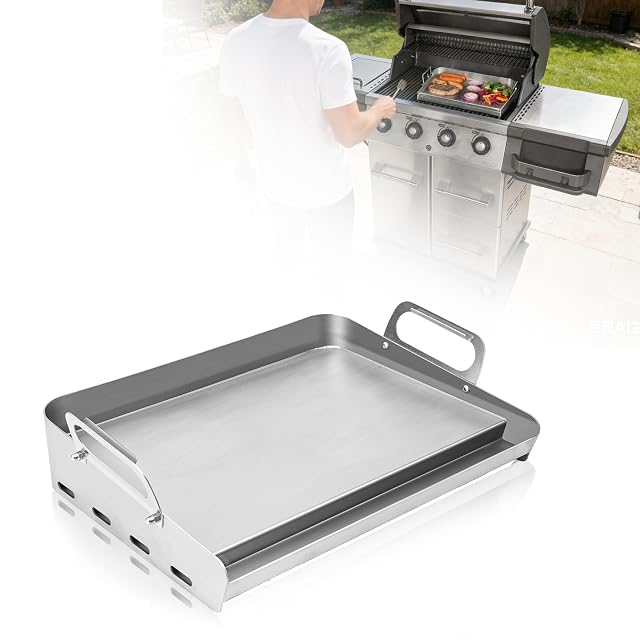
This — 18 × 16 in — 288 sq in — $51.90 — 4,300 g
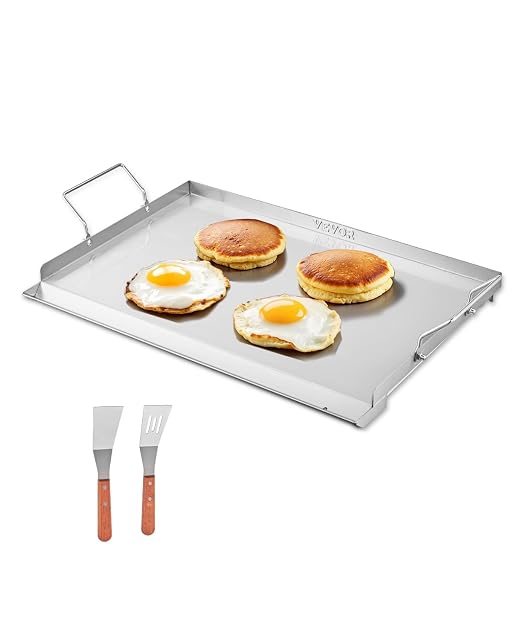
VEVOR 23 × 16 in — 368 sq in — $41.31 — 4,649 g
Eighty square inches more for $10.59 less.
And the bullets are identical word for word: same stainless construction, same 500 °F rating, same grease trough and drip hole, same sidewalls, same X-shaped bottom reinforcement. Nothing in either listing separates them except size and weight.
There is one honest argument for this plate, and it is not in the bullets: shape. Eighteen by sixteen inches is nearly square, so on a small two-burner grill it sits within the grate where a 23-inch plate would overhang the edges and sit on the frame.
If that is your grill, this is the right plate. Otherwise buy the bigger one. Prices move, so check both.
Fourteen point nine grams per square inch
No listing on this shelf publishes a plate thickness, so the weights and areas have to stand in for it:
- VEVOR 17 × 13 — 20.8 g (0.7 oz)/sq in
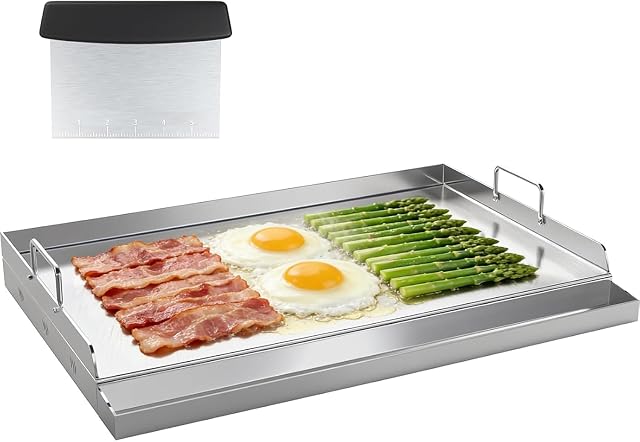
- COZEER 23 × 16 — 17.3
- This, 18 × 16 — 14.9
- VEVOR 32 × 16 — 13.5
- VEVOR 23 × 16 — 12.6
- VEVOR 36 × 22 — 12.4
Middling, and that cuts both ways.
A thinner plate heats faster, which for twenty minutes of breakfast is a real advantage, and it is lighter to lift and to store.
A thicker plate holds its temperature, which is what a griddle is for: the surface has to stay hot when cold food lands on it, or the food steams in its own juice and greys instead of browning.
For eggs, onions and vegetables, this is well judged. For a batch of smash burgers, the 17-inch plate has forty per cent more metal in it.
The X-brace, which is the only one here
The bottom x-shaped reinforcement resists to deform.
Warping is the real failure mode of a griddle plate, and this is the only structural answer to it named anywhere on this shelf.
A flat sheet over gas burners heats in stripes — hot above the flames, cool between — and expands unevenly, so it cups or rocks. Once a plate rocks, oil runs to one corner and the food cooks unevenly for the rest of its life.
VEVOR publishes the X-brace on all five of its plates. COZEER and DeintYei name no structure at all, though DeintYei claims its steel “resists warping” on material grounds.
Five hundred degrees
Published on all five VEVOR plates, and nowhere else on this shelf.
Worth reading as a limit rather than a reassurance: 500 °F is roughly what a smash burger wants at the surface, and a gas grill on full goes past it.
And the contradiction in the bullets
Bullet 1: stainless steel. Bullet 4: cast iron.
All five VEVOR plates here carry the same bullet set, so bullet 4 is a copy-paste from another product line. The title says “Stainless Steel Griddle”.
Treat it as stainless — do not season it, and do not worry about rust.
No removable handles stated, which VEVOR’s 17 × 13 plate does have. No scraper; COZEER is the only plate here that includes one.
Availability
On sale at around $52 on the American Amazon store at the time of checking.
Prices and availability are what Keepa reported on the date this page was updated; both move.
Prices quoted in this text were read on 4 October 2026. The live price is at the top of the page.