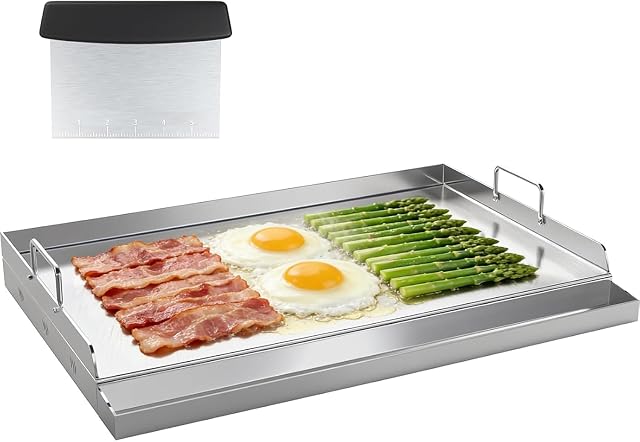
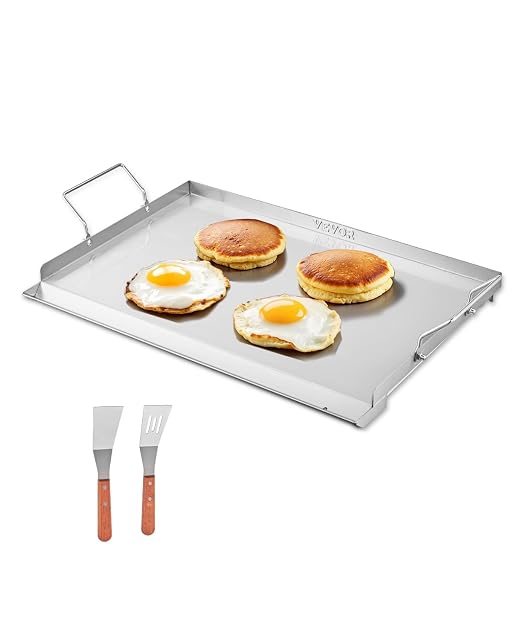
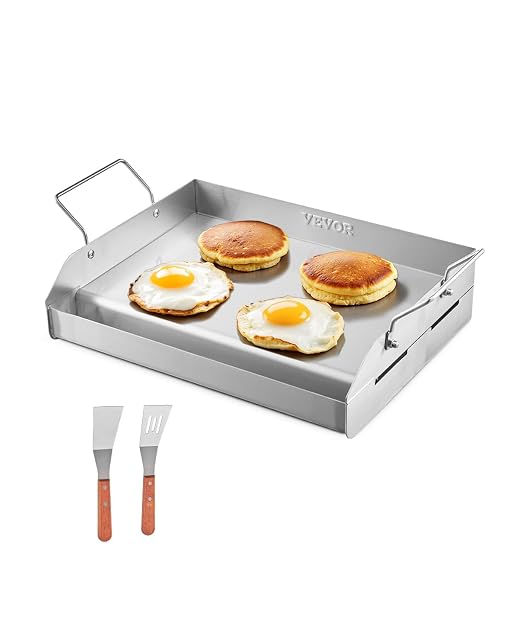
What the maker puts in writing
- “Space-saving 17″x13″ size fits one side of gas grill grates, leaving the other side free for direct grilling. Enjoy dual cooking: fry eggs/smash burgers on the griddle grill while grilling ribs/veggies on the grate”
- “Compact 17″x13″ build heats up 50% faster than larger grill griddles… Eliminates hot spots, reduces excess smoke… Unlike oversized griddles, our compact size preserves your grill’s heat flow and long-term performance”
- “Fits most small gas grills (Weber Q, Char-Broil Portable) and kitchen stovetops… The griddle pan features 221 sq. inches of cooking space… Pro tip: Preheat several mins before adding oil”
- “Built with precision-engineered stainless steel following Japanese manufacturing standards, this stainless steel griddle heats up 30% faster than cast iron alternatives, and the heat is evenly distributed, with the temperature difference in each area controlled within 3 degrees”
- “Heavy-duty stainless steel construction resists warping, scratching and rust… Raised, curved edges prevent grease and food spills… while the built-in grease tray collects drippings”
The only plate here that argues for being small
And the argument is sound.
A gas grill is a convection oven. The burners heat air; that air rises past the food and leaves through the vents. Lay a solid steel plate across every burner and the path closes — the heat has nowhere to go but into the plate and back down into the firebox.
DeintYei says it plainly: Unlike oversized griddles, our compact size preserves your grill’s heat flow and long-term performance.
Then the second half, which is about cooking rather than protection: at 17 × 13 inches it fits one side of the grate, so you can smash burgers on the plate while sausages cook on the bare grate beside them. Griddle and grill in one cook.
On this shelf the plates run to 36 × 22 inches — which covers everything. VEVOR’s own 17 × 13 answers the same worry with “hollow vents for even airflow”.
Four figures nobody else publishes
221 square inches of cooking space. 50 per cent faster to heat than larger griddles. 30 per cent faster than cast iron. And temperature variation “in each area controlled within 3 degrees”.
Plus Japanese manufacturing standards.
That is a far more specific listing than anything else here — the five VEVOR plates publish one thermal number between them (a 500 °F ceiling) and COZEER publishes none.
But the two numbers that would let you check it are missing
No weight. No plate thickness.
Those are precisely what the thermal claims rest on, because how fast a plate heats and how evenly it holds heat both follow from how much metal it has and how that metal is spread.
Every other plate on this shelf publishes a weight, which is why they can be ranked: 12.4 to 20.8 grams of metal per square inch across the range. This one cannot be placed in that list.
The claims may well be true. They are not checkable from this page.
And the price, which has to be faced
$109.99 for 221 square inches.
VEVOR’s 36 × 22 plate is $109.90 for 792 square inches — a penny less, three and a half times the surface.
Per square inch:
- $0.112 — VEVOR 23 × 16
- $0.139 — VEVOR 36 × 22 · $0.152 — COZEER · $0.162 — VEVOR 32 × 16
- $0.163 — VEVOR 17 × 13 · $0.180 — VEVOR 18 × 16
- $0.498 — this
Four and a half times the cheapest, and three times the VEVOR plate of exactly the same 17 × 13 inches.
What the money buys is the engineering claims, the raised curved edges, the built-in grease tray, a named compatibility list — and the absence of a 500 °F ceiling, which VEVOR publishes on all five of its plates.
The one piece of advice worth taking
Pro tip: Preheat several mins before adding oil.
Correct, and it applies to every plate on this shelf. Oil on a cold plate polymerizes slowly and goes sticky; oil on a properly hot plate releases food. The listing is the only one here that says so.
No scraper included — COZEER alone ships with one, and a griddle is unusable without it.
Availability
On sale at around $110 on the American Amazon store at the time of checking.
Prices and availability are what Keepa reported on the date this page was updated; both move.
Prices quoted in this text were read on 4 October 2026. The live price is at the top of the page.
The questions that come in
Is a small plate really better?
For one specific reason, yes, and DeintYei is the only maker on this shelf to make the argument. A gas grill is a convection oven: the burners heat air, that air rises past the food and leaves through the vents. A solid steel plate laid across every burner closes that path, so the heat has nowhere to go but into the plate and back down into the firebox. DeintYei states it directly — "Unlike oversized griddles, our compact size preserves your grill’s heat flow and long-term performance" — and builds the second half of the case on capacity rather than protection: at 17 × 13 inches it "fits one side of gas grill grates, leaving the other side free for direct grilling", so you can smash burgers on the plate while sausages cook on the grate. VEVOR’s 17 × 13 plate answers the same concern with "hollow vents".
Can the three-degree claim be checked?
Not from this page, and that is the gap in an otherwise unusually specific listing. DeintYei publishes four figures no other maker here publishes — 221 sq in of cooking space, 50 per cent faster to heat than larger griddles, 30 per cent faster than cast iron, and "the temperature difference in each area controlled within 3 degrees" — but no plate thickness and no weight. Those are the two numbers that would make the thermal claims testable, because a plate’s heat-up speed and its evenness both follow from how much metal it has and how it is distributed. Every other plate on this shelf publishes a weight, so you can calculate 12.4 to 20.8 grams per square inch across the range; this one cannot be placed in that list. The claims may well be true. They are not checkable here.
Why does it cost the same as a plate three times the size?
Because you are paying for the engineering claims rather than the steel, and the comparison is unavoidable on this shelf. This plate is $109.99 for 221 square inches; VEVOR’s 36 × 22 in plate is $109.90 for 792 — a penny less for three and a half times the surface. Per square inch that is $0.498 against $0.139, and the cheapest plate here, VEVOR’s 23 × 16, is $0.112. What this buys instead: published evenness and heat-up figures, Japanese manufacturing standards, raised curved edges, a built-in grease tray, and a stated compatibility list (Weber Q, Char-Broil Portable). Also no 500 °F ceiling, which VEVOR publishes on all five of its plates. If you cook for two and want the grate free, the size is the point.