What the maker puts in writing
- “Made from durable stainless steel, this griddle for gas grill can handle temperatures up to 500℉. The bottom x-shaped reinforcement resists to deform”
- “The grease trough and drip hole allow excess oils to drain away… the sidewalls help keep food in place”
- “The griddle top offers a large cooking area, providing ample space to cook multiple servings at once, making it great for family meals or entertaining guests”
- “The cast iron construction is built to last and easy to maintain”
- “Whether you have a gas, electric stovetop, this griddle for gas grill is compatible with all”
A penny less than a plate a third its size
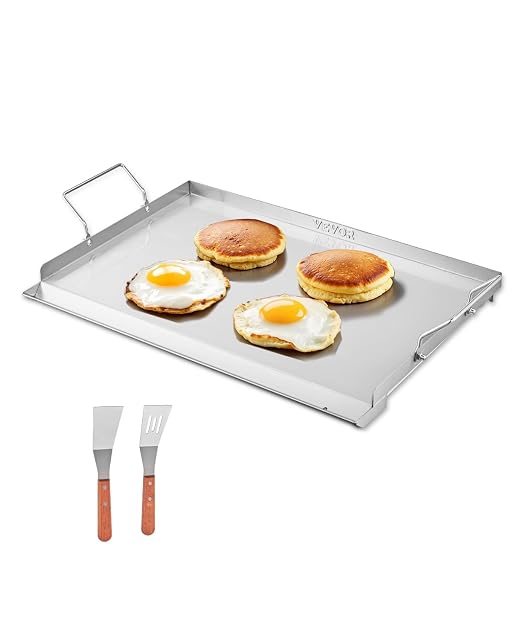
This — 36 × 22 in — 792 sq in — $109.90
DeintYei — 17 × 13 in — 221 sq in — $109.99
Three and a half times the cooking surface for one cent less.
What DeintYei offers for the money is the only set of performance figures on this shelf: 50 per cent faster to heat than larger griddles, 30 per cent faster than cast iron, “temperature difference in each area controlled within 3 degrees”, Japanese manufacturing standards — plus the argument that a small plate protects the grill’s airflow.
Those are genuine claims. Whether they are worth 570 square inches depends on how many people you feed.
Measure the depth before you order
Twenty-two inches front to back.
Most domestic gas grills are 17 to 20 inches deep between the front and back of the grate. So this plate may sit on the frame rails rather than down on the grate, or overhang the front edge. Neither is dangerous, but both change how it heats and how stable it sits.
Width is rarely the issue — 36 inches suits a four or five burner grill.
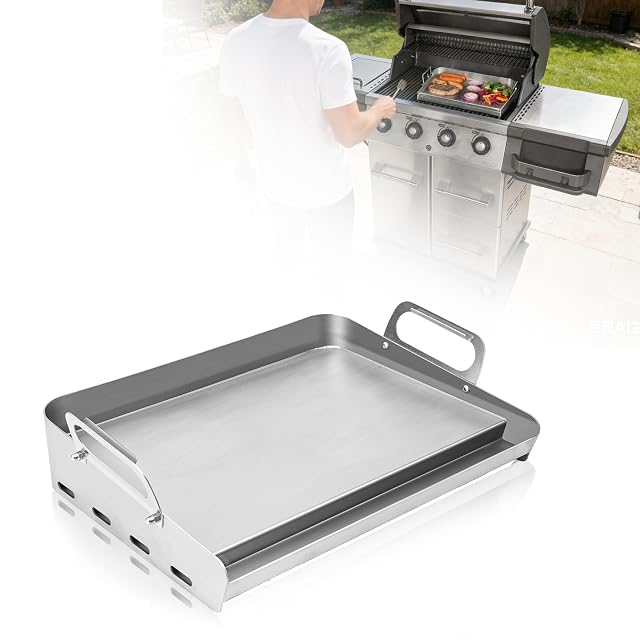
The bigger point is that a plate this size covers every burner, and a gas grill works by circulating hot air past the food and out of the vents. Close that path and the heat has nowhere to go but back into the firebox. VEVOR’s own 17 × 13 plate is the one with “hollow vents for even airflow”, and DeintYei warns about exactly this.
Run fewer burners under it.
The thinnest plate here, and that is the wrong way round
No listing on this shelf publishes a plate thickness. The weights and areas give it to you:
- VEVOR 17 × 13 — 20.8 g (0.7 oz)/sq in
- COZEER 23 × 16 — 17.3
- VEVOR 18 × 16 — 14.9 · VEVOR 32 × 16 — 13.5
- VEVOR 23 × 16 — 12.6
- This, 36 × 22 — 12.4 (the lowest)
A griddle cooks by stored heat, and a thin plate has less to give. Load a dozen cold burgers onto a large thin plate and the surface temperature drops — the meat steams in its own juice instead of browning.
The irony is that the plates most likely to be loaded heavily are the thinnest ones on this shelf.
Two things help: preheat for longer than feels necessary, and cook in two passes rather than filling the whole surface at once.
Ten kilograms
The heaviest plate here, and nothing in the bullets addresses handling.
The title says “Portable Family Cookware with Handle”, but — unlike the 17 × 13 plate — no removable handles are stated. Put it on a cold grate before lighting, and take it off only once cool. A hot 36-inch plate with grease in its trough does not get carried anywhere.
Five hundred degrees, and the contradiction
Up to 500℉, published on all five VEVOR plates and nowhere else on this shelf. A ceiling rather than a reassurance — a gas grill on full goes past it.
Bullet 1 says stainless steel; bullet 4 says cast iron. Identical bullet sets across all five VEVOR plates, so bullet 4 is a copy-paste. The title says stainless. No seasoning required.
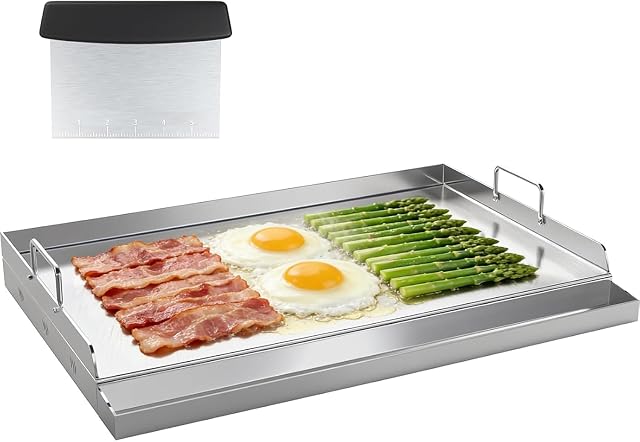
No scraper — COZEER alone includes one, and a griddle cannot be used without it.
Availability
On sale at around $110 on the American Amazon store at the time of checking.
Prices and availability are what Keepa reported on the date this page was updated; both move.
Prices quoted in this text were read on 4 October 2026. The live price is at the top of the page.