What the maker puts in writing
- “Made from durable stainless steel, this griddle for gas grill can handle temperatures up to 500℉. The bottom x-shaped reinforcement resists to deform”
- “The grease trough and drip hole allow excess oils to drain away… the sidewalls help keep food in place”
- “The griddle top offers a large cooking area, providing ample space to cook multiple servings at once, making it great for family meals or entertaining guests”
- “The cast iron construction is built to last and easy to maintain”
- “Whether you have a gas, electric stovetop, this griddle for gas grill is compatible with all”
Five hundred and twelve square inches
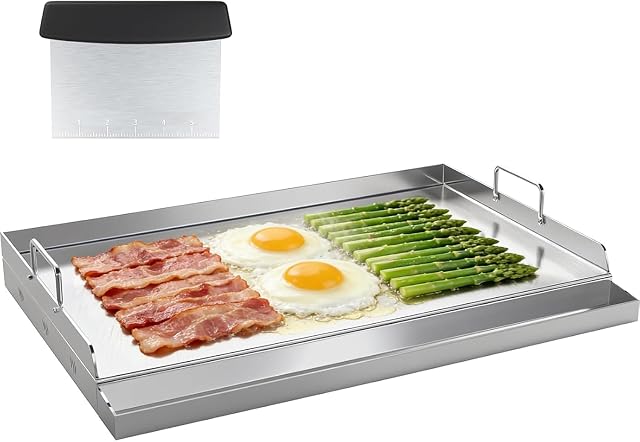
Breakfast for eight in one pass: bacon at one end, eggs in the middle, onions and peppers at the other, and nothing waiting.
That is the case for a plate this size, and nothing smaller on this shelf does it.
And the thing to think about first
Thirty-two inches will span most four-burner gas grills.
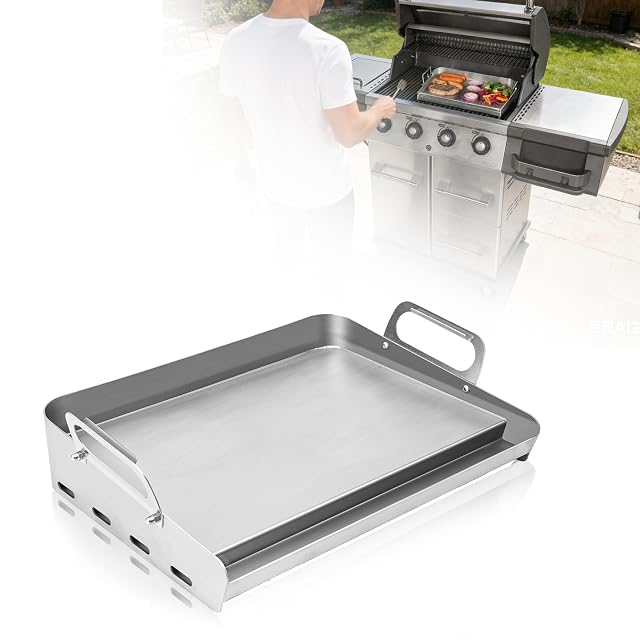
A gas grill is a convection oven. The burners heat air, and that air rises past the food and leaves through the vents. Lay a solid steel plate across every burner and that path closes — the heat has nowhere to go except into the plate and back down into the firebox.
DeintYei argues exactly this on this shelf, for its 17-inch plate: Unlike oversized griddles, our compact size preserves your grill’s heat flow and long-term performance. And VEVOR’s own 17 × 13 plate is the one with “hollow vents for even airflow”.
The practical answer: run fewer burners under a plate this size, and keep the lid up or vented.
Against the 36-inch plate beside it
This — 32 × 16 in — 512 sq in — $82.90 — 6,922 g — 13.5 g/sq in — $0.162 an inch
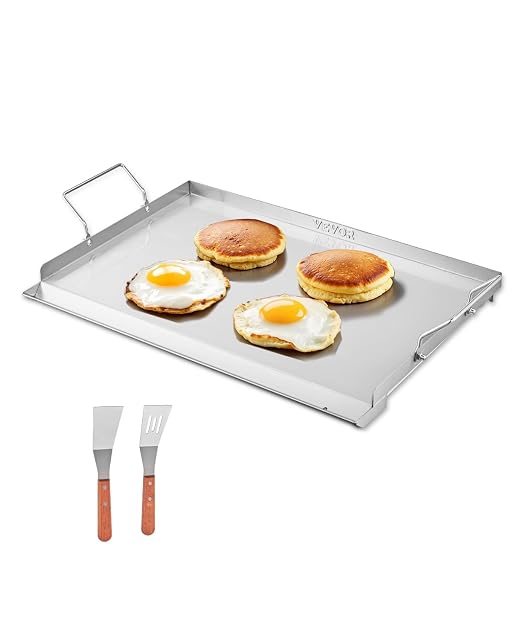
VEVOR — 36 × 22 in — 792 sq in — $109.90 — 9,861 g — 12.4 g/sq in — $0.139 an inch
So the bigger plate is better value per inch, and this one is slightly thicker.
The difference that decides it is depth: 16 inches against 22. A 22-inch-deep plate reaches further back than many grills are deep, and at nearly ten kilograms it is a serious lift.
For most four-burner grills this is the more practical of the two.
Thirteen point five grams per square inch
No listing on this shelf publishes a plate thickness, so mass per area stands in for it:
- VEVOR 17 × 13 — 20.8 g (0.7 oz)/sq in (the densest)
- COZEER 23 × 16 — 17.3
- VEVOR 18 × 16 — 14.9
- This, 32 × 16 — 13.5
- VEVOR 23 × 16 — 12.6 · VEVOR 36 × 22 — 12.4
A griddle cooks by stored heat. Thicker holds its temperature when cold food lands on it; thinner heats faster. This sits mid-range, and is thicker than both the plates that beat it on price per inch.
Seven kilograms
Second heaviest here, and no listing on this shelf addresses handling.
The title says “Portable Family Cookware with Handle”, but — unlike the 17 × 13 plate — no removable handles are stated, which also means the handles are what stops the lid closing.
The sensible routine is to put the plate on a cold grate before lighting, and take it off only once it has cooled. A hot 32-inch plate with grease sitting in a trough is not something to carry across a patio.
Five hundred degrees, and a contradiction
Up to 500℉ — published on all five VEVOR plates and nowhere else on this shelf. Read it as a ceiling: 500 °F is about what a smash burger wants at the surface, and a gas grill on full exceeds it.
And bullet 1 says stainless steel while bullet 4 says cast iron. All five VEVOR plates here carry the identical bullet set, so bullet 4 is a copy-paste from another line. The title says stainless. Treat it as stainless — no seasoning needed.
No scraper included. COZEER is the only plate here that ships with one, and a griddle is unusable without a scraper.
Availability
On sale at around $83 on the American Amazon store at the time of checking.
Prices and availability are what Keepa reported on the date this page was updated; both move.
Prices quoted in this text were read on 4 October 2026. The live price is at the top of the page.