What the maker puts in writing
- “At 18 x 12 inches, this large plastic cutting board gives you room to spread out whole chickens, roasts, and big batches of veggies without crowding”
- “Rubber feet grip the counter so the board won’t slide while you’re chopping or carving, even with wet hands. The stable base gives you more control”
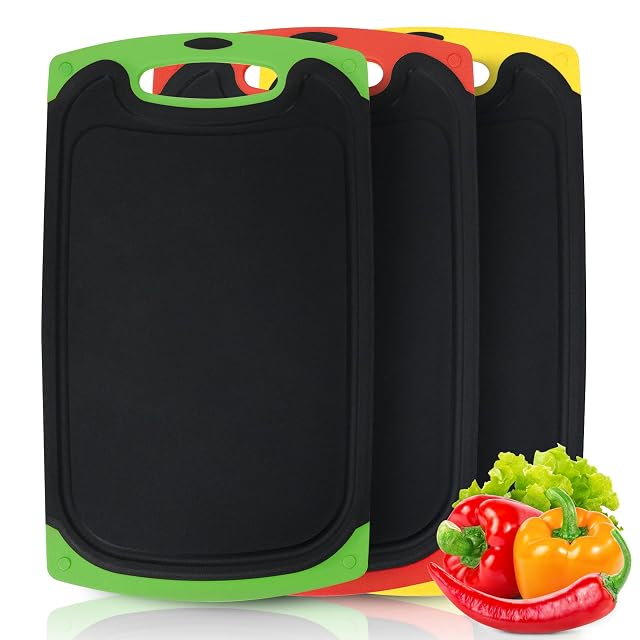
- “A wide, deep groove runs around the board to trap juices from meat, melon, tomatoes, and fruit before they spill onto your counter”
- “Flip it over for a second clean cutting surface, then drop the whole board in the dishwasher… The non-porous plastic rinses clean fast and is gentle on your knife edges, unlike glass”
- “Made from thick, food-safe BPA free plastic that holds up to everyday chopping, slicing, and carving without warping”
The largest board on this shelf
18 × 12 inches — about 216 square inches.
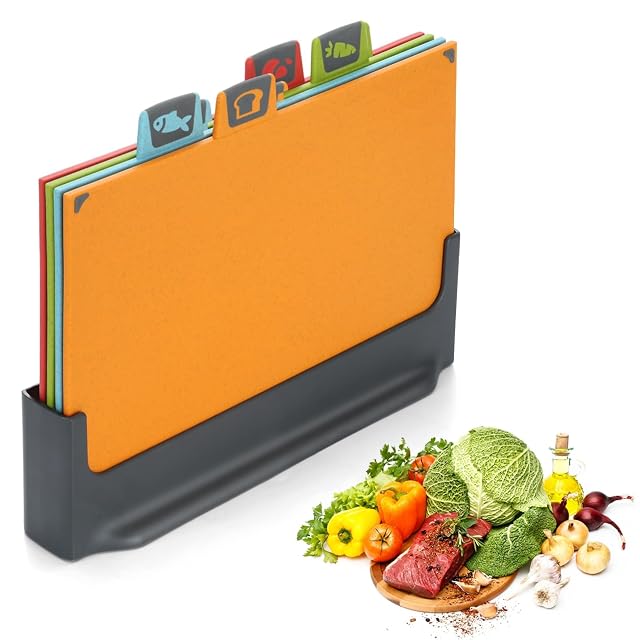
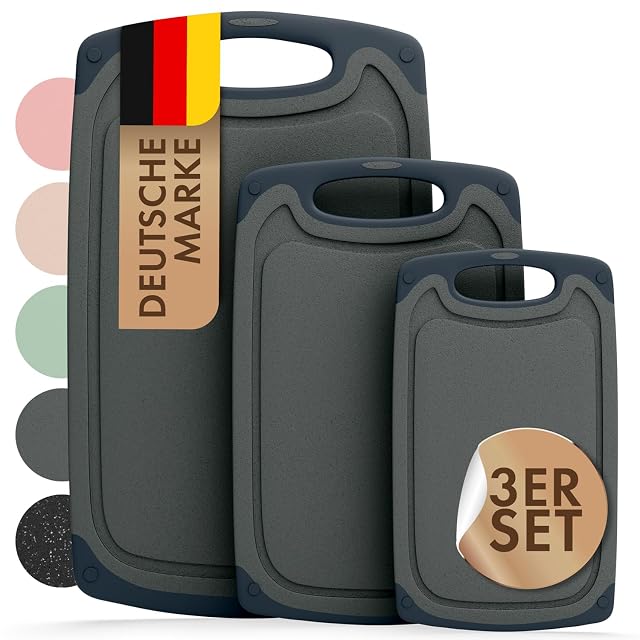
Against the largest board in each three-piece set here: 16 × 11.2 in (GORILLA GRIP), 16 × 9.8 (Freshware), 15.75 × 9.56 (ROTTOGOON), 15.6 × 9.4 (Viretang).
And Belwares names what the extra space is for, correctly: whole chickens, roasts, and big batches.
Those are the two jobs a 10 or 15-inch board does badly. Jointing a chicken needs room to turn the bird; carving a roast needs the juice to go somewhere.
Which is why the groove belongs on a board this size
A wide, deep groove runs around the board to trap juices from meat, melon, tomatoes, and fruit.
On a small board you are dicing an onion and there is nothing to catch. On an 18-inch board you are resting a chicken straight from the oven, and without a channel the juice finds the edge, crosses the worktop and runs down the cupboard door.
Six of the twelve boards here have a groove. The two Farberwares do not, and nor does the Fotouzy utility board — which is 15.5 inches, carving size.
And the feet, with the right reason given
Rubber feet grip the counter so the board won’t slide while you’re chopping or carving, even with wet hands.
That is the correct justification. The hazard with a big board is not the board moving an inch; it is the board moving while a knife is going through a joint.
But it cannot also be reversible
The listing claims both: feet that grip the counter, and flip it over for a second clean cutting surface.
A board with feet on one face cannot lie flat on the other. The feet hold it up, and it rocks — which on an 18-inch board carrying a roast is worse than annoying.
Viretang makes the identical pair of claims on this shelf. ROTTOGOON publishes four rubber feet and sensibly claims no reversibility at all.
The listings that keep both use a rubber border (GORILLA GRIP) or TPR edge handles (Empune), which grip either way up.
Assume you get the feet, and one face.
Twenty-one dollars for one board
The most expensive board on this shelf, and the comparison is stark:
- $20.99 — this, one board, 18 × 12 in
- $13.99 — Freshware or Viretang, three boards
- $21.89 — GORILLA GRIP, three boards with a rubber border and 9.4 mm (0.37 in) published
- $34.99 — Empune, four boards with a limited lifetime warranty
- $6.33 — Farberware’s 11 × 14 in single board
The honest answer in most kitchens is a cheap set plus one big board, not one big board instead of a set.
What is not published
No thickness, which is the specification that decides whether a board warps in a hot dishwasher — the shelf runs from 5 mm to 9.9 mm, and six listings publish nothing. The claim here is only that it holds up “without warping”.
No material name. Four boards here say polypropylene; “thick, food-safe BPA free plastic” is not the same information, and BPA is used in polycarbonate rather than PP in any case.
No warranty — Empune and Fotouzy both publish one.
Availability
On sale at around $20 on the American Amazon store at the time of checking.
Prices and availability are what Keepa reported on the date this page was updated; both move.
Prices quoted in this text were read on 4 October 2026. The live price is at the top of the page.