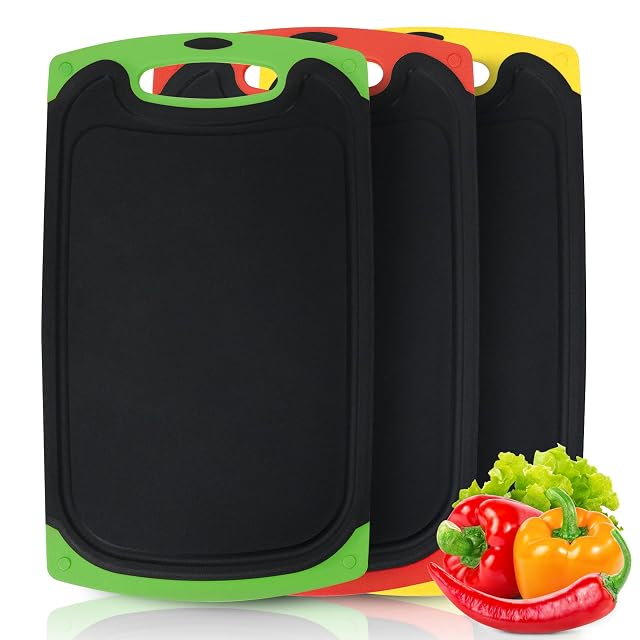
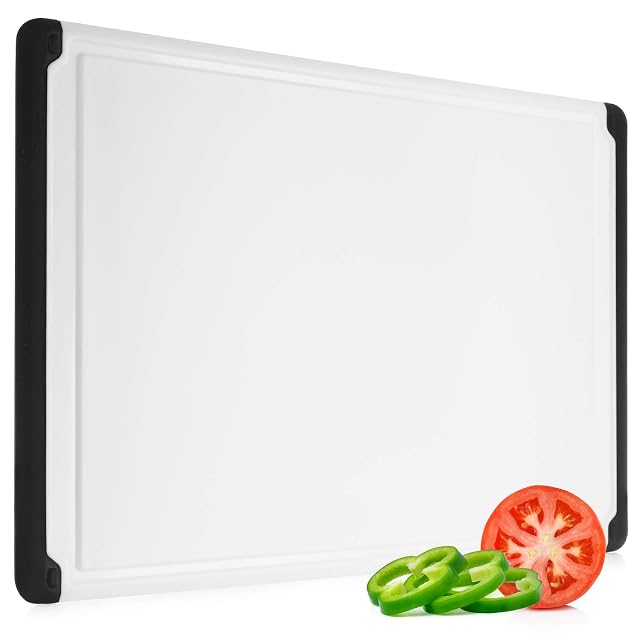
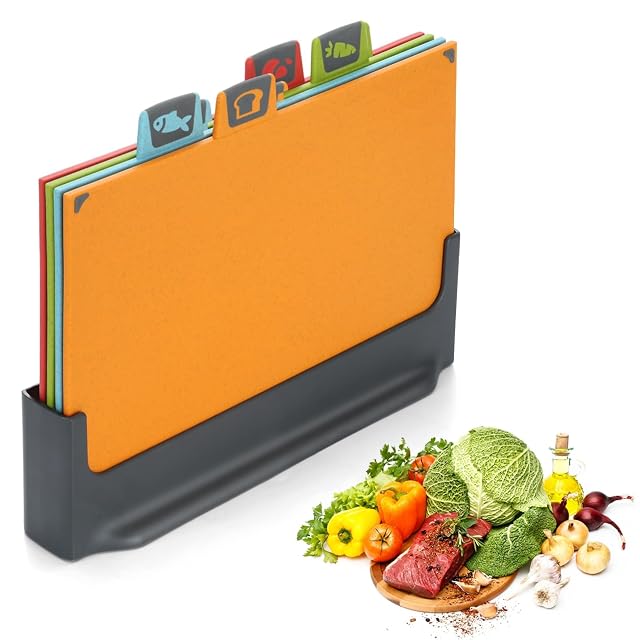
What the maker puts in writing
- “3rd Party Tested for durability, thick cutting boards have a nonporous surface that won’t splinter or peel, unlike wood cutting boards or a bamboo cutting board; deep grooves help catch messy juices”
- “designed with slip resistant handle and rubber border, secure grip helps reduce sliding on countertops”
- “unlike wood or bamboo boards, ours are dishwasher safe; tough plastic material helps to prevent liquid and odor absorption”
- “each cutting board is tested to comply with US regulations, to be BPA free and food grade… wash in the dishwasher time after time, boards will not break down”
- “largest 16 x 11.2 in, medium 13.8 x 9.6 in, small 11.8 x 8 in, each .37 in thick, combined 4.25 lbs”
The border is the clever part
Four boards on this shelf use rubber feet — Belwares, Viretang, ROTTOGOON, OXO — and feet do work: they stop a board sliding and lift it so the underside dries.
What they also do is commit the board to one side up. Feet on one face hold it off the counter when you turn it over, and it rocks under the knife.
GORILLA GRIP uses a rubber border instead: a strip round the rim, which grips whichever way the board is laid.
Empune does the same thing with “black TPR edge handles”. Those two are the only listings here with grip and both faces.
And it exposes the three listings that claim feet and reversibility together — Viretang, Belwares and the implicit case of ROTTOGOON — which cannot both be true.
Third-party testing, and what it is worth
3rd Party Tested for durability. And separately: each cutting board is tested to comply with US regulations, to be BPA free and food grade.
The only external-verification claim on this shelf. The nearest is Farberware citing NPD Group for a market-share figure — dated April 2016.
What is missing is the body and the standard. Without a named laboratory or a referenced method, “tested for durability” cannot be checked.
It is still more than the “heavy-duty” and “premium” adjectives on the other ten listings, and the regulatory-compliance half is a more specific claim than a bare “BPA free”.
16 × 11.2, 13.8 × 9.6 and 11.8 × 8 inches. Each 0.37 in thick. Combined 4.25 lb.
Only Freshware and Viretang publish as much, and six boards on this shelf publish no thickness at all — which is the specification that decides how a plastic board ages:
- 5 mm (0.20 in) — Farberware 8 × 10 · 6.35 — Farberware 11 × 14 · 7.6 — Freshware
- 8.9 — Viretang · 9.4 mm (0.37 in) — this · 9.9 — Empune
Thickness resists flex when you lean on a corner, and warping in a hot dishwasher: polypropylene softens as it heats, and a thin sheet cooling unevenly takes a permanent bow. Fotouzy publishes a <90 ℃ limit on its 4 mm (0.16 in) mats for exactly that reason.
At 9.4 mm (0.37 in) this is the second thickest on the shelf, and the listing leans on it: wash in the dishwasher time after time, boards will not break down.
Seven dollars thirty a board
- $2.50 — Fotouzy flexible mats, four
- $4.66 — Freshware and Viretang, three each
- $5.66 — ROTTOGOON · $7.30 — this · $8.00 — HOMWE · $8.75 — Empune, four
- $13.98 — OXO, two · $20.99 — Belwares, one
So the two $4.66 sets are the direct comparison. What this has over them is the thickness, the border, the published weight and the testing.
What is not published
No material named, where both Farberwares, HOMWE and Fotouzy say polypropylene — the right plastic: non-porous, and tough enough to take a knife without shedding chips. “Tough plastic material” is not the same information.
No warranty, where Empune publishes a limited lifetime and Fotouzy a lifetime no-questions-asked.
Availability
On sale at around $22 on the American Amazon store at the time of checking.
Prices and availability are what Keepa reported on the date this page was updated; both move.
Prices quoted in this text were read on 4 October 2026. The live price is at the top of the page.
The questions that come in
Why is a rubber border better than feet?
Because it does the same job without costing you the second face. Four boards on this shelf use rubber feet — Belwares, Viretang, ROTTOGOON, OXO — and feet work: they stop the board sliding and they lift it so the underside dries. What they also do is commit the board to one side up, because feet on one face hold it off the counter when you turn it over. GORILLA GRIP publishes "slip resistant handle and rubber border" instead: a strip round the rim, which grips whichever way the board is laid. Empune does the same with "black TPR edge handles". Those two are the only listings here that have grip and both faces — and it exposes the three that claim feet and reversibility together, which cannot both be true.
What does "3rd Party Tested" actually tell you?
That somebody outside the company looked, and no more than that. GORILLA GRIP publishes "3rd Party Tested for durability" and, separately, "each cutting board is tested to comply with US regulations, to be BPA free and food grade". It is the only external-verification claim on this shelf — the nearest is Farberware citing NPD Group for a market-share figure, from April 2016. What is missing is the body and the standard: without a named laboratory or a referenced test method, "third-party tested for durability" cannot be checked. It is still worth more than the unverified "heavy-duty" and "premium" adjectives on the other ten listings, and the regulatory-compliance half is a more specific claim than plain "BPA free".
Is it worth $7.30 a board?
For the border and the thickness, arguably. Two three-board sets on this shelf are $4.66 a board — Freshware (7.6 mm (0.30 in), grooves, all dimensions published) and Viretang (8.9 mm (0.35 in), grooves, a garlic-grinding patch, but also the feet-plus-reversible contradiction). HOMWE is $8.00 and Empune $8.75 for four boards with a limited lifetime warranty. What GORILLA GRIP has over the cheap pair: 9.4 mm (0.37 in) thickness, the rubber border that keeps both faces usable, a published combined weight (4.25 lb), and the testing claim. What it lacks against Empune is a warranty, and against Farberware a named material.