What the maker puts in writing
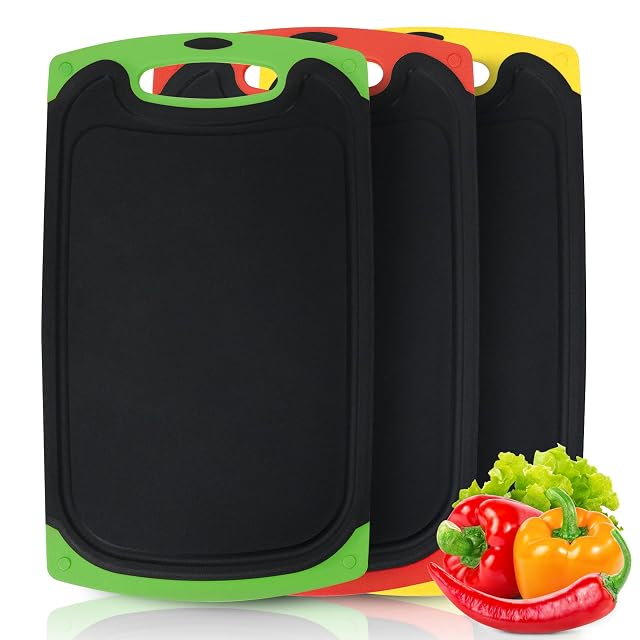
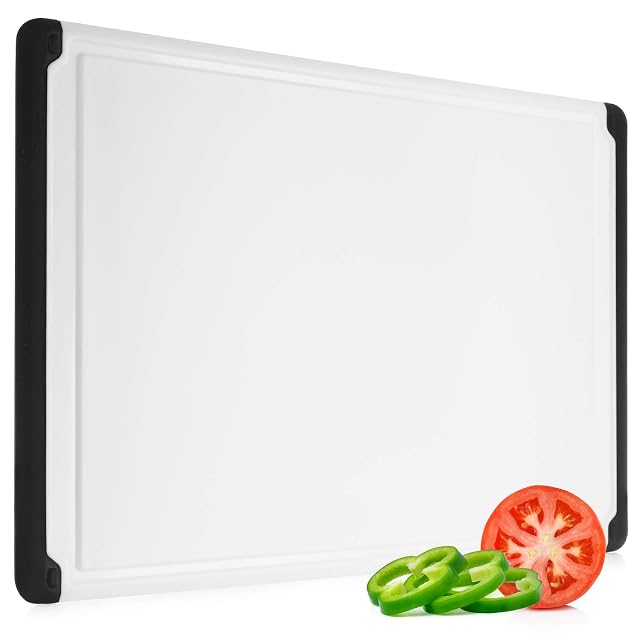
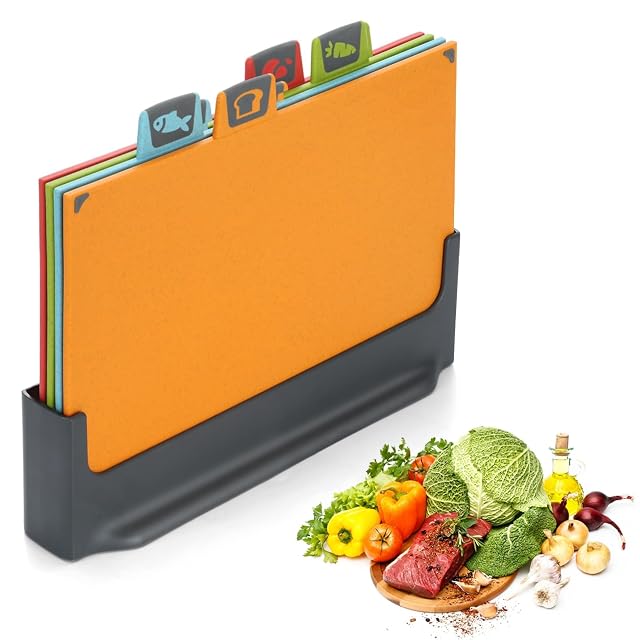
- “This set includes large, medium, and small cutting boards… Perfect for slicing fruits, dicing vegetables, preparing meats, or carving roasts. Use over the si[nk]”
- “Made from high-quality, food-grade polypropylene, these cutting boards are built to resist cracking, peeling, or splintering. Non-toxic and safe for daily use”
- “Each cutting board is equipped with textured grips that keep the board steady during chopping, slicing, and carving. Prevents slipping accidents and adds stability on countertops or sinks”
- “simple to clean and fully dishwasher safe. Resistant to odors, stains, and knife scarring”
- “Built-in grooves catch liquid from meats, fruits, and vegetables… Keeps countertops clean and drip-free while chopping juicy foods like tomatoes, watermelon, or freshly carved roasts”
- “Designed for versatile use as a meat cutting board, vegetable chopping board, or bread board. Doubles as a carving station for BBQs or serving tray for cheese and snacks”
It names the plastic
Food-grade polypropylene.
Four of twelve boards here name their material: both Farberwares, Fotouzy and this. The other eight say “plastic”, “thick heavy-duty plastic” or “BPA-free plastic”.
Polypropylene is the right one. Genuinely non-porous, so it absorbs no juice. Tough enough to take a knife without shattering or shedding chips. And it tolerates dishwasher heat better than polyethylene.
And “BPA-free” is worth less than naming the polymer: BPA is used in polycarbonate, not in PP. True, and empty.
Over the sink, which almost nobody mentions
Adds stability on countertops or sinks. And the first bullet: use over the si[nk].
That is how people actually work in small kitchens — bridge the bowl, chop, and let the trimmings go straight down.
Two things have to be right for it, and this listing gets one.
It must not flex. Unsupported in the middle, a thin board bows under a knife. Which makes the missing thickness a real gap here: the published range on this shelf is 5 mm to 9.9 mm, nearly double, and six listings publish nothing.
It must not slide. And here the choice is correct: textured grips rather than feet, because feet on a board bridging a sink sit on nothing at all. Four boards here use feet — Belwares, Viretang, ROTTOGOON, OXO.
Then the juice groove earns its place, because over a sink nothing catches what runs off the edge.
Grips and reversible, which is coherent
HOMWE claims both, and the claim holds — textured grips are molded into the edge, so they work either way up.
That matters because three listings on this shelf claim rubber feet and reversibility: Viretang, Belwares and (implicitly) ROTTOGOON. Feet on one face hold the board up when you turn it over.
The other coherent answers here are a rubber border (GORILLA GRIP) and TPR edge handles (Empune).
And the longest list of uses on this shelf
Meat board, vegetable board, bread board, carving station for barbecues, serving tray for cheese and snacks.
Which is a fair description of what a set of three plastic boards actually does. The carving use is the one worth noting, because that is where the juice groove and the stability both pay off at once.
Eight dollars a board
- $4.66 — Freshware (all nine dimensions published, 0.3 in) and Viretang (0.35 in, grinding patch)
- $5.66 — ROTTOGOON · $7.30 — GORILLA GRIP (three sizes, 0.37 in, combined weight, third-party testing)
- $8.00 — this · $8.75 — Empune, four boards with a limited lifetime warranty
What is not published
No board dimensions at all — “large, medium, and small”. No thickness. On a page this well written, those are the omissions that matter, and they are exactly what the cheaper sets here do publish.
No warranty — Empune and Fotouzy both have one.
Availability
On sale at around $24 on the American Amazon store at the time of checking.
Prices and availability are what Keepa reported on the date this page was updated; both move.
Prices quoted in this text were read on 4 October 2026. The live price is at the top of the page.