What the maker puts in writing
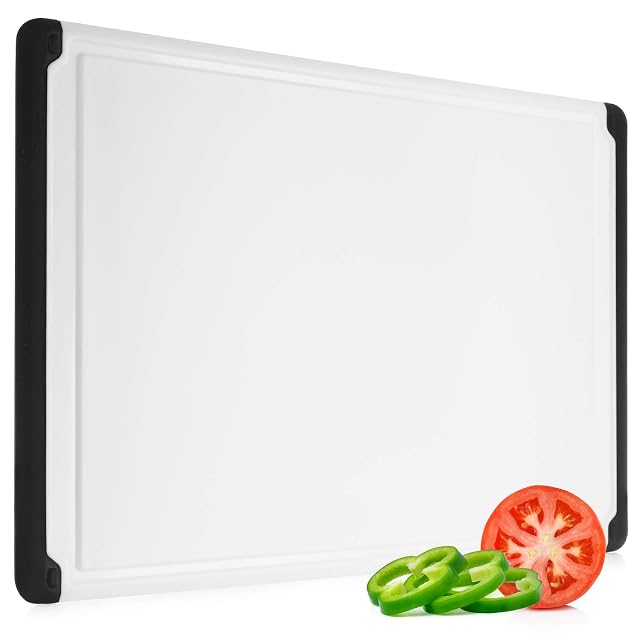
- “Includes one 7.25 x 10.75 inch Prep Board and one 9 x 12.9 inch Everyday Cutting Board”
- “Double-sided, non-porous cutting boards resist odors, help prevent cross-contamination and protect knife edges”
- “Soft, tapered edges double as handles, making it easy to lift and move both boards. The smaller Prep Board is ideal for snacks and produce, while the Everyday Board is ideal for making meals”
- “Built-in drip-catchers and easy-pour corners control liquid runoff to keep countertops cleaner”
- “Non-slip feet grip countertops firmly, keeping the cutting board steady while chopping, slicing or trimming”
Tapered edges instead of a hole
The only listing on this shelf to do it, and it fixes two things a hand hole gets wrong.
Both Farberware boards here use a hole cut through the board. So does Allsum and Fibogollo on the wooden shelf.
A hole takes a bite out of the cutting surface — the board is smaller than its dimensions suggest, and you cannot chop across that corner. And it makes a pocket that holds water, which on a board that goes in a dishwasher is a wet spot that never dries.
Soft, tapered edges double as handles. The full face stays usable, and there is nothing to trap moisture.
Easy-pour corners, which almost nobody addresses
You have diced an onion. Now it has to get into the pan — and on a flat rigid board you push it toward the edge with the knife and lose a third over the side.
OXO molds “built-in drip-catchers and easy-pour corners”: a shaped corner that funnels, so the board becomes a chute.
Fotouzy’s flexible mats solve the same problem by bending — they “curl to a certain angle, which is helpful to pour the chopped food”. Those two are the only listings here that address it.
The difference is that a rigid board with a pour corner still supports a knife, where a 4 mm (0.16 in) mat does not.
And it names each board by its job
A 7.25 × 10.75 in Prep Board. A 9 × 12.9 in Everyday Cutting Board.
With the uses attached: the Prep Board for snacks and produce, the Everyday Board for making meals.
That is more thought than any other listing here shows about which size is for what. HOMWE publishes only “large, medium, and small” with no dimensions at all.
But feet and double-sided pull against each other
The listing claims non-slip feet and double-sided use.
Feet on one face hold the board up when you turn it over. Belwares (“rubber feet” plus “flip it over”) and Viretang (“non-slip rubber feet” plus “reversible design”) make the identical pair of claims on this shelf.
The clean answers here are a rubber border (GORILLA GRIP) or TPR edge handles (Empune), which grip either way up.
In OXO’s case the tapered edges may themselves be the grip and the feet small enough to work both ways. The page does not resolve it.
Fourteen dollars a board
Second most expensive on this shelf, and neither board is large:
- $2.50 — Fotouzy mats, four · $4.66 — Freshware or Viretang, three
- $5.66 — ROTTOGOON · $7.30 — GORILLA GRIP · $8.00 — HOMWE · $8.75 — Empune, four
- $13.98 — this, two · $20.99 — Belwares, one 18 × 12 in board
The largest board here is 9 × 12.9 in, against 16 × 11.2 for GORILLA GRIP’s largest and 18 × 12 for the Belwares. So this is a prep set, not a carving set.
What is not published
No thickness, the specification that decides whether a board warps in a hot dishwasher. The shelf runs from 5 mm to 9.9 mm; six listings publish nothing.
No material name, where both Farberwares, HOMWE and Fotouzy say polypropylene.
No dishwasher statement at all, where nine of the twelve boards here make one. No warranty.
Availability
On sale at around $28 on the American Amazon store at the time of checking.
Prices and availability are what Keepa reported on the date this page was updated; both move.
Prices quoted in this text were read on 4 October 2026. The live price is at the top of the page.