What the maker puts in writing
- “Set includes three acacia wood cutting boards; sizes are 15″x10″ for large tasks; 12″x8″ for medium chopping; 9″x6″ for travel or small tasks”
- “Made from 100% acacia wood; known for its strength and natural beauty; resists water and stains; gentle on knife blades”
- “Features deep juice grooves on all three boards; prevents spills and keeps your countertop clean”
- “Suitable as cutting boards or for serving cheese and charcuterie”
- “An ideal gift for cooking enthusiasts”
Solid hardwood for the price of a laminate
This is the cheapest real wood on the shelf, and the distinction is worth making properly.
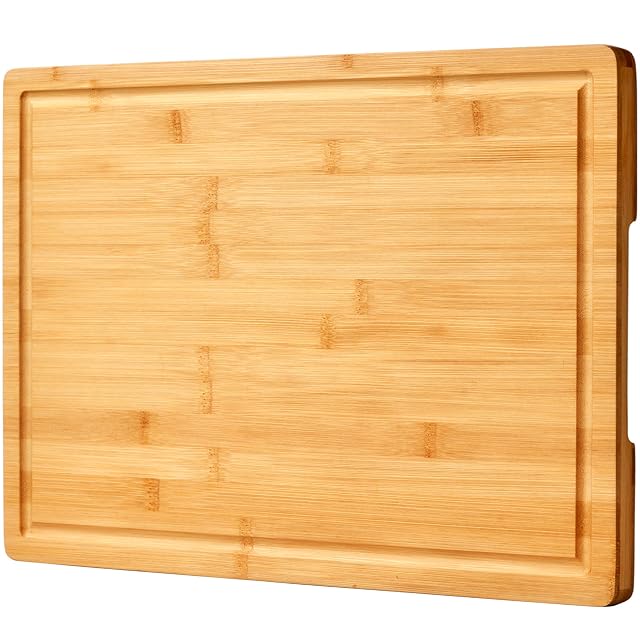
Five of the nine boards here are bamboo, which is a grass: culms sliced into strips and glued side by side. Every bamboo board is a laminate with glue lines running through it, and those lines are where a board opens up after a dishwasher cycle or a damp winter.
Acacia is solid hardwood. No glue lines.
It is also slightly softer than bamboo, which is better for knives — an edge is blunted by what it cuts into, and bamboo measures harder than maple. Farberware on this shelf states that bamboo is “harder and more durable than traditional wood” and, in the same sentence, “gentle on knives”. Those pull against each other.
Price per board across this shelf:
- $4.25 — Farberware, four bamboo
- $6.66 — this, three acacia
- $9.98 — Royal Craft Wood, three bamboo
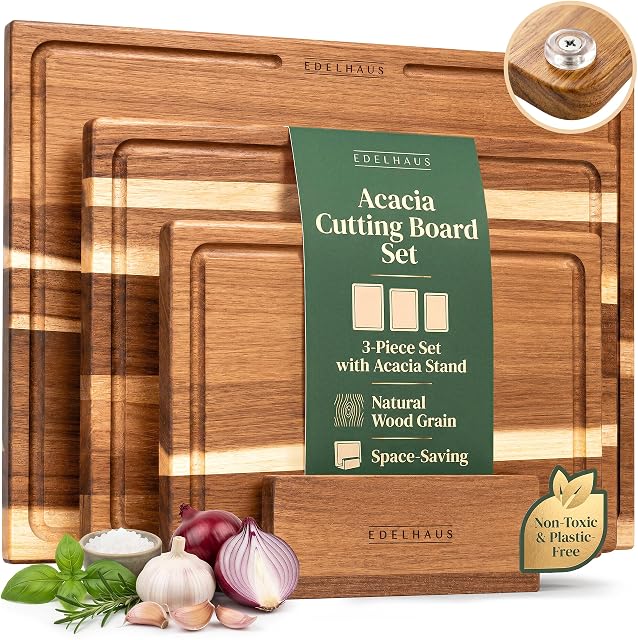
- $16.65 — EDELHAUS, three acacia · $20.00 — WALDWERK, three acacia
So you can have acacia for less than some bamboo.
Three sizes, all published
15 × 10 in for large tasks. 12 × 8 for medium chopping. 9 × 6 for small jobs.
That is more than several listings here manage — Farberware sells a four-piece set and publishes no individual sizes at all, and Fibogollo never says how many boards you get.
And deep juice grooves on all three, including the small one. Viretang, on the plastic shelf of this site, is honest that its extra feature is missing from the smallest board; AIDEA puts the groove on every board.
Five one-line bullets, and what they leave out
No care instructions. On solid wood that is the gap that matters. The board must not go in a dishwasher — Allsum is the only listing on this shelf to state the ban outright — and it must not be stored damp or flat, which is how a board cups. Allsum again: keep it away from humid environment when storage.
No finish. Four boards here state one: mineral oil (Allsum, Fibogollo), pre-oiled carbonized bamboo (Royal Craft Wood), natural beeswax (WALDWERK). That decides whether the board can be maintained: oil and wax soak in and can be renewed indefinitely, while a varnish sits on top, chips, and then lets water underneath where nothing can reach it.
Buy mineral oil and treat it monthly regardless.
No stand, where the two dearer acacia sets include one and both name drying as the reason. No non-slip feet — only EDELHAUS has them. No weight. No warranty.
Availability
On sale at around $20 on the American Amazon store at the time of checking.
Prices and availability are what Keepa reported on the date this page was updated; both move.
Prices quoted in this text were read on 4 October 2026. The live price is at the top of the page.
The questions that come in
Is acacia better than bamboo?
It is a different thing, and on two counts it is better. Bamboo is a grass: boards are made by slicing culms into strips and gluing them side by side, so every bamboo board has glue lines running through it — and those are where a board opens up after a dishwasher cycle or a season of damp. Five of the nine boards on this shelf are bamboo. Acacia is a solid hardwood with no glue lines at all. It is also slightly softer than bamboo, which is better for your knives: an edge is blunted by what it cuts into, and bamboo measures harder than maple. WALDWERK on this shelf puts the acacia case plainly — "known for its particular strength and hardness" and "extremely stable". At $6.66 a board this is the cheapest route to it here.
How do I look after it?
The listing does not say, which is the real gap on this page — and on solid wood the answer matters. Do not put it in a dishwasher: Allsum on this shelf is the one listing that states the ban outright, and it applies to every board here. Wash it by hand, and — the part only Allsum mentions — do not store it damp or flat against a wall, because a board that dries on one face cups. Stand it on edge. And oil it: a wood board needs food-grade mineral oil every month or two, which is why Allsum and Fibogollo state they come pre-oiled and WALDWERK states natural beeswax. AIDEA publishes no finish at all, so you cannot tell from the page whether it arrives oiled or sealed.
What do the dearer acacia sets add?
A stand and a finish, mostly. The three acacia sets on this shelf are this at $19.99, EDELHAUS at $49.95 and WALDWERK at $59.99, all three-piece with juice grooves and near-identical board sizes. What the money buys: both dearer sets include a storage stand, and both name drying as the reason rather than tidiness — which is correct, because a board laid flat dries on one face and cups. WALDWERK publishes its finish (natural beeswax, with "no cheap varnish or plastic coating") and a 60-day refund; EDELHAUS adds non-slip feet, the only ones on this shelf, and serving compartments. AIDEA has none of those. Whether $30 or $40 is worth a stand and a wax finish is a fair question.