What the maker puts in writing
- “Made from high-quality bamboo wood… The dense fiber structure of bamboo resists cracking and wear”
- “Perfect for cutting meat, vegetables, fruit, bread and cheese”
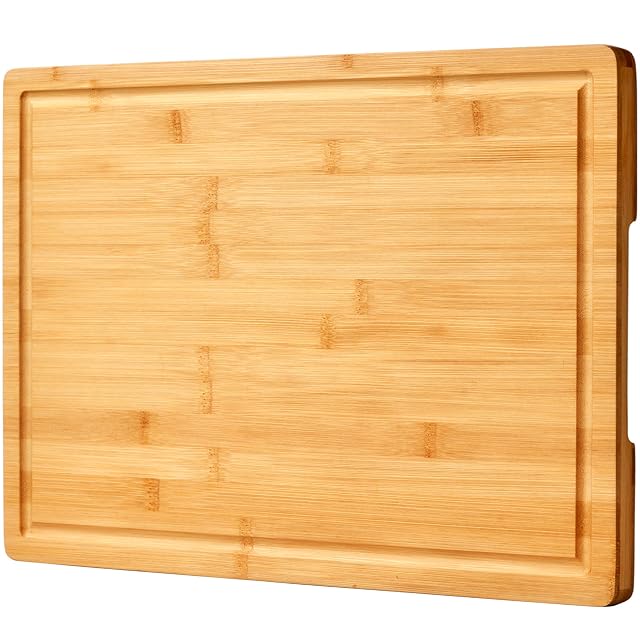
- “Every board features a wide juice groove to catch liquids… The built-in ergonomic handle makes lifting and carrying easy”
- “This bamboo cutting board is pre-treated with mineral oil to create a protective layer that prevents moisture and stains”
- “The finely sanded surface resists scratches and is gentle on knife edges… Cleaning is simple: just rinse with water and wipe dry after each use”
The instruction that matters most
“rinse with water and wipe dry after each use”
That one sentence is worth more than most of this shelf. A wood board does not fail from cutting — it fails from water: left wet it stains, smells, cups, and on a laminate it opens along a glue line.
Four of the nine boards here give a care instruction. Allsum is the blunt one — please DONOT pass it in a dishwasher. Keep it away from humid environment when storage. Farberware says hand wash and dry immediately. Five say nothing at all.
Mineral oil, which is a finish you can renew
Pre-treated with mineral oil to create a protective layer.
There are two ways to protect wood and only one of them is repairable.
Seal it — varnish, lacquer, a “protective finish” — and it looks perfect until the film chips. Then water goes underneath and nothing short of stripping the board will fix it.
Feed it — oil or wax, which soaks into the fiber. Re-oil it every month or two and the board lasts decades.
Allsum also states food-grade mineral oil. WALDWERK uses natural beeswax and is the only listing here to name the alternative it rejects: no cheap varnish or plastic coating. Four boards on this shelf name no finish at all.
Nine millimeters
The thinnest board here, and thickness is what resists cupping:
- 9 mm (0.35 in) — this
- 10 mm (0.39 in) — Royal Craft Wood, two-piece
- 19 mm (0.75 in) — Allsum, single 18 × 12 in
- 20 mm (0.79 in) — Farberware · 20 mm (0.79 in) — Hilmon
The three acacia sets publish stacked heights of 89 to 110 mm (3.50 to 4.33 in) for three boards, so each is thicker again.
At 9 mm (0.35 in) the compensation is habit: never leave it wet, never leave it flat on a wet worktop, stand it on edge.
An embedded handle
Rather than a cut-out hole. Which keeps the cutting surface whole — a hole through a board is a hole you cannot chop over, and a place water sits.
And bamboo, honestly
Bamboo is a grass, not a wood, and a bamboo board is strips of culm glued side by side. Five of the nine boards here are bamboo and all five call themselves wooden.
It is also harder than most hardwood, which this listing presents as a virtue — “resists cracking and wear” — and then pairs with “gentle on knife edges”. Those pull against each other: a harder surface takes an edge down faster. Farberware states both halves in one sentence on this shelf.
No board count. No sizes. No weight. No warranty — three boards here have one.
Availability
On sale at around $10 on the American Amazon store at the time of checking.
Prices and availability are what Keepa reported on the date this page was updated; both move.
Prices quoted in this text were read on 4 October 2026. The live price is at the top of the page.
The questions that come in
Why does mineral oil matter?
Because it is the one finish on a wood board that can be renewed forever. There are two ways to protect wood: seal it with a varnish or lacquer, which sits on top, or feed it with an oil or wax, which soaks in. A sealed board looks perfect until the film chips — and then water gets underneath it and you cannot repair the finish without stripping the whole board. An oiled board needs re-oiling every month or two, and that is the whole maintenance: wipe on food-grade mineral oil, leave it, wipe off the excess. Fibogollo and Allsum both state mineral oil here; WALDWERK goes further with natural beeswax and says explicitly "no cheap varnish or plastic coating". Four of the nine boards on this shelf name no finish at all.
Is nine millimeters thick enough?
It is the thinnest on this shelf, and thickness is what resists warping. A wood board cups because it takes up water on one face and not the other, and the thinner it is the less it can resist that bending moment. The published figures here: 9 mm (0.35 in) for this, 10 mm (0.39 in) for Royal Craft Wood’s two-piece set, 19 mm (0.75 in) for the Allsum single board and 20 mm (0.79 in) for the Farberware and Hilmon boards. The acacia sets (WALDWERK, EDELHAUS, AIDEA) publish only stacked heights of 89 to 110 mm (3.50 to 4.33 in) for three boards, so each is substantially thicker again. At 9 mm (0.35 in) the mitigation is in your hands: never leave it wet, never leave it flat on a wet worktop, and stand it on edge to dry.
Can it go in the dishwasher?
No, and this listing does not say so — which is the gap. Five of the nine boards on this shelf give no washing instruction at all. The one that is unambiguous is Allsum: "please DONOT pass it in a dishwasher. Keep it away from humid environment when storage." That is right for every board here, and for bamboo it is more serious than for solid wood. Bamboo is a laminate: strips of culm glued side by side, so a bamboo board has glue lines running through it, and a dishwasher cycle — hot water, alkaline detergent, a long damp cool-down — attacks them. The board delaminates along a joint and then splits. Fibogollo’s own instruction is the correct one: *rinse with water and wipe dry after each use*.