Peelers
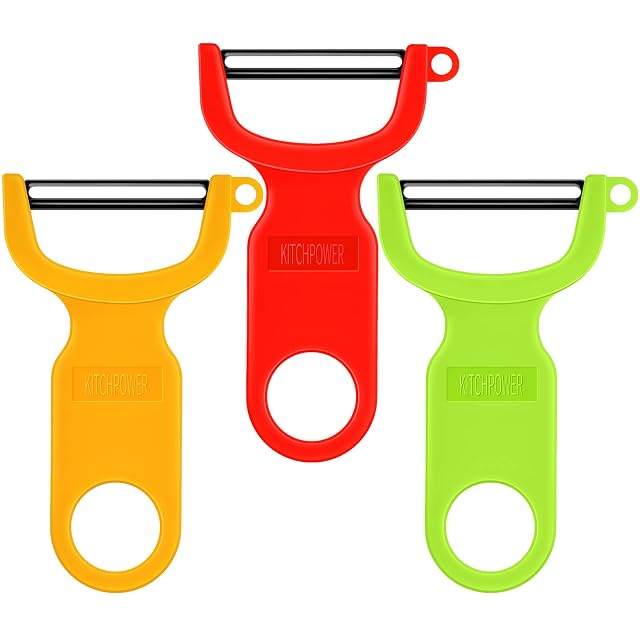
KITCHPOWER Three peelers, carbon steel
Three carbon steel swivel peelers for ten dollars, with hand washing recommended.
Specifications
- Quantity
- THREE peelers — red, green and yellow
- Cost each
- $3.33
- Blades
- Dual carbon steel, stated rustproof and ultra sharp
- Handle
- High-quality ABS, stated not to discolour
- Handedness
- Works in right or left hand
- Repetitive use
- Stated comfortable during repetitive peeling
- Washing
- Hand washing recommended — the honest instruction for carbon steel
- Clogging
- Stated to handle bumps and curves without clogging or losing its edge
- Catalog weight
- 32 g (1.1 oz) for all three, which is implausible — see the FAQ
- Eye remover
- None, where seven peelers here have one
- Swivel
- Stated in the title
- Blade guard
- None
- Warranty
- Not published by the maker
- Amazon reference
- B083PQLPPT
- EAN
- 0779207910565
What you are getting
Three swivel peelers — red, green and yellow — with dual carbon steel blades and ABS handles, for right or left-handed use. Hand washing recommended.
Three for ten dollars
Three dollars thirty-three each, which is below the cheapest single peeler on this shelf (Rainspire at $3.99).
And three colors is more useful than it sounds in a busy kitchen: one for raw, one for cooked, or simply three so there is always one clean.
Carbon steel, which is a real choice
One of two carbon blades here, with FUHUY.
Carbon steel takes a keener edge than most stainless and holds it longer, because it can be hardened further — which is why traditional Swiss peelers are made of it.
The cost is that it rusts. Hence the word “rustproof” in the bullet, which is doing a lot of work, and hence the instruction that follows.
And the instruction is the honest one
“Hand washing recommended.”
This is the only carbon-blade listing on this shelf that says so. FUHUY, also carbon steel, claims “dishwasher safe”.
Both cannot be right about the same metal. A dishwasher is a hot alkaline bath followed by a long damp cool-down, which is precisely how carbon steel spots. Wash a carbon peeler by hand and dry it.
Both hands, and arthritis
Ergonomic design works in right or left hand, and the handle is comfortable even during repetitive action peeling.
Four listings here name arthritis; this is one of them.
What is not published
No eye remover, where seven peelers here have one. No warranty. And see the FAQ on the published weight of 32 g for three peelers.
Availability
On sale at around $10 on the American Amazon store at the time of checking.
Prices and availability are what Keepa reported on the date this page was updated; both move.
Prices quoted in this text were read on 4 October 2026. The live price is at the top of the page.
The questions that come in
Is carbon steel better than stainless?
For sharpness yes, for upkeep no — and this shelf stages the argument. FUHUY, the other carbon-blade listing here, says it outright: "carbon steel metal blade which better than stainless steel". The defensible part is that carbon steel contains more carbon and no chromium, so it can be hardened further and takes a finer, longer-lasting edge — which is exactly why traditional Swiss peelers use it. The indefensible part is "rustproof": carbon steel has no chromium oxide layer, so it does rust, and a peeler left wet in a sink will spot within days. KITCHPOWER draws the right conclusion and FUHUY does not: this listing says "hand washing recommended", FUHUY claims dishwasher safe. Wash carbon by hand and dry it.
Can three peelers weigh 32 grams?
No. The catalog lists 32 g (1.1 oz) for the pack, which would be 10.7 g (0.4 oz) each — and the published weights of single peelers on this shelf run from 59 g (2.1 oz) (Rainspire, OXO Julienne) through 68 (Spring Chef, KitchenAid Classic) and 82 (Farberware) to 113 g (4 oz) (OXO Pro, with its die-cast zinc body). A peeler with a dual carbon blade and an ABS handle weighing ten grams is not plausible; that is roughly the weight of the blade alone. Expect something near 180 to 210 g (6.3 to 7.4 oz) for the three. It is worth noting because weight on a peeler is mostly handle: a heavier handle is usually a thicker, softer one, which is what the OXO and Spring Chef listings here are selling.
Why three colors?
The listing does not say, but the use is obvious enough to be worth stating. Color-coding is standard practice in professional kitchens for separating raw from ready-to-eat — the same reason the chopping board shelves on this site sell sets of three or four in different colors. Three peelers in red, green and yellow lets you keep one for potatoes and root vegetables, one for fruit, and one spare for when the others are in the wash. The simpler benefit is just that: there is always a clean one. At $3.33 each this is the cheapest peeler on the shelf per unit, and the colors are the one thing it offers that no other listing here does.