What the maker puts in writing
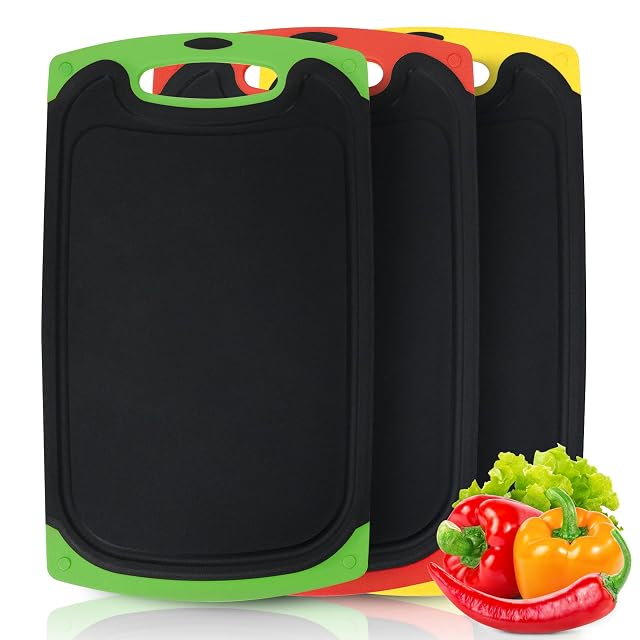
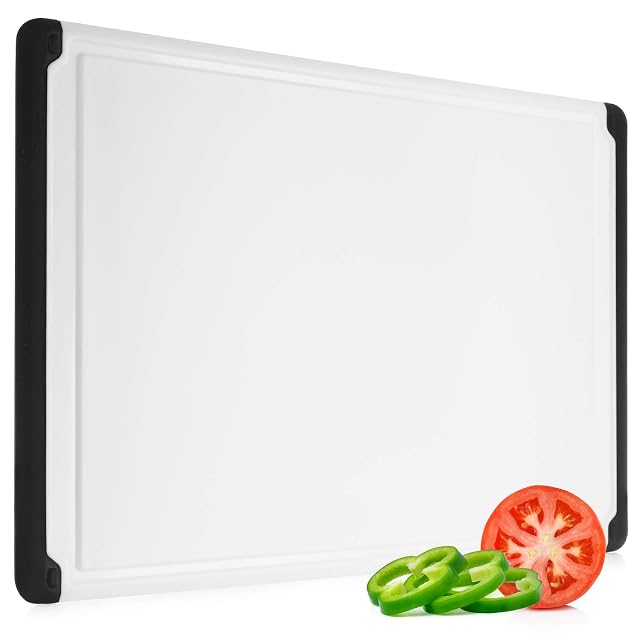
- “Our kitchen chopping boards come with 3 sizes: a small: 10 x 5.8 x 0.3″ size, a medium 12.4 x 7.8 x 0.3″ size, and a large 16 x 9.8 x 0.3″ size. Multi-size cutting boards can be separately used”
- “The plastic cutting board is non-porous, dishwasher safe, which won’t splinter, crack or peel and can be put in the dishwasher for quick, easy cleanup, No oiling or maintenance necessary”
- “Our meat cutting board is tough enough to withstand heavy chopping, slicing, dicing, and sharp knives and surface won’t retain bacteria, stains or odors for long-term use”
Three bullets. The shortest page on this shelf — and it still publishes more measurements than most.
10 × 5.8 × 0.3 in. 12.4 × 7.8 × 0.3. 16 × 9.8 × 0.3.
Length, width and thickness for every board. Only GORILLA GRIP and Viretang are as complete on this shelf; six listings publish no thickness at all.
And thickness is the specification that decides how a plastic board ages:
- 5 mm (0.20 in) — Farberware 8 × 10 · 6.35 mm (0.25 in) — Farberware 11 × 14
- 7.6 mm (0.30 in) — this
- 8.9 mm (0.35 in) — Viretang · 9.4 mm (0.37 in) — GORILLA GRIP · 9.9 mm (0.39 in) — Empune
It resists flex when you lean on a corner, and warping in a hot dishwasher — polypropylene softens as it heats, and a thin sheet cooling unevenly takes a permanent bow. Fotouzy is the only listing here to publish a wash temperature limit for exactly that reason (<90 ℃).
At 7.6 mm (0.30 in) this sits comfortably in the middle.
The honest case against wood, in one sentence
“No oiling or maintenance necessary”
The wooden boards on this site need food-grade mineral oil every month or two, must never go in a dishwasher — Allsum states that ban in capitals — and cup if stored damp.
A plastic board goes in the machine and comes out ready. That is the whole argument, and Freshware puts it plainly along with the other half: it won’t splinter, crack or peel.
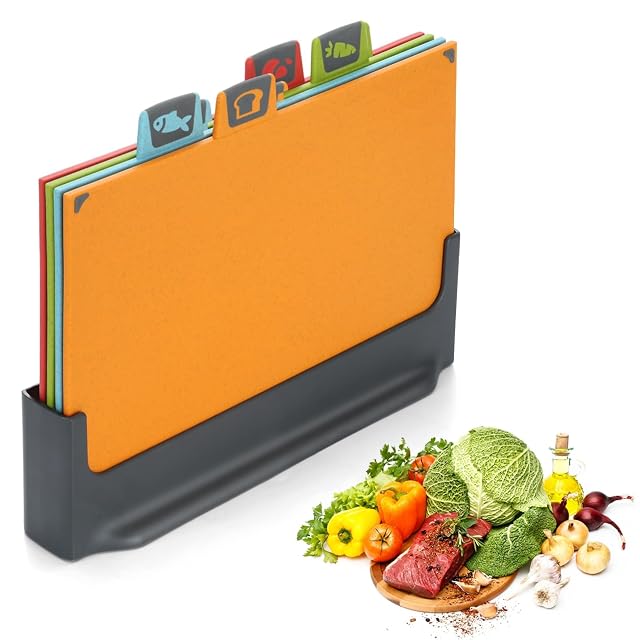
What you give up is that plastic scores. Knife cuts accumulate as grooves that are harder to clean than a fresh surface — which is why cheap replacement and color coding matter. Fotouzy’s flexible set is the only color-coded one on this shelf.
Four dollars sixty-six a board
- $2.50 — Fotouzy flexible mats, four
- $4.66 — this and Viretang, three each
- $5.66 — ROTTOGOON · $7.30 — GORILLA GRIP · $8.00 — HOMWE
- $8.75 — Empune, four · $13.98 — OXO, two · $20.99 — Belwares, one
Where it falls short
Non-slip handles, not feet or a border. A textured grip helps your hand; it does not stop the board moving. Four boards here have rubber feet (Belwares, Viretang, ROTTOGOON, OXO) and two a rubber border or edge handles (GORILLA GRIP, Empune) — and the border is the coherent choice, because feet on one face stop a board being reversible.
The large board is 16 × 9.8 in. Fine for chopping, tight for jointing a chicken or carving a roast. The big single boards here are Belwares at 18 × 12 and Fotouzy at 15.5 × 10.
No material named, where both Farberwares, HOMWE and Fotouzy say polypropylene — the right plastic for a board, non-porous and tough enough to take a knife without shedding chips.
No warranty. Only Empune and Fotouzy publish one.
Availability
On sale at around $14 on the American Amazon store at the time of checking.
Prices and availability are what Keepa reported on the date this page was updated; both move.
Prices quoted in this text were read on 4 October 2026. The live price is at the top of the page.
The questions that come in
Why does publishing thickness matter so much?
Because it is the specification that decides how a plastic board ages, and half of this shelf leaves it out. Freshware gives 0.3 in (7.6 mm) for all three boards. The published range here runs from 5 mm (0.20 in) (Farberware’s 8 × 10) through 6.35, 7.6 and 8.9 to 9.9 mm (0.39 in) (Empune) — nearly double — and six listings publish nothing at all. Thickness does two things: it resists flex, which you notice when you lean on a corner or work over a sink edge, and it resists warping in a dishwasher, because polypropylene softens as it heats and a thin sheet cooling unevenly can take a permanent bow. At 7.6 mm (0.30 in) this sits comfortably mid-shelf — thicker than both Farberwares, thinner than GORILLA GRIP and Empune.
What is the real advantage over a wood board?
No maintenance, and Freshware states it in the plainest terms on this shelf: "No oiling or maintenance necessary" and the board "won’t splinter, crack or peel". That is the honest case. The wooden boards on this site need food-grade mineral oil every month or two, must never see a dishwasher, and warp if stored damp — Allsum states the dishwasher ban in capitals and adds "keep it away from humid environment when storage". A plastic board goes in the machine and comes out ready. What you give up is the feel, and the fact that a plastic board scores: knife cuts accumulate as grooves that are harder to clean than the fresh surface, which is why color-coded sets and cheap replacement matter.
Is a 16-inch large board big enough?
For most jobs, yes; not for carving a bird. 16 × 9.8 in is about 157 square inches, which handles a chopping session comfortably. Where it falls short is the two things that need room to spread: jointing a chicken, and carving a roast with juices running. For those, the single large boards on this shelf are the comparison — Belwares at 18 × 12 in ($20.99, with rubber feet and a deep juice groove) and Fotouzy at 15.5 × 10 ($16.99) — and Empune includes an "extra-large" board in its four-piece set at $34.99. The practical answer in most kitchens is a cheap three-piece set like this for daily work plus one big board, rather than paying for a large board three times over.