What the maker puts in writing
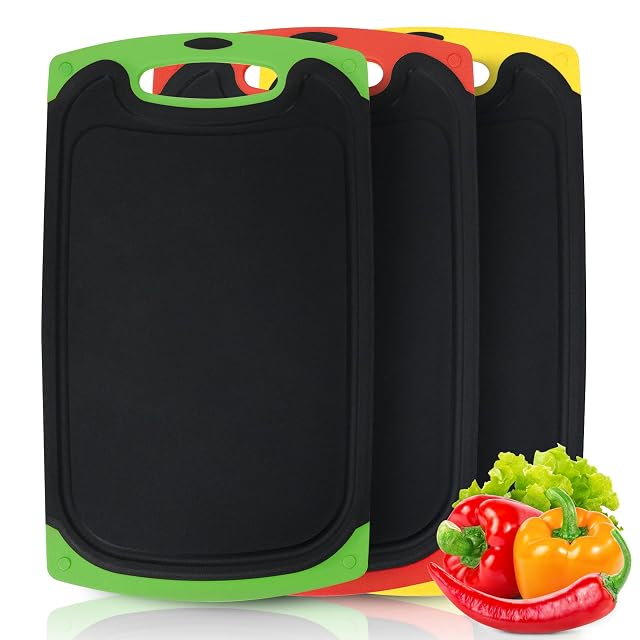
- “Non-slip rubber feet keep these cutting boards stay on the countertop and handle makes Viretang plastic cutting board easy to grip, the handle is also convenient to hang it on the wall”
- “They are made from thick, heavy-duty plastic, and marble pattern design reduces scratches on chopping board… non-porous design makes cutting board dishwash[er safe]”
- “Juice groove along the border can help catching the juices from meat, fruit, or vegetable… Reversible design”
- “A large cutting board for meat or steak (15.6x9.4); A medium cutting board for vegetables (12.4x7.8); A small cutting board for fruits (9.6x5.7). Thickness is 0.35″”
- “We have added the grind place of two bigger cutting boards. (The small cutting board do not have) you can grind out the garlic or ginger on these cutting boards for kitchen more easily”
The only grinding patch on this shelf
A textured field molded into the board — usually small raised pyramids — that you rub a peeled clove of garlic or a knob of ginger against.
What it saves is washing a separate grater for one clove, which is the whole point of it.
Nothing else here has one.
And the bracket that makes the bullet unusual
“(The small cutting board do not have)”
That is rare candour on this shelf. Listings here routinely describe one board’s feature as though it covered the set — and ROTTOGOON cannot even agree with itself about how many boards there are, saying “Set of 4” in the title and “the set of three comes with” in a bullet.
Viretang tells you which board lacks the thing you are buying it for.
But feet and reversible cannot both be true
The listing claims non-slip rubber feet and, separately, a reversible design.
A board with feet on one face cannot lie flat on the other — the feet hold it up and it rocks under the knife.
Belwares makes exactly the same pair of claims on this shelf, and ROTTOGOON publishes “four nonslip rubber feet on bottom”.
The coherent answers here are a rubber border round the rim (GORILLA GRIP) or TPR edge handles (Empune), both of which grip whichever way up the board is.
Assume you get the feet, and one usable face.
Eight point nine millimeters
Upper-middle on this shelf, which matters more than it sounds:
- 5 mm (0.20 in) — Farberware 8 × 10 · 6.35 mm (0.25 in) — Farberware 11 × 14 · 7.6 mm (0.30 in) — Freshware
- 8.9 mm (0.35 in) — this · 9.4 mm (0.37 in) — GORILLA GRIP · 9.9 mm (0.39 in) — Empune
Thickness resists flex under a cleaver and warping in a hot dishwasher, because polypropylene softens as it heats and a thin sheet cooling unevenly takes a permanent bow. Six boards on this shelf publish no thickness at all.
The marble pattern, honestly
Marble pattern design reduces scratches.
A pattern cannot make plastic harder. What it genuinely does is conceal the knife scoring that a plain white board shows within weeks.
Whether that is a feature is a fair question. The argument for plain white — which both Farberwares and the Empune set use — is that you can see when a board is too scored to clean properly, and scored grooves are where bacteria sit.
Plastic boards are consumables either way: Fotouzy’s color-coded mats are $2.50 each.
And a handle you can hang it by
Which is the right storage answer: a board hung on a wall dries on both faces. Laid flat in a cupboard it does not — the problem the wooden boards on this site solve with a stand.
No material named, where both Farberwares, HOMWE and Fotouzy say polypropylene. No warranty — Empune and Fotouzy publish one.
Availability
On sale at around $14 on the American Amazon store at the time of checking.
Prices and availability are what Keepa reported on the date this page was updated; both move.
Prices quoted in this text were read on 4 October 2026. The live price is at the top of the page.