Peelers
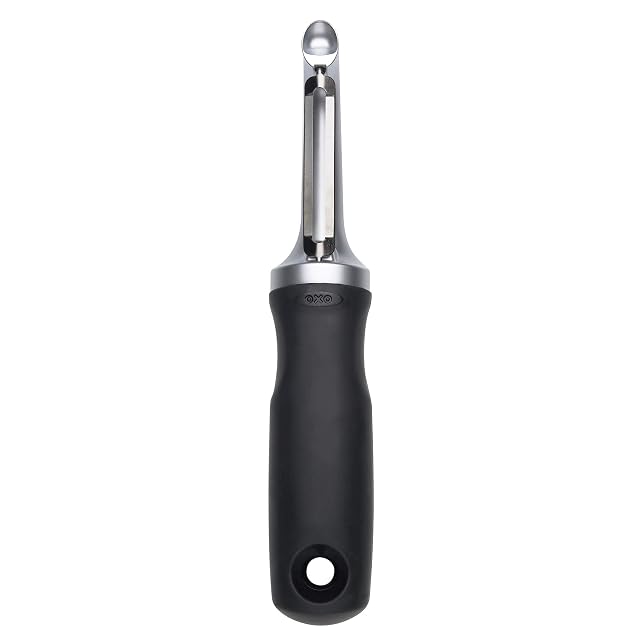
OXO Die-cast zinc, replaceable blade
The only peeler here with a replaceable blade, on a die-cast zinc body at 113 g (4 oz).
Specifications
- Replaceable blade
- Available — the only peeler on this shelf with one
- Body
- Sturdy die-cast zinc
- Blade
- Extra-hardened stainless steel, stated to stay sharp
- Handle
- Non-slip and contoured, with extra cushioning
- Eyer
- Sharp, removing blemishes in one scoop
- Control
- Stated superior on delicate fruit and hearty vegetables
- Dishwasher
- Safe
- Weight
- 113 g (4 oz) — the heaviest peeler on this shelf
- Steel grade
- Not published — only the two KitchenAids publish 420
- Blade guard
- None, where both KitchenAids include one
- Warranty
- Not published by the maker
- Amazon reference
- B0000DAQ46
- EAN
- 0719812006024
What you are getting
A swivel peeler with an extra-hardened stainless steel blade on a die-cast zinc body, a non-slip contoured handle with extra cushioning, a sharp eyer, dishwasher safe — and a replaceable blade available.
Four words that make it the only serious peeler here
“replaceable blade available”
A peeler has exactly one failure mode. It does not break: the edge dulls, the peel stops lifting cleanly, you start pressing, and you gouge the vegetable. At that point eleven of the twelve peelers on this shelf are finished — including the two with lifetime warranties, because a blunt blade is wear rather than a defect.
This one takes a new blade.
For a tool used every week for twenty years, that is the difference between one purchase and twenty.
A metal body, which is the other half
Constructed of sturdy, die-cast zinc.
Only FUHUY’s zinc alloy frame also offers this here; everything else is ABS or unstated plastic.
What a metal frame buys is rigidity at the blade mount. Peeling tries to twist the head, and a plastic frame flexes a little more each year until the blade sits at a slightly wrong angle and stops cutting cleanly — which is a second way a cheap peeler dies, before the edge has even gone.
At 113 g (4 oz) this is the heaviest peeler on this shelf, against 59 g (2.1 oz) for the lightest. That is the zinc.
An extra-hardened blade, and an eyer
Extra-hardened stainless-steel blade stays sharp, with a sharp eyer [that] easily removes blemishes in one scoop.
Seven of twelve peelers here have an eye remover; this is the only one that describes the action.
What is not published
No steel grade — only the two KitchenAids publish one (420). No blade guard, which both KitchenAids include. No warranty, which is less needed when the wearing part is replaceable.
Availability
On sale at around $18 on the American Amazon store at the time of checking.
Prices and availability are what Keepa reported on the date this page was updated; both move.
Prices quoted in this text were read on 4 October 2026. The live price is at the top of the page.
The questions that come in
Is a replaceable blade worth the money?
It is the only answer on this shelf to how a peeler actually ends. A peeler does not break. The edge dulls — gradually, so you do not notice until you are pressing hard and taking flesh with the skin — and then it is done. Eleven of the twelve peelers here are landfill at that point, including the three with warranties: a blunt blade is wear, not a defect, and no warranty covers it. OXO states "replaceable blade available", which turns a $17.95 tool into a handle you keep and a blade you renew. Over the life of a kitchen that is the difference between one purchase and a drawer of dead peelers. The two KitchenAids hedge it differently with a blade guard that keeps the edge from being knocked in storage.
What does the die-cast zinc body do?
It stops the head going out of true, which is the failure nobody expects. Peeling puts a twisting load on the blade mount: you are pushing a blade along a curved surface, and the force tries to rotate the head relative to the handle. On an ABS or plastic frame — which is what nine of the twelve peelers here use — that joint flexes a fraction more each year, until the blade meets the vegetable at a slightly wrong angle and stops taking a clean strip even though the edge is still sharp. Die-cast zinc does not creep. The only other metal frame on this shelf is FUHUY’s "zinc alloy body". The cost is weight: 113 g (4 oz) here against 59 g (2.1 oz) for the lightest peelers, which is also why this one feels like a tool.
How does it compare with OXO’s cheaper swivel peeler?
Eight dollars buys a metal body and a future. OXO sells three peelers on this shelf: the Good Grips Swivel at $9.97 (87 g (3.1 oz), twin swivel blades, eye remover, soft oversized handle), the Julienne at $11.80 (a Y-shaped strip cutter, a different tool altogether), and this Pro at $17.95. Against the standard Swivel, the Pro adds a die-cast zinc body instead of plastic, an extra-hardened blade, extra handle cushioning, and the replaceable blade. It gives up nothing — both have an eye remover, both swivel. So the question is only whether you keep kitchen tools. If a peeler is a thing you replace every few years without thinking, buy the $9.97 one; if it is a thing you expect to still own, buy this.