What the maker puts in writing
- “FINISHED WITH NATURAL BEESWAX – No cheap varnish or plastic coating. The natural beeswax finish protects the wood while preserving its authentic look and feel”
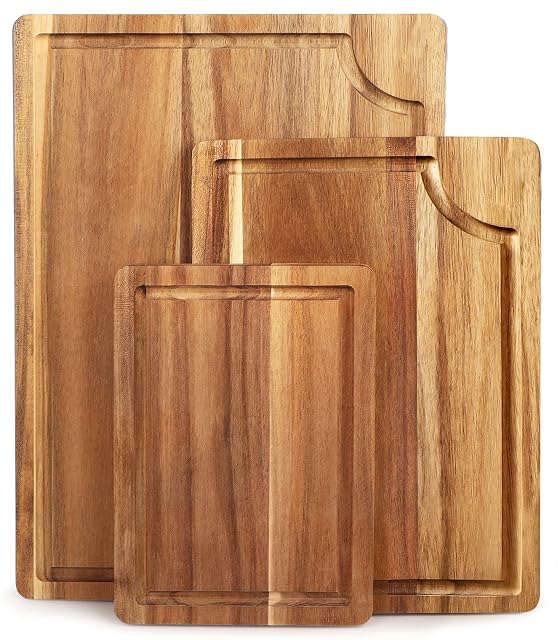
- “SOLID ACACIA WOOD - is known for its particular strength and hardness. The rustic wood is extremely stable and will give you years of enjoyment!”
- “INCLUDING BOARD STAND - for quick drying and elegant storage of your WALDWERK cutting boards”
- “CLEAN WORK - thanks to the milled juice groove. This catches the fruit and vegetable juice that is produced when cutting”
- “60 DAYS MONEY BACK - if your WALDWERK Wood Cutting Boards fail to meet or exceed your expectations, you are free to return it within 60 days for a hassle-free refund”
The only finish on this shelf that is named and defended
“FINISHED WITH NATURAL BEESWAX – No cheap varnish or plastic coating”
This decides whether the board can ever be repaired, and no other listing here addresses it.
Seal wood — varnish, lacquer, “plastic coating” — and the film sits on the surface. The board looks perfect for a year, then the film chips where a knife catches it. Water gets underneath, into wood you can no longer reach, and the only fix is stripping the whole thing.
Feed wood — beeswax, or food-grade mineral oil — and it soaks into the fiber. The maintenance is wiping more on every month or two, and the board lasts decades.
Four boards here state an oil (Allsum, Fibogollo, Royal Craft Wood). Four name no finish at all — including the other two acacia sets. On a $50 board that is the question to ask.
And the stand is for drying
For quick drying and elegant storage.
Drying first, which is the right order.
A board left flat, or propped against a wall, dries on one face while the other stays damp — and that difference across the thickness makes it cup until it rocks on the counter.
EDELHAUS is the only other board here with a stand, and gives the same reason. Allsum states it from the other end: keep it away from humid environment when storage.
Three listings on this shelf treat storage as a technical matter rather than tidiness. They are right.
One thousand four hundred and thirty-nine grams a board
The heaviest wood here:
- 1,439 g (50.8 oz) — this, acacia
- 1,058 g (37.3 oz) — EDELHAUS, acacia
- 1,656 g (58.4 oz) — Allsum, but that is one 18 × 12 in board
- 619 to 621 g (21.8 to 21.9 oz) — both Royal Craft Wood bamboo sets
Mass on a wood board is thickness and density, and both resist cupping. Acacia is a dense hardwood; bamboo is a grass, sliced into strips and glued side by side, with glue lines that open up.
Twenty dollars a board
The most expensive wood on this shelf, and the comparison is unavoidable:
- $6.66 a board — AIDEA, three acacia, $19.99
- $16.65 — EDELHAUS, three acacia, $49.95
- $20.00 — this, three acacia, $59.99
Same material, same three sizes, same juice grooves. What this buys is the named finish, the stand, the mass and a 60-day no-conditions refund — the clearest guarantee on this shelf, against Royal Craft Wood’s unspecified 1-year warranty.
What it does not have is non-slip feet, which EDELHAUS has ten dollars below it and nothing else here does.
What is not published
No care instructions beyond the finish, and no dishwasher statement. Solid wood must never go in one — Allsum is the only listing on this shelf to state the ban in plain terms.
No handles, where Royal Craft Wood has side handles and Allsum and Fibogollo have hand holes. Not stated as reversible — only Farberware is.
Availability
On sale at around $60 on the American Amazon store at the time of checking.
Prices and availability are what Keepa reported on the date this page was updated; both move.
Prices quoted in this text were read on 4 October 2026. The live price is at the top of the page.
The questions that come in
Why does beeswax matter against varnish?
Because it decides whether the board can ever be repaired. There are two ways to protect wood. Seal it — varnish, lacquer, a "plastic coating" — and the film sits on top: the board looks perfect, and then the film chips where a knife catches it. Water goes underneath, into wood you can no longer reach, and the only fix is stripping the whole board. Feed it — beeswax or mineral oil, which soak into the fiber — and the maintenance is wiping more on every month or two, forever. WALDWERK is the only listing on this shelf to name both halves: "finished with natural beeswax – no cheap varnish or plastic coating". Four boards here state oil (Allsum, Fibogollo, Royal Craft Wood) and four name no finish at all, which on a $50 board is the thing to ask about.
What is the stand actually for?
Drying, and WALDWERK says so first: the stand is "for quick drying and elegant storage". That is the right order. A board left flat — on a worktop, or propped against a wall — dries on one face while the other stays damp, and that moisture difference across the thickness makes it cup until it rocks. Stood on edge, both faces dry evenly. EDELHAUS, the only other board here with a stand, gives the same reason ("keeps your boards dry"), and Allsum states it from the other end: "keep it away from humid environment when storage". Those three listings are the only ones on this shelf that treat storage as a technical matter rather than a tidiness one, and they are right to.
Is it worth three times the AIDEA acacia set?
That is the honest question, and the answer is in two features. The three acacia sets here are AIDEA at $19.99, EDELHAUS at $49.95 and this at $59.99 — all three-piece, all solid acacia, all with juice grooves, with near-identical sizes. What this adds: a published finish you can maintain (beeswax, with the alternative named), a stand for drying, 1,439 g (50.8 oz) a board against EDELHAUS’s 1,058, and a 60-day no-conditions refund. What it does not have is non-slip feet, which EDELHAUS has and nothing else here does. So: AIDEA for bare acacia cheaply, EDELHAUS for the feet, this for the finish and the mass. At $20 a board it is the most expensive wood on the shelf.