Mixing bowls
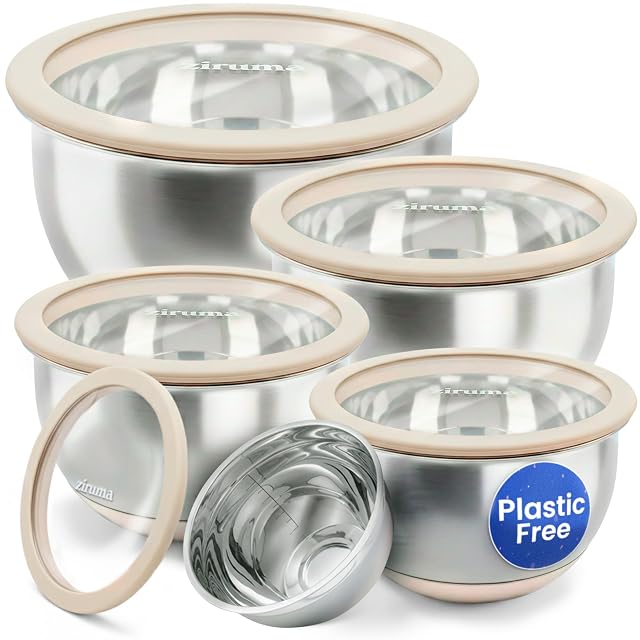
Ziruma 1 to 4.5 qt, glass lids
Five steel bowls from 1 to 4.5 quarts with airtight glass lids, measurement marks and silicone bases.
Specifications
- Pieces
- FIVE bowls — 1, 2, 2.5, 3.5 and 4.5 quarts
- Lids
- Glass, airtight and dishwasher safe — the only glass lids on this shelf
- Why glass
- Plastic lids warp in a dishwasher and stop sealing; glass keeps its shape
- Plastic
- None anywhere — steel bowls, glass lids, silicone bases
- Measurement marks
- Inside the bowls, for accuracy
- Bases
- Non-slip platinum silicone
- Material
- 100 per cent food-grade stainless steel
- Storage
- Nesting
- Cost per bowl
- $12.99
- Microwave
- Not claimed — no steel set here does
- Weight
- Not published by the maker
- Steel gauge
- Not published
- Pour spout
- None
- Warranty
- Not published by the maker
- Amazon reference
- B0D9ZL5DFX
- EAN
- 5060960291127
What you are getting
Five food-grade stainless steel bowls — 1, 2, 2.5, 3.5 and 4.5 quarts — with airtight glass lids, measurement marks inside, non-slip platinum silicone bases, nesting.
The glass lids are the argument, and the shelf proves it
“Say goodbye to flimsy plastic lids! These… come with sturdy, dishwasher-safe glass lids that keep their shape and seal”
Six sets on this shelf have lids, and five of them are plastic. Priority Chef confirms the problem without meaning to: its own instruction reads “top rack dishwasher safe [Wash Lids By Hand]”.
A plastic lid is a thin molding held under tension when it seals, and a hot cycle relaxes it out of shape. Once it has gone, it never seals again.
Glass keeps its shape. It is also heavier, and it breaks if dropped.
Plastic-free, coherently
No plastic ever touches your food — steel bowls, glass lids, platinum silicone bases. Silicone is a polysiloxane rather than a plastic, so the claim holds.
Measurement marks, which two sets have
Mix and measure in the same bowl, no jug to wash. Priority Chef is the other, and its marks are etched — which survives a dishwasher where printed marks fade.
Five bowls, every capacity published
1, 2, 2.5, 3.5, 4.5 qt. Four of the thirteen sets here publish none at all.
Thirteen dollars a bowl
The second most expensive on this shelf. WHYSKO’s five steel bowls are $6.00 each — without lids, marks, bases or published capacities.
What is not published
No weight. No steel gauge. No microwave claim — no steel set here makes one. No warranty, at $64.95.
Availability
On sale at around $65 on the American Amazon store at the time of checking.
Prices and availability are what Keepa reported on the date this page was updated; both move.
Prices quoted in this text were read on 4 October 2026. The live price is at the top of the page.
The questions that come in
Are glass lids really better?
Yes, and the proof is on this shelf. Ziruma argues it directly — "say goodbye to flimsy plastic lids... sturdy, dishwasher-safe glass lids that keep their shape and seal" — and Priority Chef confirms it without meaning to, publishing its own set as "top rack dishwasher safe [Wash Lids By Hand]". The mechanism: a plastic lid seals by being stretched slightly over the rim, so it is under tension — and a hot dishwasher cycle softens it just enough to relax out of shape. After that it never seals properly again, which is the commonest way a bowl set with lids fails. Glass does not deform at dishwasher temperatures. The costs are weight and the fact that glass breaks, where a plastic lid merely stops working.
Is "plastic free" a real claim here?
Yes, and it is coherent, which is more than most such claims manage. The set is stainless steel bowls, glass lids and platinum silicone bases — and silicone is a polysiloxane, a silicon-oxygen polymer, rather than a carbon-chain plastic. So "no plastic ever touches your food" holds up on the materials as described. The comparison on this site is BESTZMWK’s utensil set, which makes the same argument with silicone heads on 304 steel handles. Where such claims usually fail is the lid, and Ziruma is the only set on this shelf that does not have a plastic one. "Platinum" refers to the curing catalyst, which is the higher-grade process for food-contact silicone.
Is it worth twice the WHYSKO?
Only if you want the lids and the marks, and then probably yes. The two five-bowl steel sets here are WHYSKO at $29.99 — $6.00 a bowl — and this at $64.95, $12.99 a bowl. WHYSKO publishes no capacities, no lids, no measurement marks and no non-slip base: it is five deep steel bowls, cheaply. Ziruma publishes all five capacities (1 to 4.5 qt), glass lids, etched-equivalent marks, silicone bases and a plastic-free construction. So you are paying $35 for the lids, the graduations and the bases. If a mixing bowl is also your fridge container and your measuring jug, that is a fair trade. If it is only a bowl, WHYSKO is half the price.