What the maker puts in writing
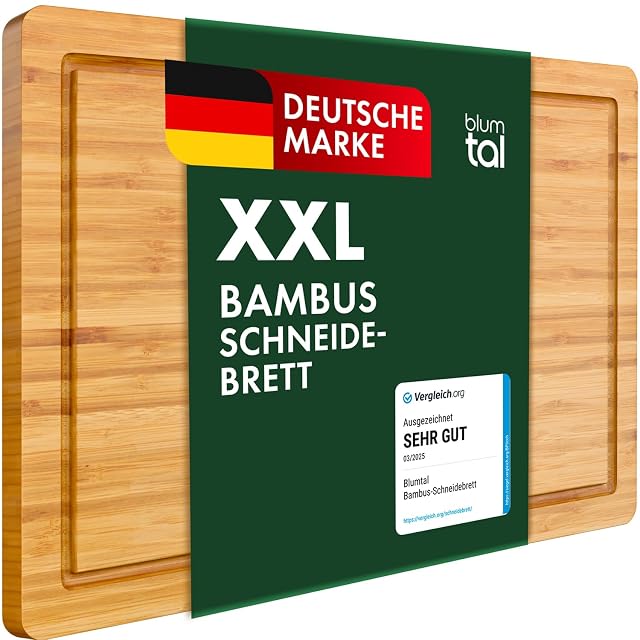
- “18″ x 12″, large and stable, won’t slide on counter while using it. Can be served as a large charcuterie board”
- “100% organic bamboo, which is durable, resilient and eco-friendly. Won’t dull the knife”
- “Every cutting board is nicely polished and per-seasoned with food grade mineral oil before shipment. Smooth, no splinters”
- “Built-in juice groove helps catching juice from running on counter; inner handle will make it easier to be carried around”
- “Wash it under running water and leave it air dry. Please DONOT pass it in a dishwasher. Keep it away from humid environment when storage”
The clearest care instruction on this shelf
“Please DONOT pass it in a dishwasher. Keep it away from humid environment when storage.”
The dishwasher ban is right, and for bamboo more than most: a bamboo board is strips of culm glued side by side, and a hot alkaline cycle with a long damp cool-down attacks the glue lines until the board opens along a joint.
The second sentence is the one nobody else gives, and it is where boards actually die.
A board cups when one face takes up more water than the other — and the way to guarantee that is to stand a damp board flat against a wall or lay it on a worktop. One side breathes, the other does not, and within a week it rocks.
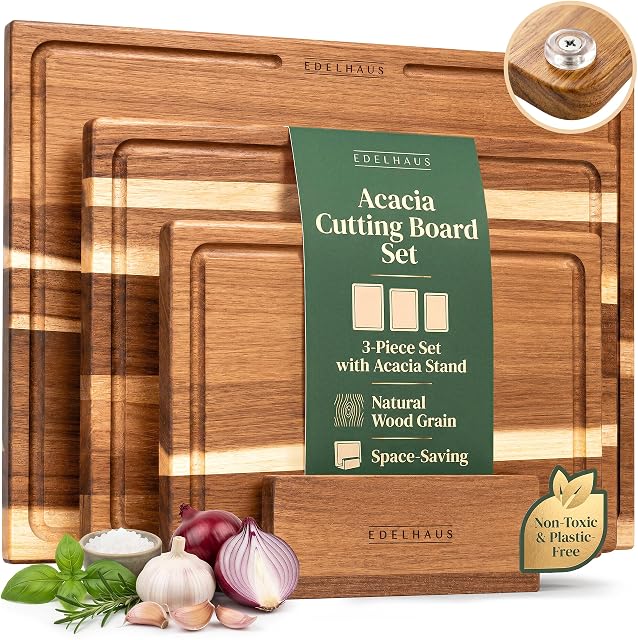
That is also why the two most expensive boards on this shelf include a stand, and why both name drying rather than tidiness as the reason: WALDWERK (“for quick drying”) and EDELHAUS (“keeps your boards dry”).
On a single board, stand it on edge.
Eighteen by twelve, and nineteen millimeters
The largest single board here, and the most substantial bamboo:
- 19 mm (0.75 in) — this
- 20 mm (0.79 in) — Farberware, Hilmon
- 10 mm (0.39 in) — Royal Craft Wood’s two-piece
- 9 mm (0.35 in) — Fibogollo
And 1,656 g (58.4 oz) — nearly the mass of Royal Craft Wood’s entire three-board set, which weighs 1,864 g (65.8 oz).
That mass is the stability claim doing real work: large and stable, won’t slide on counter. Only EDELHAUS on this shelf has non-slip feet; everything else relies on weight, and a light board on a wet worktop moves.
Pre-seasoned with mineral oil
Which is a finish you can renew. Oil soaks into the fiber, so re-oiling it every month or two keeps the board going for decades. A varnish or lacquer sits on top, looks perfect, and then chips — after which water goes underneath and only stripping the board will fix it.
Fibogollo also states mineral oil. WALDWERK uses natural beeswax and is the only listing here to reject the alternative by name: no cheap varnish or plastic coating. Four boards on this shelf name no finish at all.
One board or a set
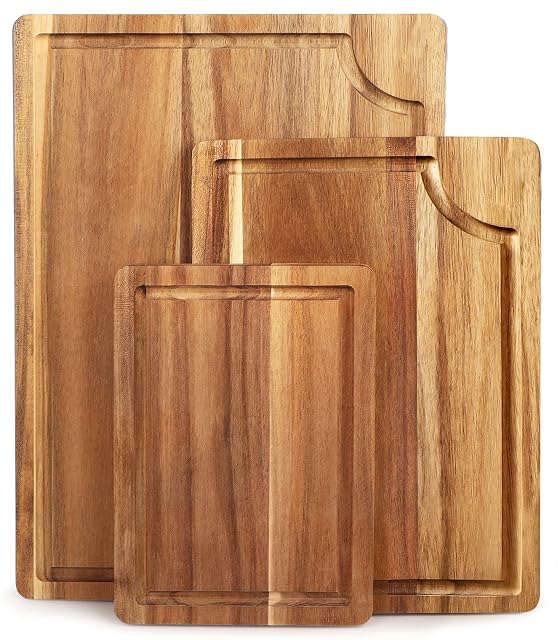
The set argument is separation — a small board for fruit, a big one for raw meat.
The single-board argument is that most of the time you want space, and that the “large” board in a cheap three-piece set is usually 15 × 10 inches. Eighteen by twelve takes a whole chicken or a roast to carve.
For comparison on price per board: Farberware’s four-piece bamboo set is $4.25 a board, AIDEA’s three acacia $6.66, and this one $12.99.
What is not published
Not stated as reversible — Farberware is the only board on this shelf that is, and it gives the right reason: one side for raw, one for bread.
No stand. No non-slip feet. No warranty — Royal Craft Wood offers one year and WALDWERK sixty days.
Availability
On sale at around $13 on the American Amazon store at the time of checking.
Prices and availability are what Keepa reported on the date this page was updated; both move.
Prices quoted in this text were read on 4 October 2026. The live price is at the top of the page.