What the maker puts in writing
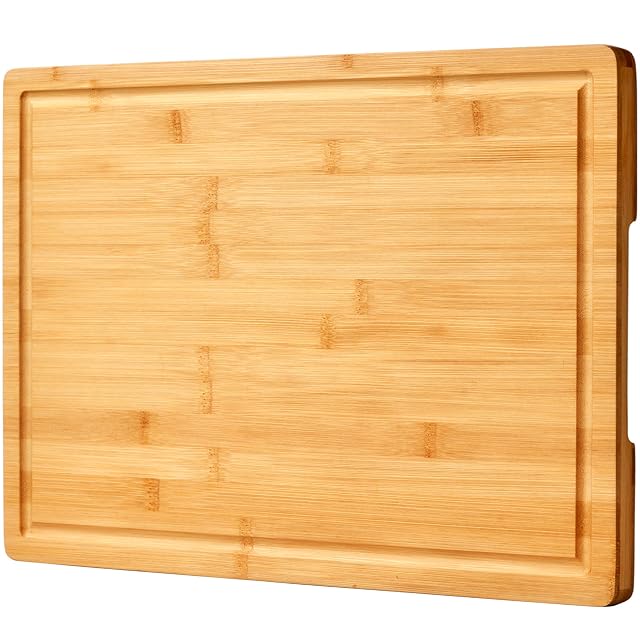
- “This 4-piece bamboo cutting board set covers every food prep task - from slicing fruits and chopping vegetables to carving meats”
- “Each board features a reversible surface, letting you flip between dedicated prep and serving sides. Use one side for raw ingredients and the other for breads and spreads to prevent cross-conta[mination]”
- “Transform any of these boards into a stunning charcuterie or cheese board”
- “Bamboo is harder and more durable than traditional wood cutting boards while remaining gentle on knives. As one of the fastest-renewing natural materials, it is a responsible choice”
- “Hand wash with warm water and a mild detergent after each use and dry immediately to maintain the boards’ integrity”
Four dollars twenty-five a board
The cheapest on this shelf, by a third:
- $4.25 — this, four boards, $16.99
- $6.66 — AIDEA, three acacia, $19.99
- $9.98 — Royal Craft Wood, three bamboo, $29.95
- $12.99 — Allsum, one 18 × 12 in board
- $16.65 — EDELHAUS, three acacia · $20.00 — WALDWERK, three acacia
- $29.99 — Hilmon, one titanium-and-ebony board
The only reversible set here
Use one side for raw ingredients and the other for breads and spreads to prevent cross-contamination.
That is the right reason, and it doubles your surfaces for nothing: four boards, eight faces.
Why can nobody else on this shelf do it? Geometry. A juice groove or non-slip feet on one face commits a board to one side up. Farberware publishes neither — that is the trade it has made, and the groove is the thing six other boards here have.
The sentence that argues with itself
“Bamboo is harder and more durable than traditional wood cutting boards while remaining gentle on knives”
The first half is true. Bamboo’s fiber is dense and it measures harder than maple or walnut, which is why bamboo boards resist scoring.
Which is exactly why the second half is strained. An edge is blunted by what it cuts into, and a harder surface takes more off the edge with every stroke. The materials genuinely kind to knives are soft end-grain hardwoods and polypropylene.
Four of the five bamboo listings on this shelf make some version of the gentle claim, and so do all three acacia ones. Treat it as marketing, and keep a honing rod.
And bamboo is not wood
It is a grass. Boards are made by slicing culms into strips and gluing them side by side, so every bamboo board is a laminate with glue lines through it — which is why the dishwasher matters more here than on solid timber, and why Farberware’s hand-wash instruction is correct.
The three acacia boards on this shelf have no glue lines at all.
Four of nine boards here give a care instruction; five say nothing.
Allsum is the blunt one — DONOT pass it in a dishwasher, plus the instruction nobody else gives: keep it away from humid environment when storage, because a damp board stored flat cups.
Farberware’s dry immediately is the same point stated shorter.
What is not published
No individual board sizes, where Royal Craft Wood, AIDEA and EDELHAUS all publish three.
No finish — the thing that decides whether a board can be maintained. Oil and wax soak in and can be renewed; a varnish chips and cannot be repaired. WALDWERK is the only listing here to address it directly.
No juice groove. No weight. No warranty — three boards here have one.
Availability
On sale at around $17 on the American Amazon store at the time of checking.
Prices and availability are what Keepa reported on the date this page was updated; both move.
Prices quoted in this text were read on 4 October 2026. The live price is at the top of the page.
The questions that come in
Can bamboo be harder than wood AND gentle on knives?
Not really, and Farberware puts both claims in one sentence: "Bamboo is harder and more durable than traditional wood cutting boards while remaining gentle on knives." The first half is true — bamboo’s fiber is dense and it measures harder than maple or walnut, which is why bamboo boards resist scoring. That is exactly why the second half is strained: an edge is blunted by what it cuts into, and a harder surface takes more off the edge with every stroke. The materials genuinely kind to knives are soft end-grain hardwoods and polypropylene. Four of the five bamboo listings on this shelf make some version of the gentle claim; the solid acacia boards here (AIDEA, WALDWERK, EDELHAUS) make it too. Treat it as marketing and keep a honing rod.
Why is reversibility worth having?
Because it doubles your surfaces for nothing, and this is the only wooden board on the shelf that offers it. Farberware states the use correctly: "use one side for raw ingredients and the other for breads and spreads to prevent cross-conta[mination]". That is the cheap version of what a color-coded set does — keeping the surface that touches raw chicken away from the surface that touches the bread you eat. Four reversible boards is eight faces. The reason the other eight boards here cannot do it is mostly geometry: a juice groove or non-slip feet on one face commit a board to one side up. Farberware publishes neither a groove nor feet, which is the trade it has made.
What is missing from the page?
The measurements, and the finish. The listing never gives individual board sizes — the set is described only as "4-piece" covering "every food prep task", where Royal Craft Wood publishes 15 × 10, 12 × 8 and 9 × 6 inches, AIDEA the same three, and EDELHAUS 15.7 × 11.8, 13 × 9.5 and 10.2 × 7. It also publishes no finish: four boards on this shelf state one — mineral oil (Allsum, Fibogollo), pre-oiled carbonized bamboo (Royal Craft Wood) and natural beeswax (WALDWERK, which adds "no cheap varnish or plastic coating"). That matters because an oiled board can be re-oiled forever while a sealed one cannot be repaired once the film chips. And no juice groove is stated, where six boards here have one.