What the maker puts in writing
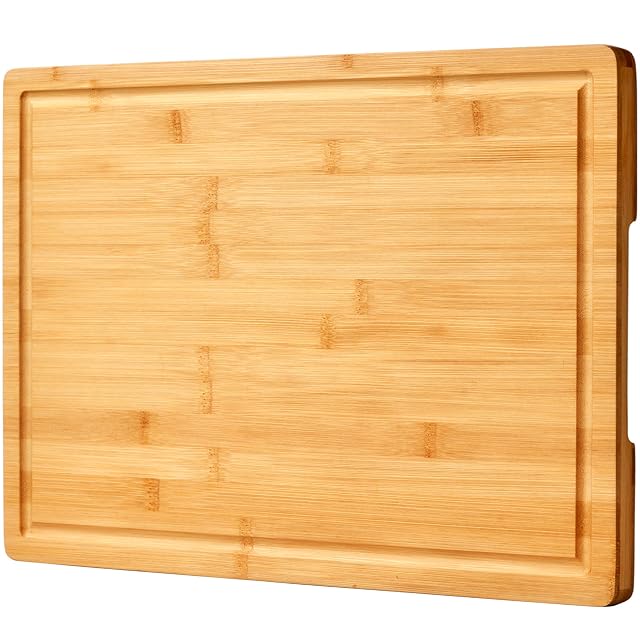
- “This bamboo cutting board set includes three essential cutting board sizes - 15x10″, 12x8″, 9x6″”
- “Crafted from 100% natural bamboo, these non toxic wooden cutting boards… combine modern design with practical performance”
- “Thoughtfully designed side handles make it easy to move ingredients or serve dishes directly from counter to table. Each serving board with handles doubles as a serving tray or cheese platter”
- “The smooth bamboo surface is naturally knife-friendly… A protective finish prevents water and odor absorption”
- “Each cutting board… features a deep juice groove along the edge”
- “Made from strong, pre-oiled carbonized bamboo… Resistant to cracking, warping, and water absorption”
- “Simply rinse, wipe, and it’s ready for the next meal… For best results, hand wash with mild soap and warm water”
- “we offer a comprehensive customer support program with a 1-year war[ranty]”
The most documented bamboo listing here
Nine bullets, against five on the AIDEA and WALDWERK sets. Three board sizes published, a finish named, care advice given and a warranty stated.
That is worth something on a shelf where Farberware sells four boards without publishing a single size and Fibogollo never says how many boards you get.
Carbonized, which is a real process
The only listing on this shelf to name it.
The strips are baked before lamination, which caramelizes the sugars in the fiber — that is the darker color — and drives out moisture, so the finished material absorbs less water.
For a cutting board that genuinely matters: less water means less staining, less odor, less cupping. The listing claims exactly that, and the claim follows from the process.
The trade, which the page does not mention, is that heat treatment leaves bamboo slightly more brittle and a little weaker in bending. A carbonized board is marginally more likely to crack if dropped. On balance still the better choice; not a free upgrade.
Side handles rather than a hole
A cut-out hand hole — which Allsum and Fibogollo use here — takes a bite out of the cutting surface and makes a pocket where water sits and does not dry.
Side handles are carved into the edge: the full face stays usable and nothing traps moisture. And they are what lets a board carry a cheese course to the table without a thumb in the food.
Nine ninety-eight a board
- $4.25 — Farberware, four bamboo · $6.66 — AIDEA, three acacia
- $9.98 — this · $9.99 — the maker’s own two-piece set
- $12.99 — Allsum, one 18 × 12 in · $16.65 — EDELHAUS · $20.00 — WALDWERK
Note that Royal Craft Wood’s two-piece set is the same price per board. The ten dollars between them buys the 9 × 6 board — which holds one tomato — plus these side handles and the stated finish.
Where the care advice is too soft
Simply rinse, wipe… for best results, hand wash.
That is advice, not a prohibition. Allsum states it properly: please DONOT pass it in a dishwasher. Keep it away from humid environment when storage.
For bamboo the stakes are higher than for solid wood, because bamboo is a laminate — strips of grass glued side by side. A hot alkaline cycle attacks the glue lines until the board opens along a joint, and carbonizing does nothing to protect the adhesive.
And Allsum’s second sentence is the one nobody else gives: a damp board stored flat cups, because one face dries and the other does not.
What is not published
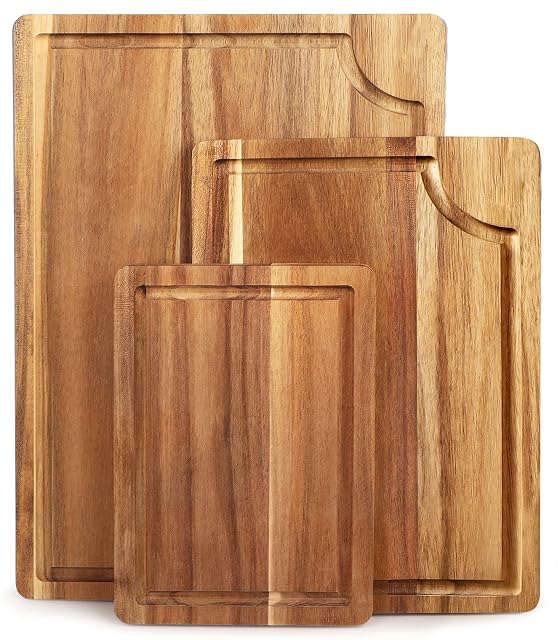
No stand, where the two acacia sets above this one include one — and both name drying as the reason, which is the right reason. No non-slip feet (only EDELHAUS). Not reversible (only Farberware).
And the gentle-on-knives claim is worth reading against Farberware’s own sentence on this shelf: bamboo is harder and more durable than traditional wood and gentle on knives. Those pull against each other.
Availability
On sale at around $30 on the American Amazon store at the time of checking.
Prices and availability are what Keepa reported on the date this page was updated; both move.
Prices quoted in this text were read on 4 October 2026. The live price is at the top of the page.