End grain is kinder to an edge and heavier to lift · review
Waldland 40 × 30 × 3 cm (15.7 × 11.8 × 1.2 in) end grain acacia review
An end-grain acacia board 3 cm (1.2 in) thick: the fibers stand upright, so the blade parts them rather than cutting across them — the construction that is genuinely kindest to an edge.
What we would actually buy End grain is the real thing rather than a marketing word, and this is the cheaper of the two here.
What you are getting
A 40 × 30 × 3 cm (15.7 × 11.8 × 1.2 in) end-grain acacia board with visible growth rings and non-slip feet.
End grain, explained
The board is built from short blocks with the fiber ends facing up. A knife parts those fibers instead of cutting across them, and they close behind the blade. That is why end grain shows fewer marks and is easier on an edge — and why it costs more and weighs more.
The thickness
Three centimeters. Thick enough that cupping is not a realistic worry, and heavy enough that the board stays where it is put.
The care
Wash both faces, stand it on edge to dry, and oil it when water stops beading. End grain absorbs more than edge grain, so expect to oil it more often at first.
Availability
Not found on the American Amazon store, where the buy link falls back to a local search rather than to a page that does not exist.
Prices and availability are what Keepa reported on the date this page was updated; both move.
What we rate, and what we do not
Strengths
End grain, which is the construction that genuinely spares a knife edge
3 cm (1.2 in) thick, so it will not cup
Non-slip feet, which is what stops a board sliding under pressure
Compromises
Heavy — end grain at 3 cm (1.2 in) is a substantial object
Too large and too heavy for most sinks
End grain needs oiling more often than edge grain
Specifications
Dimensions
40 × 30 × 3 cm (15.7 × 11.8 × 1.2 in)
Construction
End grain — the cut ends of the fibers face up
Material
Acacia, with visible growth rings
Feet
Non-slip
Stated
Fibers part rather than being cut; the surface closes with a little moisture
Amazon reference
B0D8NFPGH5
EAN
4262466830188
Where this model is listed
A listing is not an offer: the reference exists on these stores, availability changes daily.
France
Germany
Italy
Spain
United Kingdom
The questions that come in
What does end grain actually do?
The fibers stand vertically, so a blade parts them and they close again rather than being severed. It is kinder to edges and it shows fewer marks — at the cost of weight and price.
How often does it need oiling?
More often than edge grain, because the exposed fiber ends absorb more. When water stops beading, oil it.
Our score
8.1/ 10
End grain is the real thing rather than a marketing word, and this is the cheaper of the two here.
What use this one answers, among cookware and knives
A worktop board that stays out, in a kitchen that cooks daily.
Where this model is cited, among our cookware and knives guides
Specifications: the manufacturer sheet for cookware and kitchen knives and the matching Amazon product page. Prices and availability: Keepa. Every figure on this page names its source.
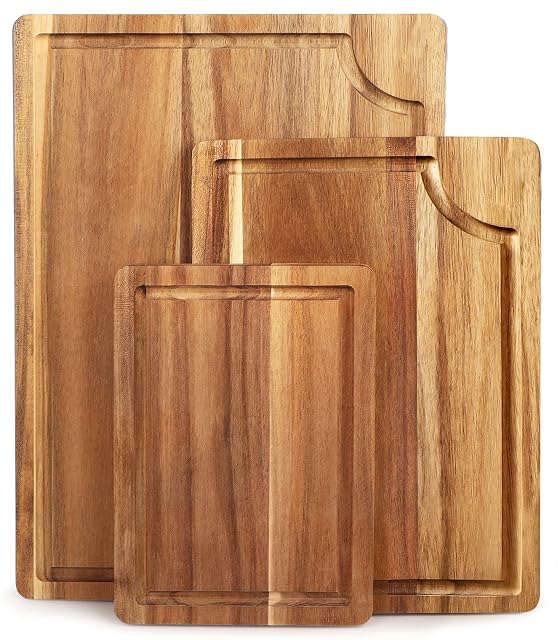
A three-piece set of 100 per cent acacia wood cutting boards measuring 15 × 10, 12 × 8 and 9 × 6 in, with deep juice grooves on all three, stated to resist water and stains
Three solid acacia boards — 15 × 10, 12 × 8 and 9 × 6 in — with deep juice grooves, for twenty dollars.
Best for: Solid hardwood on a budget — real acacia for the price of a bamboo set
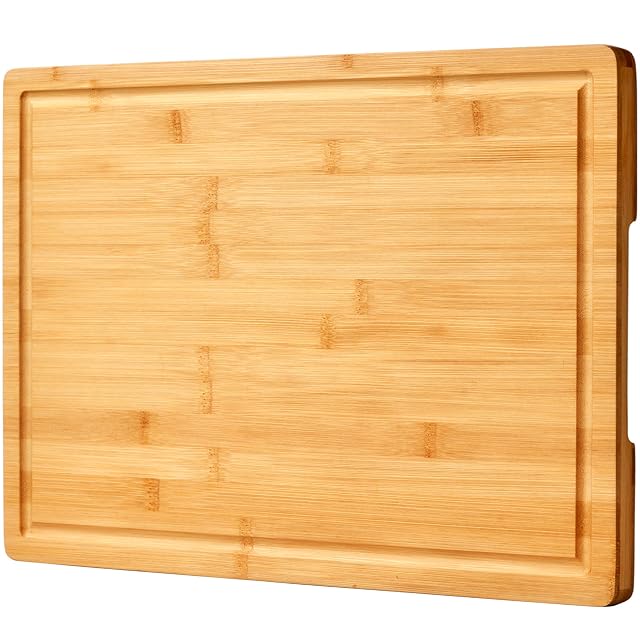
18 × 12 in bamboo cutting and charcuterie board, 19 mm (0.75 in) thick, polished and pre-seasoned with food-grade mineral oil before shipment, with a built-in juice groove and an inner handle, not to be put in a dishwasher
A single 18 × 12 in bamboo board at 1656 g (58.4 oz), pre-seasoned with mineral oil and not for the dishwasher.
Best for: One good large board — eighteen inches, nineteen millimeters, and honest care instructions
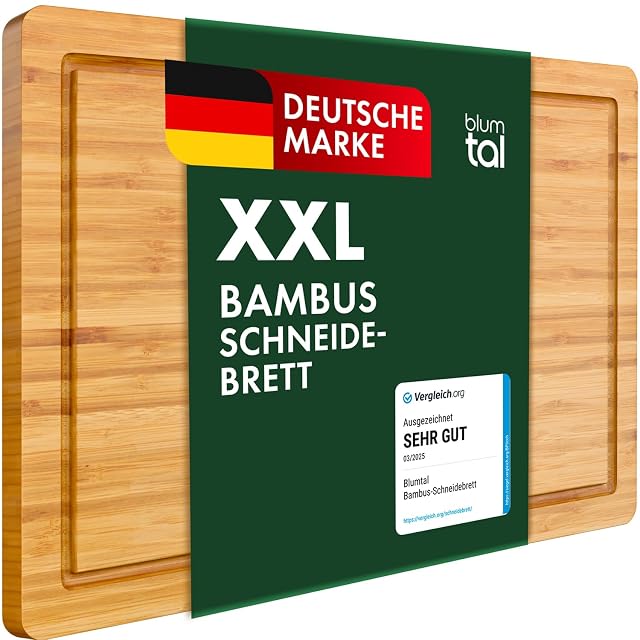
45 × 30 × 2 cm (17.7 × 11.8 × 0.8 in) · 100% bamboo · juice groove · stated antiseptic and blade-friendly
A large 45 × 30 cm (17.7 × 11.8 in) bamboo board with a juice groove — and a claim about being blade-friendly that deserves the nuance this site applies elsewhere.
Best for: A worktop board for prep, washed at the sink rather than in it.