Barbecue
Barbecue kit: four things, and the order to buy them
A barbecue accessory set is three tools and seventeen skewers. What actually changes the experience is a chimney starter, long tongs, a way to clean the grate and a cover that lets the barbecue dry. This guide covers those four, in the order they earn their place.
By Jean-Benoit Buisson
Four accessories, in order.
1. A chimney starter
It replaces lighter fluid, which is the single biggest improvement available to a charcoal barbecue. This site lists five, from a 17 × 27.5 cm (6.7 × 10.8 in) metal one to a 6.5 liter stainless XL — and one with a heat-resistant wooden handle, which matters at the moment you tip a cylinder of lit coals.
2. Long tongs
Length is the specification and almost nobody publishes it. This site has one set with 42 cm (16.5 in) tongs and angled grips, and a 32.5 cm (12.8 in) pair in Cromargan.
3. A way to clean the grate
Brushes here run from 30 to 45 cm (11.8 to 17.7 in), some with grooved scrapers shaped for round bars. Whichever you buy: brush the grate warm, and wipe it with folded damp paper afterwards to check for detached bristles.
4. A cover that breathes
A sealed cover traps whatever moisture is underneath it against the metal for weeks. Only one cover in this catalog states breathability. Measure your barbecue with the lid down and the shelves out before ordering any of them.
What is on this page instead of accessories
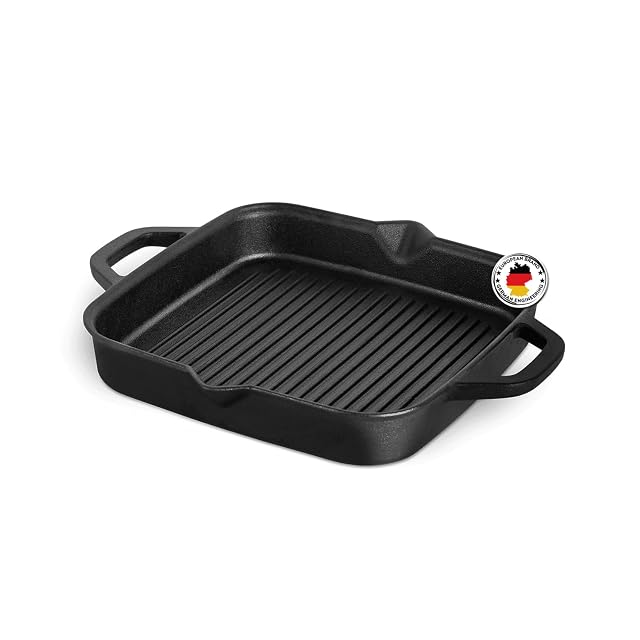
The things worth spending on first: a barbecue with a thermometer and two vents, a cast iron grate to replace thin steel, a grill pan for what falls through, and a plancha for what a grate cannot cook at all.
Which pan does your cooking want?
- You buy one thing
- Long tongs, which you will use every single time.
- You cook charcoal
- A chimney starter changes lighting completely.
- You cook meat
- A thermometer is the accessory that affects safety, not just results.
- You are tempted by a big set
- Most of it will never leave the box.
Picking by what you cook
Handling food
Long tongs and a wide spatula, used at every barbecue without exception.
Lighting
A chimney starter, which replaces lighter fluid entirely and works better.
Knowing when it is done
A thermometer, which is a food safety tool as much as a cooking one.
Cleaning
A brush or scraper used while the grate is warm, which is when it actually works.
What makes the difference in use
- Length
- Barbecue tools need to be longer than kitchen ones. That is the whole point of buying dedicated ones.
- Heat resistance
- Handles must stay cool. Metal handles on a barbecue tool are a design failure.
- Genuine usefulness
- Tongs, spatula, thermometer, chimney, brush. Almost everything else in a boxed set is filler.
- Gloves
- Proper heatproof gloves matter more than most accessories, and are usually the last thing bought.
- Brush condition
- Wire brushes shed bristles as they age. Checking and replacing them is a food safety matter.
Which figure for which dish
Where it usually goes wrong
- Buying a large accessory set
- Most of it never gets used. Four or five genuinely useful tools beat a boxed set of fifteen.
- Using kitchen tongs
- They are too short, which means your hands are over the fire. Length is the entire reason for dedicated tools.
- Keeping an old wire brush
- Aging brushes shed bristles that can end up in food. Inspect them and replace them without hesitation.
- Skipping gloves
- They are the accessory that actually prevents injuries, and usually the one bought last.
By the cook you are
- The first-time buyer
- Tongs, gloves and a chimney starter, and nothing else until a need appears.
- The meat cook
- Adds a thermometer, which affects safety as well as results.
- The gadget buyer
- Should resist the boxed set, most of which never leaves the packaging.
Care, seasoning and how long it lasts
Barbecue accessories live outdoors and are cleaned less than kitchen tools, which is why they fail. Hinges seize with baked-on fat, wooden handles split in the weather, and brushes degrade in a way that matters for food safety rather than performance.
- Clean tools after use rather than leaving fat to set on them.
- Store under cover; outdoor storage ruins handles and hinges.
- Inspect wire brushes regularly and replace them when bristles loosen.
- Check thermometer batteries before the season starts.
Safety
The accessories that matter most are safety ones.
- Use long tools so your hands stay clear of the fire.
- Wear proper heatproof gloves rather than using a folded cloth.
- Replace wire brushes that shed bristles; they can end up in food.
- Use a thermometer to check meat is properly cooked.
The questions that come in
What is the first accessory to buy?
A chimney starter. It removes lighter fluid from the process entirely, lights charcoal evenly in fifteen to twenty minutes, and costs about twelve euros at the cheapest. Nothing else changes the result as much.
How long should barbecue tongs be?
Long enough to reach the far side without your hand crossing the coals. On a 57 cm (22.4 in) kettle that is around 40 cm (15.7 in) — this site publishes one tong length, 42 cm (16.5 in), and one at 32.5 cm (12.8 in).
Are wire grill brushes a problem?
A bristle can work loose and stay on the grate. The habit that prevents it: after brushing, wipe the grate with folded damp paper and look at what comes off, and replace any brush that is visibly shedding. Brush a warm grate rather than a cold caked one, so less force is needed.
Is a chimney starter worth it?
It lights charcoal faster and better than lighter fluid, without flavouring the food or adding risk. It costs very little.
Do I need a thermometer?
For meat it is a food safety tool as well as a cooking one, and it removes most of the guesswork.
Are big accessory sets worth buying?
Rarely. Four or five genuinely useful tools serve better, and most of a fifteen-piece set never leaves the box.
Can I use my kitchen tongs?
They are too short, which puts your hands over the fire. Length is the reason dedicated barbecue tools exist.
What about the wire brush?
Inspect it regularly and replace it when bristles loosen, since shed bristles can end up in food. It is a safety matter.