Barbecue
Cast iron over fire: grates, pans and one thing that does not belong
Cast iron holds heat in a way that thin steel does not, which is exactly what a barbecue needs when cold food lands on it. Replacing a steel grate with cast iron is the single biggest improvement available to most barbecues — provided the dimensions match, which is where most of these purchases go wrong.
By Jean-Benoit Buisson
Five pieces of iron, and the measurement that decides all of them.
The largest grate
The Wiltec, 67 × 40 cm (26.4 × 15.7 in), solid rectangular cast iron for charcoal and gas barbecues. Rectangular and large — measure your opening before ordering.
The modular one
The Tepro in enamelled cast iron, with a grate-in-grate system and a removable center that takes inserts. Enamelled means no seasoning; it also means no wire brush and no chainmail, because enamel is glass.
The model-specific one
The GFTime, 49.5 × 32.5 cm (19.5 × 12.8 in) of solid cast iron, stated to fit Weber Genesis E/S/EP-310, 320 and 330. A named model list removes the measuring problem entirely.
The pan for the fire
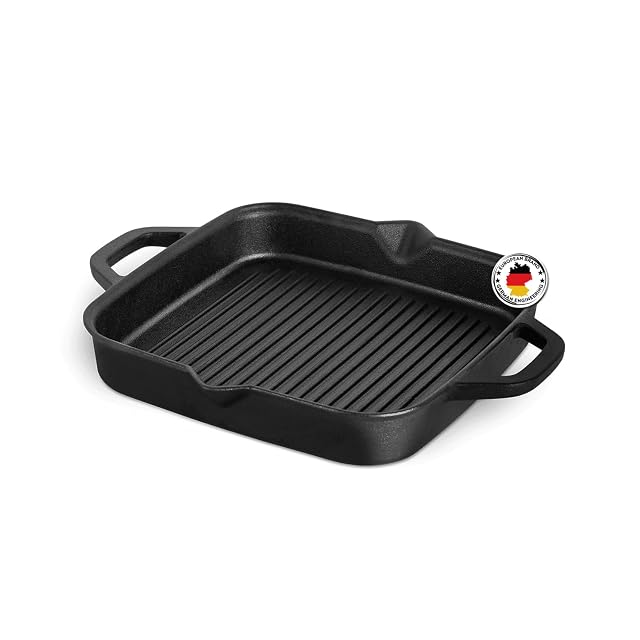
The Burnhard 30 cm (11.8 in), pre-seasoned cast iron with pouring spouts, stated for gas barbecue, open fire, oven and hob including induction. Spouts matter on a grill pan: fat has to go somewhere.
The largest pan
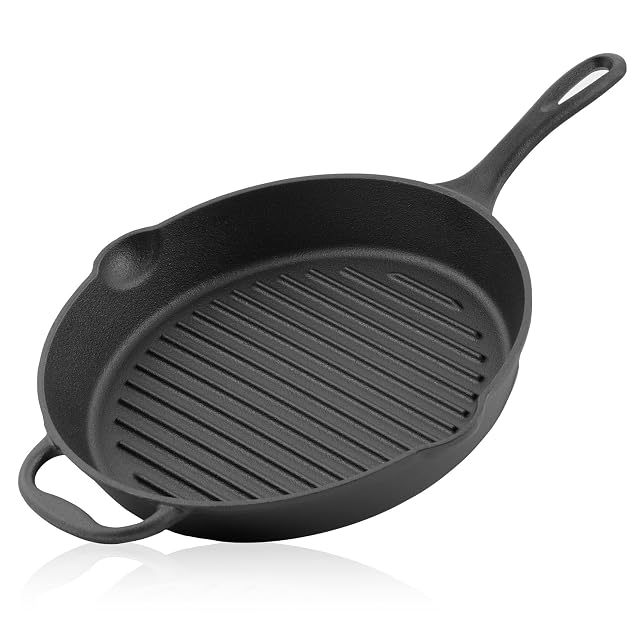
The BBQ-Toro Ø 34 cm (13.4 in), ribbed cast iron with a loop handle plus a stick handle and two spouts, pre-seasoned. Two handles is what lets you lift 34 cm of hot iron off a fire with both hands.
The care rule, split by finish
Bare iron: chainmail, hot water, dry on the heat, wipe with oil. This site lists five chainmail scrubbers.
Enamelled iron: hot water and a soft brush. Never chainmail.
Which pan does your cooking want?
- You want grill marks
- Cast iron grates hold heat and mark food as nothing else does.
- You cook small items
- A cast iron plate or pan stops everything falling through.
- You leave it outdoors
- Cast iron rusts, and a barbecue is the worst place to neglect it.
- You cook rarely
- The maintenance may outweigh the benefit.
Picking by what you cook
Grates
Where heat retention gives searing and marking that thin steel cannot.
Plates and griddles
Where small or delicate items would fall through bars.
Pans on the grill
Where a cast iron pan turns a barbecue into a hob.
Long cooking
Where thermal mass evens out the swings of a charcoal fire.
What makes the difference in use
- Seasoning
- Cast iron on a barbecue must be seasoned and kept seasoned, or it rusts fast in outdoor conditions.
- Weight
- Cast iron grates are heavy to lift out for cleaning, which is when maintenance gets skipped.
- Enamelled or bare
- Enamel resists rust and can chip under barbecue heat and knocks. Bare iron needs care and can be restored.
- Fit
- Replacement grates must fit your barbecue exactly. Universal fits rarely are.
- Realistic maintenance
- Outdoors, cast iron demands more than indoors. If it will be neglected, stainless is the better choice.
Which figure for which dish
Where it usually goes wrong
- Leaving it out in the rain
- Bare cast iron rusts quickly outdoors. On a barbecue this is the most common way it is ruined.
- Scrubbing off the seasoning
- Harsh cleaning takes the layer back to bare metal, and then it rusts and sticks. Brush while warm instead.
- Buying a grate that nearly fits
- It sits badly, moves under food and is a hazard. Fit is not approximate.
- Choosing cast iron you will not maintain
- Neglected, it performs worse than the stainless grate it replaced. Be honest about the routine.
By the cook you are
- The frequent griller
- Gains most, since regular use and regular care go together.
- The searer
- Wants cast iron for the heat retention and accepts the weight.
- The occasional user
- Is often better served by stainless, which tolerates being ignored.
Care, seasoning and how long it lasts
Outdoors, cast iron faces everything it dislikes: rain, humidity, long idle periods and acidic marinades. The seasoning that protects it indoors is under constant attack, which is why barbecue cast iron needs more attention than the same material in a kitchen.
- Brush the grate while it is still warm rather than scrubbing it cold.
- Oil lightly after cleaning and before storing.
- Store dry and covered; never leave it exposed to rain.
- Reseason whenever the surface looks dull or food begins to stick.
Safety
Heavy, hot and slow to cool.
- Cast iron stays hot long after the fire is out.
- Use proper heatproof gloves; cast iron grates are heavy as well as hot.
- Never move a hot grate across an unstable surface.
- Let everything cool completely before cleaning or storing.
The questions that come in
How do I measure for a replacement grate?
Measure the opening the grate sits in, not the old grate — grates can be undersized. Then check the listing’s dimensions, and for a model-specific grate check the model list. The GFTime here names Weber Genesis E/S/EP-310, 320 and 330.
Does cast iron need seasoning on a barbecue?
Bare cast iron does: oil it, heat it, repeat. Enamelled cast iron does not, and it should not be treated with chainmail or a wire brush — enamel is a glass coating.
What is a grate-in-grate system?
A grate with a removable center section, so an insert — a plancha plate, a wok ring, a pizza stone — drops into the middle. The Tepro here is the one with that feature.
Is cast iron better for a barbecue?
For searing and marking, yes: it holds heat as thin steel cannot. The cost is weight and considerably more maintenance.
Will it rust?
Quickly, if left exposed outdoors. Barbecue cast iron faces rain and long idle periods, which is exactly what it dislikes.
Enamelled or bare?
Enamel resists rust and can chip under heat and knocks. Bare iron needs seasoning and can always be restored.
How do I clean it?
Brush while still warm, then oil lightly. Harsh cold scrubbing strips the seasoning and leaves it to rust.
Will any grate fit my barbecue?
No. It has to fit exactly, since a grate that shifts under food is a genuine hazard. Universal fits rarely are.
Is it worth it for occasional use?
Often not. Neglected cast iron performs worse than stainless, and occasional users rarely keep up the routine.