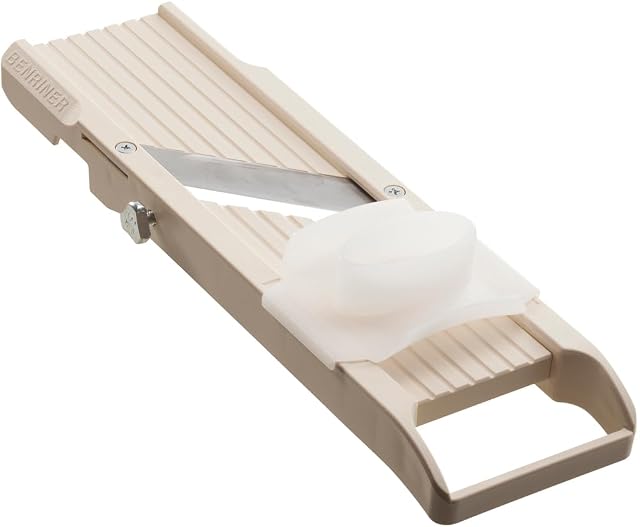
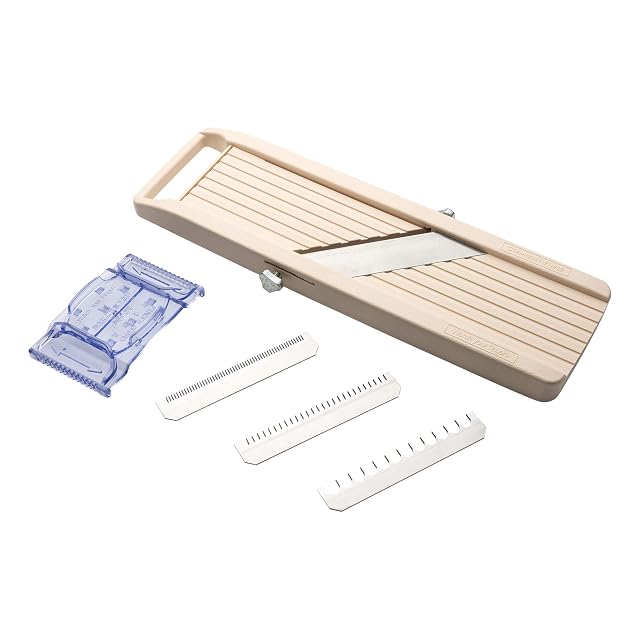
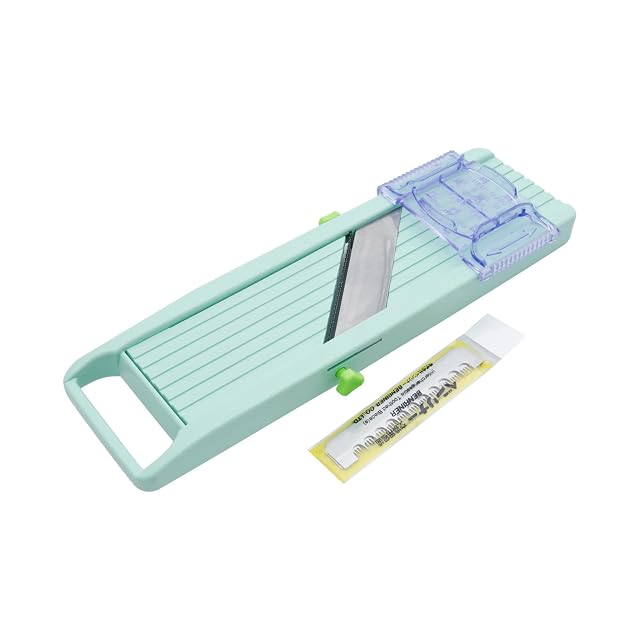
What the maker puts in writing
- “Safely and evenly slice a variety of fruit and vegetables”
- “Precision food grip features three styles of grip: Pinch grip for small items; Center grip for round slices; Flat grip for longer slices”
- “Three slice thickness”
- “Non-slip tip and easy-grip handle”
- “Protective guard keeps fingers away from blade”
The only listing here that notices the holder problem
Every mandoline comes with a food holder, and every mandoline owner discovers its limit within a week.
The standard holder is a disc of spikes you press into the vegetable and push. It works beautifully on a potato. It skates straight off a tomato or a lemon — anything with a skin over a slippery interior — and it cannot hold anything long without the piece pivoting on the spikes.
Joseph Joseph publishes three holds:
Pinch grip for small items. Center grip for round slices. Flat grip for longer slices.
Three mechanical answers for three geometries. Nothing else on this shelf acknowledges there is more than one problem.
A mandoline is the commonest source of serious cuts in a domestic kitchen, and the injury comes at the last slice — when what is left is too small to hold and the fingertips pass over a fixed razor edge.
A holder that slips off a tomato is the mechanism by which that happens.
The other serious answers on this shelf: Fullstar fits steel tips to its guard rather than plastic ones, and says so. Gramercy includes cut-resistant gloves, the only listing that does. Ibergrif adds a blade lock for the drawer. OXO Precision makes the holder automatic and height-adjustable.
Two listings publish no guard at all: OXO’s cheapest handheld and the old-version Benriner.
Three thicknesses, unnumbered
The listing says “three slice thickness” and stops.
Five listings here publish millimeters: Fullstar 1, 2, 3, 4 mm (0.16 in) · OXO 1, 2.5, 4 mm (0.16 in) on two models · Ibergrif 1, 2, 4 mm (0.16 in) · Benriner a dial from 0.5 to 8 mm (0.02 to 0.31 in) · Mueller Austria 1 to 9 mm (0.04 to 0.35 in).
What three unnumbered clicks still give you is repeatability — the same setting gives the same slice whether or not you can name it. What they do not give you is a recipe figure: 2 mm (0.08 in) for a gratin, 1 mm for crisps.
OXO Precision does the same thing in words: julienne, thin, medium, thick, extra thick.
Against the Fullstar, at the same price
Both $14.98.
Fullstar: four numbered thicknesses, a built-in julienne blade, published 420 stainless, a steel-tipped guard.
This: three distinct grips, a non-slip tip, and no figures for anything.
Slice mostly potatoes and courgettes — buy the Fullstar. Slice what is in the fruit bowl — the grips matter more.
What is not published
No thickness figures. No blade steel, where Gramercy publishes 4CR15 and Fullstar 420. No julienne. No dishwasher statement. No slicing surface width — only Benriner gives one, at 2.5 inches, and it is what decides what actually fits across the blade. No warranty.
Two hundred grams, which sits mid-range among the handhelds here (70 to 350 g (2.5 to 12.3 oz)).
Availability
On sale at around $15 on the American Amazon store at the time of checking.
Prices and availability are what Keepa reported on the date this page was updated; both move.
Prices quoted in this text were read on 4 October 2026. The live price is at the top of the page.
The questions that come in
What do three grips actually solve?
The problem every mandoline owner meets and no other listing on this shelf names: a single food holder does not fit every shape. The standard holder is a disc of spikes you press into the vegetable and push — which works beautifully on a potato, and skates straight off a tomato, a lemon or anything with a skin and a slippery interior. It also cannot hold something long without the piece pivoting. Joseph Joseph publishes three: "Pinch grip for small items; Center grip for round slices; Flat grip for longer slices." That is three different mechanical holds for three geometries. Every other listing here supplies one holder — Fullstar improves it with steel tips, OXO Precision with automatic height adjustment, Gramercy by adding gloves.
Does it matter that no millimeters are published?
For repeatability, yes. The listing says only "three slice thickness" with no figures, and five listings on this shelf do give them: Fullstar at 1, 2, 3 and 4 mm (0.16 in), OXO at 1, 2.5 and 4 on two models, Ibergrif at 1, 2 and 4, Benriner on a dial from 0.5 to 8 mm (0.02 to 0.31 in), and Mueller Austria from 1 to 9. Why it matters: a recipe that calls for 2 mm (0.08 in) potato for a gratin or 1 mm (0.04 in) for crisps is asking for a number, and without one you are judging by eye each time. What three unnumbered settings do still give you is repeatability — the same click gives the same slice even if you do not know what to call it. OXO Precision does the same with words: thin, medium, thick, extra thick.
How does it compare with the Fullstar at the same price?
They solve different halves of the same problem, at $14.98 each. Fullstar gives you four numbered thicknesses (1 to 4 mm (0.04 to 0.16 in)), a built-in julienne blade, a published 420 stainless steel and a steel-tipped hand guard — more cutting capability and a better version of the standard holder. Joseph Joseph gives you three distinct grips for three produce shapes, which is a different and arguably deeper answer to safety, plus a non-slip tip — and publishes no thickness figures, no steel, no julienne and no dishwasher statement. If you slice mostly potatoes and courgettes, buy the Fullstar. If the fruit bowl is where your mandoline gets used, the grips matter more.