What the maker puts in writing
- “This large mortar measures 5.1 inches across and 2.2 inches deep, paired with a sturdy 6.5 inch pestle. Total set weight is approximately 5 lbs — heavy, solid granite designed for serious grinding”
- “Home made, fresh delicious guacamole, pesto and more can be made on demand with this granite mortar and pestle set”
- “This mortar and pestle set small size with a 1.5 cup capacity and sturdy 6.2 inch pestle gets the job done quickly. Crush, grind and pound herbs, nuts, spices and more to release natural flavors and aromas”
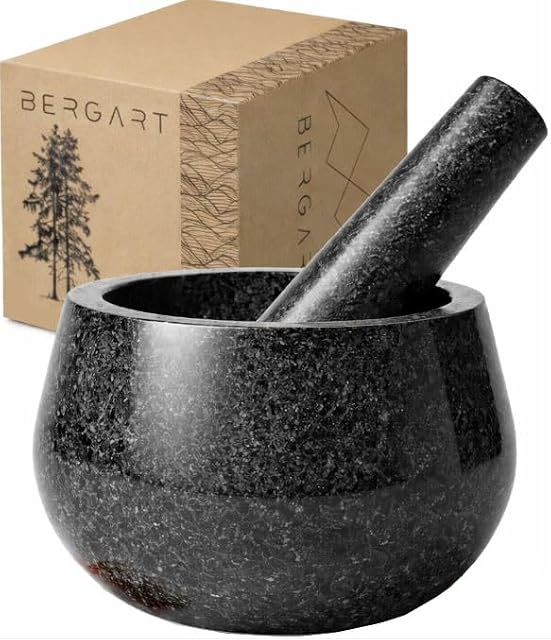
- “This unpolished grey granite stone mortar and pestle is a beast! Super sturdy and heavy enough to leave out on display, but that could cause scratches to your countertop. That’s why we have included 2 non slip countertop protectors”
- “Elegant black granite molcajete bowl adds style to any kitchen”
The most honest sentence on this shelf
“that could cause scratches to your countertop. That’s why we have included 2 non slip countertop protectors”
Unpolished granite has a deliberately rough base, and 2,420 g (85.4 oz) of it dragged half an inch across quartz, laminate or a sealed wooden worktop will mark it.
Nine of the fourteen mortars here say nothing about this and put bare stone on your surface.
The ones that do address it: WALDWERK, with an anti-scratch wood base on both its mortars; HPYNPES, with an anti-slip base; Tera, with padding on the bottom. And both Priority Chefs, with two protectors in the box and an explanation.
Unpolished, which is the right word
Unpolished grey granite.
This is the specification most buyers get backwards. You cannot grind on a smooth surface — a polished bowl lets food slide round the wall instead of being crushed against it.
At least six of the sixteen listings on this shelf state their interior finish. IMUSA publishes both halves correctly — polished exterior finish and rough textured interior surface. ChefSofi says “unpolished granite” and calls the result “metate-like”. HIC says “textured interior” on three mortars.
Two listings describe themselves only as “smooth”.
And granite is the right stone. WALDWERK is the only listing here to explain why: one of the oldest and hardest rocks in the world. It hardly absorbs any water. Granite is 6 to 7 on the Mohs scale; the two marble mortars on this shelf are calcium carbonate at about 3 — softer, absorbent, and etched by lemon or vinegar.
Figures this page publishes, and most do not
1.5 cups. 5.1 inches across, 2.2 inches deep. Approximately 5 lbs — which matches the catalog’s 2,420 g (5.34 lb) well.
Only five of fourteen listings here publish a capacity at all. At $14.66 a cup this is not the cheapest volume on the shelf — HPYNPES gives 2.6 cups for $17.99, or $6.92 a cup — but those are porcelain and ceramic, and this is granite.
Three things on this page that disagree with themselves
The pestle is 6.5 inches in bullet 1 and 6.2 inches in bullet 3. The maker’s 5.5-inch model states 6.2 consistently, so that figure may be a copy across. Either length clears a 5.1-inch rim comfortably — WALDWERK is the only maker here to name why reach matters: a short pestle means your hand… collide[s] with the edge of the mortar.
The granite is grey in bullet 4 and black in bullet 5. Unpolished granite is commonly grey and looks darker wet, so both may be describing the same stone; the page does not resolve it.
The capacity is 1.5 cups, and so is the 5.5-inch model’s. At the same 2.2-inch depth, a 5.5-inch bowl has about 16 per cent more floor area and must hold more. One of the two figures is wrong, and this is the one where the stated and catalog weights agree.
What is not published
No washing instruction. Granite needs none of marble’s care, but the UMIEN granite mortar on this shelf says hand wash, which is the sensible treatment: detergent lingers in textured stone.
No warranty. Only WALDWERK (60 days, unconditional) and ChefSofi (a vague “Risk-Free purchase”) publish anything on this shelf.
Availability
On sale at around $22 on the American Amazon store at the time of checking.
Prices and availability are what Keepa reported on the date this page was updated; both move.
Prices quoted in this text were read on 4 October 2026. The live price is at the top of the page.
The questions that come in
How long is the pestle?
The page says both 6.5 and 6.2 inches, and it is worth knowing which because reach is a real specification. Bullet 1: "paired with a sturdy 6.5 inch pestle". Bullet 3: "a sturdy 6.2 inch pestle gets the job done quickly." Those are the same product, two bullets apart. For context, the maker’s 5.5 inch model on this shelf states 6.2 inches consistently, so 6.2 may be a copy across from that listing. Why it matters: WALDWERK is the only maker here to name the problem a short pestle causes — an *extra long pestle... ensures that your hand does not collide with the edge of the mortar*. On a 5.1-inch bowl, either figure gives adequate clearance; the discrepancy is a sign about the listing rather than a problem with the tool.
Do the countertop protectors matter?
Yes, and this is the most honest sentence on this shelf. Priority Chef writes: "This unpolished grey granite stone mortar and pestle is a beast! Super sturdy and heavy enough to leave out on display, but that could cause scratches to your countertop. That’s why we have included 2 non slip countertop protectors." Unpolished granite has a deliberately rough base, and 2,420 g (85.4 oz) of it dragged half an inch across quartz, laminate or a sealed wooden worktop will leave a mark. Nine of the fourteen mortars on this shelf publish nothing about this and put bare stone on your surface. The others that address it: WALDWERK with an anti-scratch wood base on both its mortars, HPYNPES with an anti-slip base, and Tera with padding.
Is 1.5 cups the same as the 5.5 inch model?
Both listings say so, and they cannot both be right. Priority Chef sells two mortars here: this at 5.1 inches across and 2.2 inches deep, and a Heavy Duty at 5.5 inches across and 2.2 inches deep — and both claim a 1.5 cup capacity. At the same depth, a 5.5-inch bowl has roughly 16 per cent more floor area than a 5.1-inch one, so it must hold more. The weights differ too (2,420 g (85.4 oz) here against 2,490 g (87.8 oz) there, four dollars apart) and the stated weights diverge further: "approximately 5 lbs" here, which matches 2,420 g (85.4 oz) well, and "approximately 7 lbs" on the other, which does not match its 2,490 g (87.8 oz) at all. Read 1.5 cups as the figure for this one.