What the maker puts in writing
- “Both pestle and mortar are made of food grade 18/8 stainless steel. Not only are they rustproof, it is also resistant to damage and corrosion by acidic food. Small compact mortar, about the size of the average palm”
- “Made of solid metal, the pestle feels substantial in your hand and the mortar sits securely on your kitchen counter. Padding on the bottom makes it stay put even more”
- “Because stainless steel does not hold residue or leftover odor, all it takes is a thorough rinsing under the tap to get it ready for next use”
- “Translucent lid allows you to gauge your strikes and keeps the contents in the bowl, not over counter top”
- “From medical pills, to herbs and spices; from the pharmacy to your kitchen”
The only lid on this shelf
Every mortar owner discovers this in the first minute: whole spices jump.
A peppercorn, a mustard seed or a coriander seed struck square does not crush. It shoots — out of the bowl, across the worktop, onto the floor.
Tera is the only mortar here with a lid, and the description is precisely right: translucent lid allows you to gauge your strikes and keeps the contents in the bowl, not over counter top.
Translucent, so you can see how far the grind has got without taking it off.
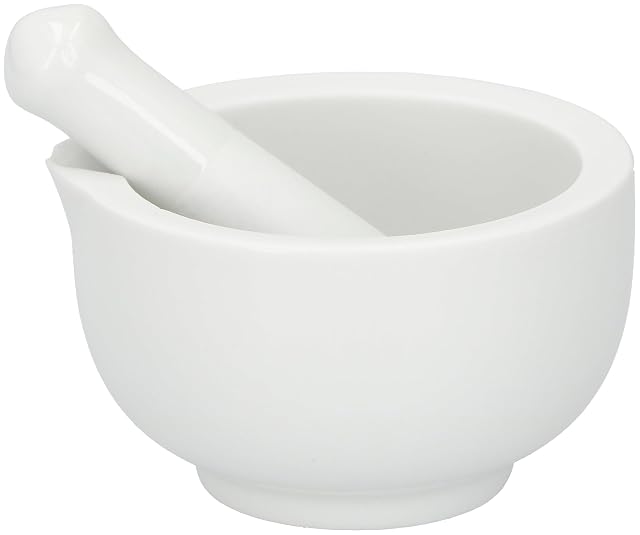
The only other listing that addresses the same problem is HPYNPES, with “a round deep design to help reduce spilling” — geometry instead of a lid. And HIC’s pour-spout mortar solves the opposite half of the problem: getting the finished paste out.
Two obvious ideas, one instance of each, on a shelf of fourteen.
Nothing stays behind
Because stainless steel does not hold residue or leftover odor, all it takes is a thorough rinsing under the tap.
This is the one claim on this shelf no other material can match, and it matters for a specific reason.
Five listings here name pill crushing — four HIC mortars and this one. A mortar used for medication one day and cardamom the next needs to leave nothing behind.
- Stainless steel — non-porous and smooth. Nothing bridges between uses.
- Granite — “hardly absorbs any water”, as WALDWERK says, but textured, and texture holds traces.
- Marble — genuinely absorbs, which is why HIC says to “dry thoroughly” after hand washing its Carrara bowl.
- Bamboo — the HPYNPES pestle, which absorbs most of all. A bamboo pestle used for garlic smells of garlic.
Steel also shrugs off acid, where the two marble mortars on this shelf will etch under lemon or vinegar.
A cleaning brush is included.
And the honest limit: steel is smooth
Grinding needs friction. Food has to be crushed against a wall that grips it — which is why the best listings on this shelf specify a rough interior deliberately. IMUSA publishes “rough textured interior surface”; ChefSofi and PriorityChef both say “unpolished granite”.
Stainless steel is inherently smooth, and Tera states no texture.
What it has instead is mass in the pestle: made of solid metal, the pestle feels substantial in your hand.
For hard brittle things, mass is enough. A pill, a peppercorn, a dried chilli, a cinnamon stick all shatter on impact — they do not need to be ground against anything.
Where smooth steel struggles is making a paste: a wet garlic-and-salt paste or a pesto depends on grinding rather than crushing, and for that the unpolished granite mortars here will do better.
Palm-sized, and the padding
About the size of the average palm. No diameter and no capacity are published, which makes quantities hard to judge — on this shelf HPYNPES publishes 2.6 cups, UMIEN 3.5 and both Priority Chefs 1.5.
862 g with padding on the bottom, which is one of only five answers to the worktop question on this shelf. The others: HPYNPES’s anti-slip base, both WALDWERK wood bases, and both Priority Chef models, which include 2 non slip countertop protectors and say honestly why — heavy stone “could cause scratches to your countertop”.
Steel will not scratch a worktop the way unpolished granite does.
No capacity. No warranty, like twelve of the fourteen mortars here.
Availability
On sale at around $21 on the American Amazon store at the time of checking.
Prices and availability are what Keepa reported on the date this page was updated; both move.
Prices quoted in this text were read on 4 October 2026. The live price is at the top of the page.